
General Marketing
Nobody Half-Watches a Game 5 — Why Live Sports Is the Most Premium Inventory in CTV, and Why the Action It Drives Is Real
The Knicks ended a 53-year drought and the UFC took the White House lawn and millions watched live. Live sports is the last campfire in media. Here's why it's CTV's most premium inventory, and why the action it drives is real.
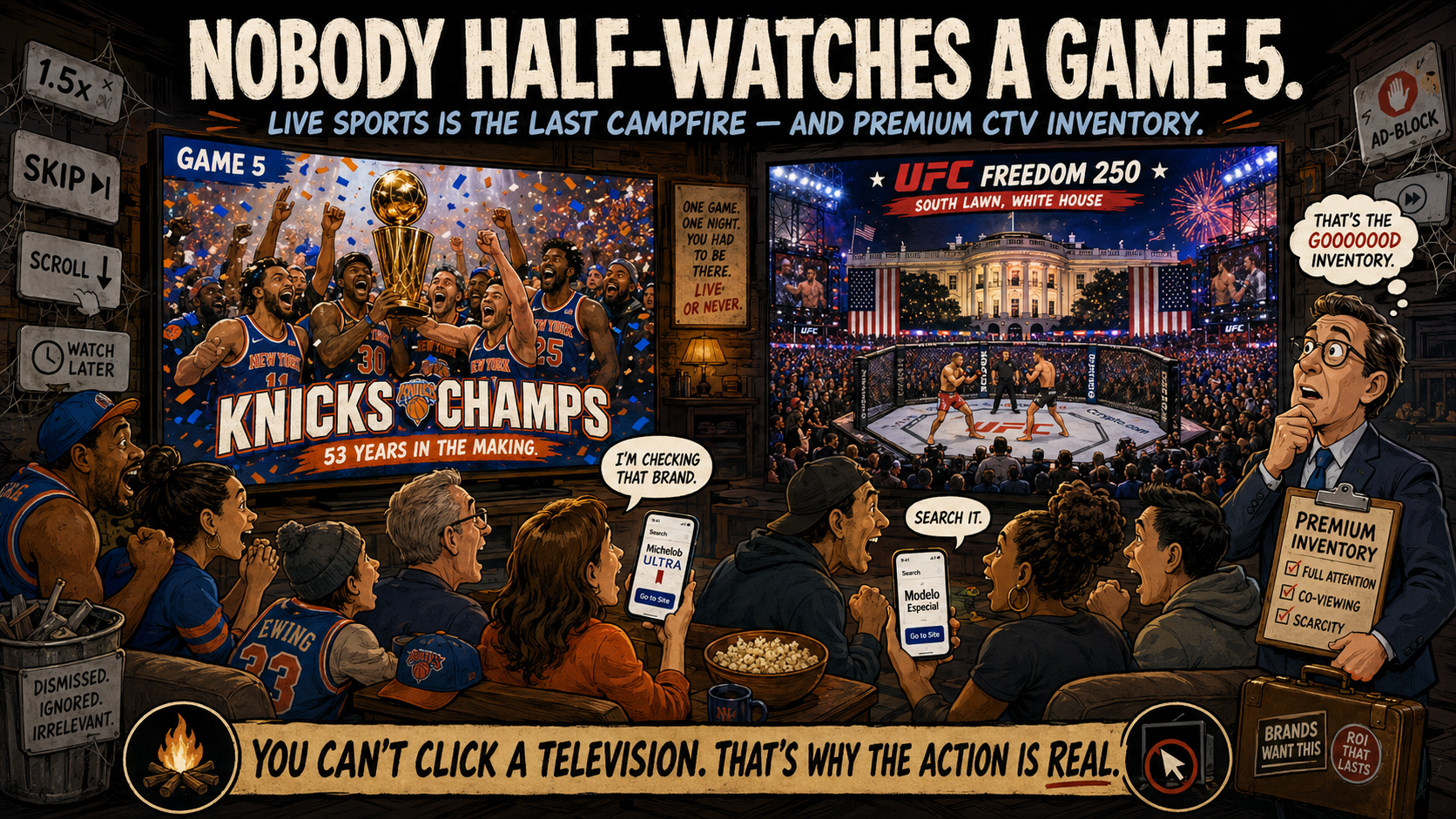
This weekend, two things happened that almost never happen anymore.
The New York Knicks won their first championship in fifty-three years. Jalen Brunson dropped forty-five in the close-out, the franchise ended a drought that started in 1973, and an entire city stopped what it was doing to watch it happen in real time.
And on the South Lawn of the White House, the UFC built a full Octagon and staged Freedom 250 as part of America's 250th anniversary — a live spectacle the whole country tuned in to see, the kind of event that gets watched once, live, or not at all.
Millions of people watched both. At the same time. Leaning forward.
And not one of them skipped a single second.
That is the thing worth noticing. In a media world built entirely around skipping — fast-forward, ad-block, scroll past, swipe away, watch it later at 1.5x — live sports is the last place on earth where millions of people sit still, at the same moment, and pay full attention to something they cannot pause.
That is not just great television. It is the most premium inventory in advertising. And the action it drives is more real than anything a banner ad will ever produce.
The Last Campfire
For most of human history, attention was shared. The whole tribe gathered around the same fire. The whole town read the same paper. The whole country watched the same three channels at the same time.
Then media fractured into a billion pieces. On-demand. Personalized. Infinite. Everyone watching something different, at a different time, on a different screen, half-paying-attention while a second screen glows in their other hand.
Shared attention died almost everywhere.
Almost.
Live sports is the last campfire. It is the one thing left that still pulls millions of people to the same moment, at the same time, fully present, because the entire value of it is that it is happening now and you cannot experience it later in the same way. A recorded game is a different thing than a live one. Everyone knows it. So everyone shows up live.
The Knicks ending fifty-three years of waiting only mattered if you watched it as it happened. The UFC on the White House lawn was a live event or it was nothing. You could not TiVo the feeling. You had to be there, in real time, with everyone else.
That is the rarest commodity in modern media. Simultaneous, unskippable, fully-present mass attention. It barely exists anymore.
And it is exactly what an advertiser is buying when they buy live sports on CTV.
Why Live Sports Is Premium Inventory
This is not sentiment. The numbers make the premium undeniable.
Start with attention, because attention is the whole game. Sixty-four percent of CTV viewers say they actively pay attention to the ads during live sports — a number that would be a fantasy in any other environment, where the ad is a tax the viewer endures on the way to the content. In live sports, the viewer is locked in, emotionally invested, and watching in real time, which means they are watching the ads in real time too.
That attention converts. CTV ads delivered during live sports outperformed their cable and broadcast equivalents by as much as sixty-six percent in performance outcomes during the 2024 to 2025 NFL season. Some events pushed that lift past a hundred percent. The same spot, in the same category, did dramatically more work simply because of where it ran.
Then there is co-viewing — the thing live sports does that almost nothing else does anymore. People watch the game together. In living rooms, in groups, in bars, on the biggest screen in the house. One impression reaches a household, not a person. The ad lands on multiple sets of eyes at once, in a social setting, where it gets talked about in the moment. No mobile feed can replicate a room full of people watching the same ad at the same time.
Then there is scarcity, and scarcity is the engine under the premium. Live sports inventory is finite. The game happens once. The ad breaks are limited. The impressions in a market are capped. When the season sells out, it is sold out, and no amount of budget creates more. Streaming services are projected to spend $14.2 billion on live sports rights in 2026 — more than double what they spent in 2022 — precisely because this attention cannot be manufactured. It can only be bought, and there is only so much of it.
And then there is brand safety, the quiet premium. When your ad runs in a live championship game, you know exactly what it is running against. No questionable content. No made-for-advertising junk. No mystery placement in the long tail. You are in the most-watched, most-trusted, most-premium environment in television, next to the moment millions of people will remember for years.
Attention, co-viewing, scarcity, safety. Every one of them is a reason the CPM is higher. And every one of them is a reason the higher CPM is worth it.
The Part Nobody Talks About: The Action Is Real
Here is the argument I have made about CTV since the beginning, and live sports is where it hits hardest.
You cannot click a television.
There is no button on the screen. So when a viewer sees an ad during a game and then does something about it — picks up their phone, searches the brand, visits the site, remembers the name a week later when they are shopping — that action took a deliberate act of will. They had to choose to act. On a second device. Of their own volition. In the middle of a game they care about.
That is not an accidental click. Nobody fat-fingers a conversion during the Finals. That is not a curiosity click — the idle, meaningless tap on a banner that attribution dashboards love to count and that means absolutely nothing. There are no accidents in non-clickable inventory. There is only genuine, intentional action.
Now stack that on top of live sports, and you have the highest-quality demand signal in all of advertising.
Think about what it takes for a brand to move someone during a live game. The viewer is at peak emotional engagement. Their team is up, or down, or tied with two minutes left. Their attention is the most expensive it will ever be, locked onto the most important thing on the screen. And in that environment, your ad does enough work that the viewer chooses — deliberately, on their own, with no button to make it easy — to go act on it.
That action is worth ten of any click you will ever buy on a banner. Because it survived the highest-attention, highest-emotion, hardest-to-interrupt moment in media, and the person took it anyway, on purpose, because they actually wanted to.
Live sports gives you the attention. The non-clickable screen guarantees the intent. Put them together and every action that comes out the other side is real. No accidents. No curiosity. No noise. Just genuine interest, expressed by a human who had to mean it.
That is the cleanest demand signal money can buy.
Why It's Good for Certain Brands
Live sports on CTV is premium, and premium is not for everyone. So let's be honest about who it is for.
It is for the brand that wants mass simultaneous reach — that needs to put a message in front of a huge audience at the same moment, the way a product launch, a seasonal push, or a brand-defining campaign demands. Nothing else assembles that audience anymore.
It is for the brand that sells to households, not just individuals. Co-viewing means the whole decision-making unit sees the ad together — the couple deciding on the car, the family choosing the insurance, the roommates picking the streaming service. When the purchase is a household decision, the household audience is the right audience.
It is for the brand that wins on emotion and association. Live sports is passion, energy, triumph, heartbreak, the city pouring into the streets after fifty-three years. A brand that wants to stand next to that feeling — to borrow the energy of the moment — cannot buy a better stage. Attention plus emotion is how brands get remembered, and live sports has more of both than anything else on television.
And it is for the brand that understands the premium CPM is a feature, not a bug. The higher price is the scarcity, the attention, the safety, and the co-viewing, all priced in. If you measure live sports on cost-per-impression alone, you will always think it is too expensive. If you measure it on attention captured, action driven, and demand created, it is frequently the most efficient money on the plan.
Who is it not for? The brand chasing the lowest possible CPM with no regard for attention. The brand that needs hyper-narrow niche targeting more than it needs reach. The brand with no creative worth putting in front of millions of fully-attentive people. For them, premium live sports is the wrong buy, and that is fine — there is plenty of CTV inventory that fits a different goal.
But for the brand that wants the attention, the emotion, the household, and the genuine action that only a non-clickable screen during a live game can produce — there is nothing else like it.
The Premium Is the Point
Some buyers look at live sports CPMs and flinch. They see the price climbing and assume they are overpaying.
They have it backwards.
Rising live sports CPMs are not a sign of waste. They are a sign of demand meeting scarcity in the one environment that still delivers what every advertiser claims to want. The price is high because the attention is real, the inventory is finite, and the results justify it. Seventy-eight percent of CTV advertisers are already running live sports campaigns, and the overwhelming majority plan to increase that spend — not because they enjoy paying more, but because they have measured what it returns.
You do not get premium attention at commodity prices. You never have. The brands that understand this stopped asking why live sports costs more and started asking what it is worth. And what it is worth — full attention, co-viewing reach, brand-safe placement, and genuine non-clickable action during the most-watched moments in media — is more than almost anything else they can buy.
The premium is not the obstacle. The premium is the proof.
The Final Take
The Knicks won a title fifty-three years in the making, and millions of people watched it live because there was no other way to feel it. The UFC put a cage on the White House lawn, and the country tuned in at the same time for the same reason. Nobody skipped. Nobody time-shifted. Nobody half-watched.
That is the rarest thing left in media — and it is exactly what live sports on CTV delivers to a brand. Simultaneous, unskippable, fully-present, emotionally-charged mass attention, on the biggest screen in the house, in the safest environment on television.
And because you cannot click a television, every action that ad drives is real. No accidental clicks. No curiosity clicks. Just genuine, deliberate, intentional interest from a human who had to choose to act in the middle of the one thing they refused to look away from.
That is premium inventory. Not because someone slapped a premium label on it. Because it earns the name on attention, on scarcity, and on the quality of the action it produces.
The whole country still shows up for the game.
The only question is whether your brand is standing there when they do.
Cory Poccia CEO, CS & Co. Marketing Studio™