
General Marketing
The Impression That Hurts You — Why More CTV Without Management Is Worse Than No CTV at All
More impressions without management isn't advertising. It's a brand tax.
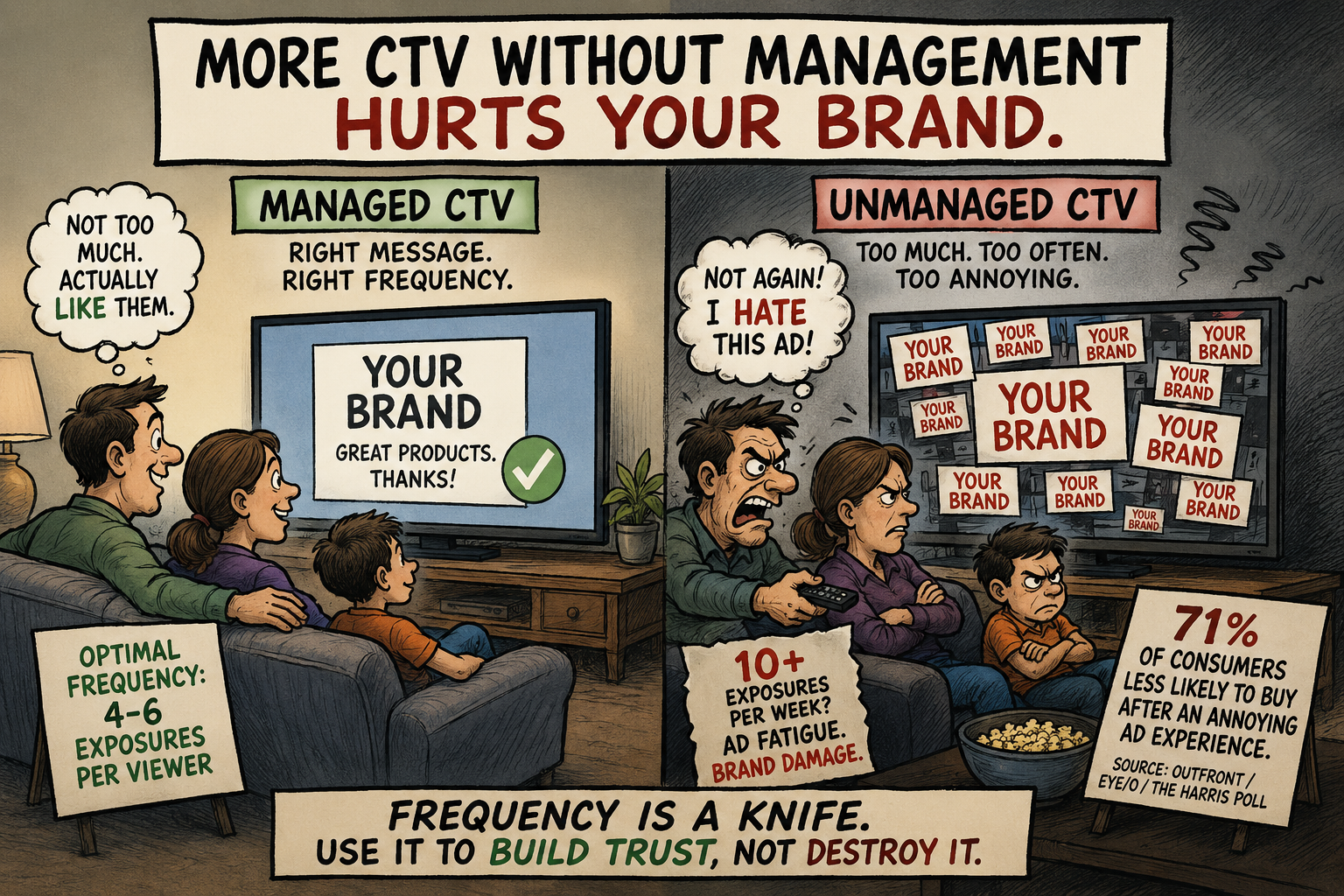
There is a number that should terrify every CMO running Connected TV right now.
Seventy-one percent.
That is the percentage of consumers who say they are less likely to buy from a brand after an annoying or intrusive ad experience.
Not "less likely to remember." Less likely to buy.
The source is OUTFRONT's 2026 Advertising Trends Report, citing EYE/O and The Harris Poll. Seventy percent of consumers say they find digital advertising unpleasant and annoying. Two thirds say those experiences actively reduce their trust in the brand behind the ad.
This is not a digital display problem. This is not a mobile problem.
This is a CTV problem. And if you are running unmanaged CTV — on a self-serve platform with default settings, or through an agency that treats impression volume as a KPI — you are almost certainly making it worse.
The Impression Nobody Talks About
Every conversation about CTV starts with reach. How many households. How many impressions. How many completed views.
Nobody talks about the impression that makes a customer like you less.
That impression exists. It has been measured. And it is the single biggest risk in every unmanaged CTV campaign running right now.
Innovid's data shows that as CTV campaign investments grow, frequencies are routinely hitting ten or more exposures per household. At that level, attention units begin to collapse. The viewer is no longer absorbing the message. They are enduring it.
But it is worse than indifference.
There is a clear, documented correlation between excessive repetition and a decrease in brand favorability. The viewer does not just tune out. They turn against you. The ad that was supposed to build your brand is now actively eroding it.
The 2026 industry benchmark for optimal CTV frequency is four to six exposures per viewer. Beyond ten exposures per week, ad fatigue triggers negative brand sentiment. That is not a guideline. That is an empirically validated cliff.
And here is the part that should keep you up at night.
tvScientific found that just eight to fifteen percent of households exceeded their intended frequency cap — but those households accounted for forty-two to sixty percent of total impressions. A small slice of overexposed viewers is consuming the majority of your budget. You are paying premium CPMs to make your best prospects like you less.
That is not inefficiency. That is self-inflicted damage.
Why Unmanaged CTV Does This
The CTV ecosystem is structurally fragmented. Your ad runs on Hulu. It runs on Peacock. It runs on Tubi. It runs on Pluto. It runs on Samsung TV Plus. Each platform sets its own frequency cap independently. None of them talk to each other.
You set a cap of five per week on each platform. The viewer watches content on three of them. They see your ad fifteen times.
Your dashboard says frequency is five. The viewer's living room says frequency is fifteen.
This is not a hypothetical. This is the default state of every CTV campaign that is not actively managed across platforms with a unified identity layer and cross-publisher frequency controls.
Self-serve platforms do not solve this. They make it worse.
Self-serve CTV platforms are designed to make it easy to launch a campaign. They are not designed to prevent you from destroying your brand in the process. The default settings optimize for delivery — getting your impressions out the door, spending your budget on schedule, hitting your contracted volume. They do not optimize for whether those impressions are helping or hurting.
A poorly managed agency does the same thing, just with a higher invoice attached. If the agency's KPI is impressions delivered, they will deliver impressions. They will hit your contracted number. They will show you a completion rate north of ninety-five percent and call it performance.
They will not tell you that the same four percent of households saw your ad forty times while sixty percent of your addressable market never saw it once.
They will not tell you that the households who saw it forty times now associate your brand with annoyance.
They will not tell you that the impressions that "performed" are the ones that did the most damage.
The Diminishing Returns Curve Is Not Flat — It Goes Negative
Most marketers understand diminishing returns intuitively. The tenth impression is worth less than the first. Fine. Everyone nods.
But the curve does not flatten at zero. It goes negative.
A political CTV study published just this month by Optimum Media found that pushing beyond the optimal frequency threshold produced additional impressions and maintained recall — but failed to deliver proportional improvements in persuasion. In many cases, higher frequency exposure resulted in more voters remaining undecided. Oversaturation was not just wasteful. It was counterproductive. The additional impressions were actively undoing the work of the earlier ones.
This is not unique to politics. The mechanism is identical in DTC, in supplements, in insurance, in financial services, in every category where the consumer needs to trust you before they buy.
Impression number four builds trust.
Impression number fourteen destroys it.
The difference between those two outcomes is not creative. It is not targeting. It is not the platform.
It is management.
What Management Actually Means
Real CTV management is not setting a frequency cap and walking away. It is an active, continuous discipline built on three foundations.
One. Cross-publisher frequency unification. Your frequency cap means nothing if it only applies within a single platform. A managed CTV operation tracks exposure at the household level across every publisher, exchange, and app in the buy. This requires a unified identity layer — deterministic device graphs, IP-based household matching, or a demand-side platform with cross-publisher deduplication. Without it, you are flying blind inside the viewer's living room.
Two. Creative rotation against fatigue. Frequency is not just about how many times a household sees an ad. It is about how many times they see the same ad. An always-on creative rotation system — cycling messaging, hooks, talent, and offers on a cadence of seven to fourteen days — resets attention even at higher frequency levels. The Innovid data is clear: attention units collapse at ten-plus exposures of the same creative. Rotate the creative and you push that cliff further out.
Three. Outcome-linked frequency analysis. Most platforms cannot connect exposure levels to downstream outcomes. They can tell you how many times the ad was served. They cannot tell you what happened after the sixth exposure versus the third. A managed operation ties frequency data to conversion events — cost per session by frequency band, cost per lead by exposure count, cost per order by household frequency. When you can see that CPS improves from exposure one through five and then degrades from six through twelve, you have a frequency strategy. When you cannot, you have a media plan running on faith.
The Self-Serve Trap
The rise of self-serve CTV platforms has been positioned as a democratization of television advertising. Any brand can now buy streaming inventory without an agency, without a sales call, without a minimum spend.
That is true. And it is also dangerous.
A self-serve platform gives you the keys to the car. It does not teach you how to drive. It does not tell you when you are about to drive off a cliff.
The defaults on most self-serve platforms are set to maximize delivery, not effectiveness. The frequency caps are either absent or set high. The pacing is optimized for budget completion, not audience management. The reporting shows impressions delivered and completion rates — the two metrics least likely to reveal that your campaign is actively hurting you.
A brand that launches on a self-serve platform without frequency unification, creative rotation, and outcome-linked measurement is not advertising on CTV. They are paying to annoy their best prospects at scale.
The Agency Version of the Same Problem
A poorly managed agency is worse than self-serve, because it adds cost without adding control.
If the agency bills on impressions delivered, their incentive is volume. If they report on completion rate, their incentive is to run non-skippable inventory and call the forced view a success. If they do not manage frequency across publishers, the viewer pays the price and the brand picks up the bill.
The question to ask any CTV agency or platform is not "how many impressions will I get." It is: "At what frequency does my campaign stop helping and start hurting — and how do you prevent us from crossing that line?"
If they cannot answer that question with data, they are not managing your campaign. They are delivering your budget.
The Math That Changes the Conversation
Let's make this concrete.
A brand spends fifty thousand dollars a month on CTV. At a twenty-five dollar CPM, that buys two million impressions.
In an unmanaged campaign, tvScientific's data suggests eight to fifteen percent of reached households will exceed the frequency cap. Those overexposed households will consume forty-two to sixty percent of total impressions.
That means somewhere between $21,000 and $30,000 of the monthly budget is being spent on impressions that are actively degrading brand favorability.
Not wasted. Degrading.
The brand is not just losing that money. It is paying to make future conversions harder. Every dollar spent past the frequency cliff raises the cost of every future acquisition — because the prospect now trusts the brand less than they did before they saw the ad.
This is the hidden cost that never shows up on a CTV dashboard. The platform reports two million impressions delivered, ninety-seven percent completion rate, and the client thinks the campaign is working.
It is working — against them.
What a Managed CTV Operation Looks Like
The difference between managed and unmanaged CTV is not sophistication for its own sake. It is the difference between a campaign that compounds value over time and a campaign that compounds damage.
A managed CTV operation starts with a frequency architecture before it buys a single impression. It defines the effective frequency window — typically four to six exposures for DTC, potentially higher for high-consideration categories — and builds the cross-publisher controls to enforce it.
It rotates creative on a seven-to-fourteen-day cycle, not because the old creative is "bad" but because the same creative shown twelve times becomes wallpaper. And wallpaper does not convert.
It measures cost per session by frequency band. It watches for the inflection point where additional exposure stops improving CPS and starts inflating it. When it finds that point, it reallocates budget from overexposed households to net-new reach.
It tracks branded search lift and direct site traffic as second-order indicators of whether the campaign is generating demand or generating fatigue.
And it does all of this every week. Not quarterly. Not monthly. Weekly.
That is what CTV management means. It is not a service tier. It is the minimum standard for running CTV without actively hurting your brand.
The Final Take
More impressions is not a strategy.
More impressions delivered without frequency management, creative rotation, and outcome measurement is not even advertising. It is a brand tax — paid by the advertiser and levied by the viewer who now trusts them less.
The OUTFRONT 2026 report puts it plainly. Seventy-one percent of consumers are less likely to buy from a brand after an annoying ad experience. That number is not about banner ads. It is about every impression, on every screen, that a consumer did not ask for and cannot escape.
CTV is the most powerful screen in the consumer's home. It commands three times the attention of display. It delivers ninety-seven percent completion. It reaches the viewer in a lean-back, high-attention state that no other digital channel can replicate.
That power is exactly why it is dangerous in the wrong hands.
An unmanaged CTV campaign does not just waste money. It weaponizes the most attentive screen in the house against the brand that paid for the impression.
Managed CTV builds brands. Unmanaged CTV burns them.
The impression that helps you and the impression that hurts you cost exactly the same CPM. The only difference is whether someone is watching the frequency, rotating the creative, and measuring the outcome.
That someone is the operator. And if you do not have one, you do not have a CTV strategy.
You have a budget with a delivery date.
Cory Poccia
CEO, CS & Co. Marketing Studio™