
General Marketing
When CTV Stopped Being a Top-of-Funnel Channel — And Why Most Brands Haven't Noticed
For 10 years, CTV was a top-of-funnel awareness play. The 2026 IAB NewFronts made it official: that era is over. Innovid's data shows CTV delivered 38% of impressions and 63% of attributable conversions. The bottom of the funnel just got a television
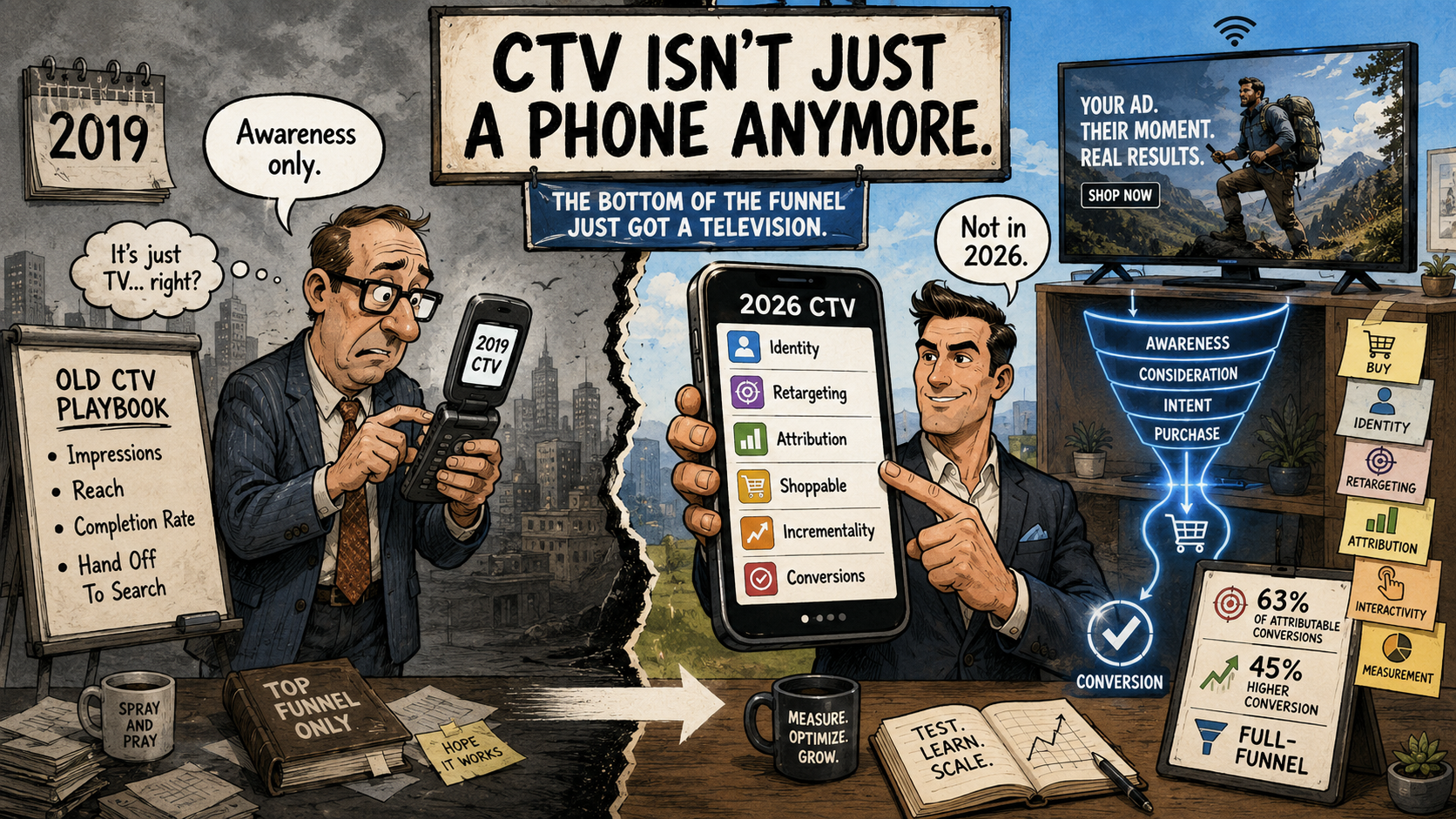
A phone used to be a phone.
You picked it up. You dialed seven digits. You talked. You hung up.
That was the entire job.
Then it became a camera. Then a wallet. Then a GPS. Then a television. Then a bank. Then a doctor. Then a stock exchange.
Today nobody calls it a phone.
They call it a device. They call it a computer. They call it a smartphone. The word "phone" no longer captures what is in their hand.
Connected television is having the exact same transformation.
For ten years, CTV was a phone. It made one call. Awareness. Top of the funnel. The cinematic spot that built the brand and handed the customer off to Google and Meta to close.
It is not a phone anymore.
And the brands still treating it like one are dialing seven digits while their competitors are unlocking a smartphone.
The 2026 NewFronts Made It Official
The IAB NewFronts is the streaming industry's annual stage. Every major platform — Netflix, Disney, NBCUniversal, Roku, Amazon, Warner Bros. Discovery — gets a slot to pitch advertisers on what to buy next.
In 2026, the message was so consistent it felt rehearsed.
CTV is now a performance channel. Full-funnel. Shoppable. Measurable. Accountable.
Not awareness. Not "brand-adjacent performance." Not "performance someday."
Performance, today, measured the same way Meta and Google are measured.
AdExchanger called 2026 "the year CTV goes full funnel." Roku's VP of global ad sales told Beet.TV at CES that "proof of performance has changed." Teads' 2025 State of Video and CTV study found that 41% of senior marketers now rank sales and conversions as a top KPI for video — sitting alongside viewability at 45% and brand awareness at 38%.
The funnel did not collapse upward. It expanded downward. CTV used to live in the top third of the funnel. It now lives in all three thirds.
And the brands that have not updated their model of CTV are missing the most important shift in digital advertising since social went programmatic.
The Numbers That Should Reframe Every Media Plan
Innovid's 2025 CTV Insights report buried a single statistic that should rewrite how every CMO thinks about the channel.
CTV accounted for 38% of impressions in their data set.
It drove 63% of attributable conversions.
Read that again. A channel that delivered roughly a third of the impressions produced two thirds of the closes.
This is not the math of a top-of-funnel awareness vehicle. This is the math of a bottom-of-funnel performance channel that happens to also run awareness.
CTV-exposed households converted 45% higher than non-exposed households. Average ROAS sat near $6 returned for every $1 spent — three times the return of linear television. View-through windows extended to seven and fourteen days captured conversions that last-click models throw away entirely.
A DTC apparel brand reallocated 20% of its budget to CTV and produced a 4.2x ROAS with a 15% lift in attributable sales. Metro Vein Centers cut their cost per qualified visitor by 85% — from $14.86 to under $3 — after layering retargeting and identity-based attribution onto their CTV buy. Kane Footwear delivered 250% above their ROAS goal in a single CTV campaign.
These are not awareness metrics. These are P&L metrics. They show up in revenue. They show up in customer acquisition cost. They show up in the same dashboards CFOs use to evaluate Meta and Google.
The channel changed. The reporting caught up. The brands that built their CTV strategy in 2021 are looking at a 2026 channel through a 2019 lens.
What Actually Changed
The reason CTV could not close in 2019 was structural.
There was no identity layer. No household graph. No way to connect the impression on the living room television to the conversion on the mobile phone three days later. The viewer saw the ad. The viewer searched for the brand. Google got the click. CTV got the impression report. The connection between the two existed in theory and nowhere else.
Then six things changed.
Identity resolution matured. Companies like LiveRamp, The Trade Desk, and Roku built deterministic household graphs that connect every screen in a home to a single addressable identity. The ad served on the smart TV and the search performed on the phone now sit on the same record.
Cross-screen attribution became standard. Multi-touch attribution platforms — Innovid, Adelaide, iSpot, Rockerbox — moved beyond last-click to give credit to the impression that actually started the journey. Major e-commerce brands using multi-touch CTV attribution report ROAS uplifts of 35% after reallocating budget away from last-click models.
Retargeting arrived on CTV. The viewer who watched the ad and visited the site but did not buy can now be retargeted on the same television they saw the original ad on. The retargeting layer that built Meta into a $130B advertising business is now native to CTV.
Interactive formats became measurable. Engagement per impression hit 1.94% in Q2 2025 — nearly double the 1% rate from one year earlier, per BrightLine data licensed by EMARKETER. Interactive ads boost unaided recall by 36%, foot traffic by 13%, and brand affinity by 33%.
Shoppable inventory shipped. By 2026, interactive shoppable ads will represent roughly 10% of all CTV inventory. The data on those formats is unambiguous — shoppable CTV ads convert at five times the rate of standard video. JCPenney's scannable in-store offer campaign drove $20M+ in revenue with a 2.93% conversion rate and measurable lifts in both consideration and purchase intent.
Incrementality testing became a service. Geo-holdouts, ghost ads, and matched-market experiments — methodologies that used to require a data science team — are now point-and-click features on platforms like Stella, Haus, and Measured. A CTV campaign can now be proven causally lifted with the same rigor a Meta campaign can claim.
That is six structural shifts. Any one of them would have moved CTV down the funnel. All six happening simultaneously is what produced the channel that exists in 2026.
The QR Code Distraction
There is a debate happening in the industry about whether CTV has actually moved down the funnel — and the debate is being conducted in the wrong place.
The skeptics point to QR code scan rates. They were 0.010% in the first half of 2025. They fell to 0.004% by Q4. The conclusion: interactivity is plateauing, the bottom-funnel CTV story is overhyped, the channel is still mostly awareness.
This is the wrong frame.
QR codes are one mechanism. They are not the mechanism. A viewer who sees an ad on Hulu and does not scan the on-screen code is not a failure of bottom-funnel CTV. They are a normal CTV-driven customer.
What that viewer does is pick up their phone three days later, type the brand name into Google, click through, and buy. The CTV ad caused the purchase. The on-screen QR code had nothing to do with it.
The 63% conversion share that CTV produced in the Innovid dataset did not happen because viewers scanned QR codes at scale. It happened because the identity layer, the retargeting layer, the multi-touch attribution layer, and the cross-screen graph captured the conversion that the QR code never needed to.
The QR code is a feature. Bottom-funnel CTV is the channel. Confusing the two is how brands convince themselves the smartphone is still a phone.
Why Most Brands Are Still Buying 2019 CTV
There is a structural reason this shift has not propagated to most CTV buying.
The people setting media plans in 2026 wrote the playbook in 2019, 2020, or 2021. They learned CTV as an awareness channel. They built their measurement frameworks around brand lift studies, reach and frequency curves, and incremental linear extensions. Their dashboards report impressions delivered and completion rates.
None of those frameworks are wrong. They are just incomplete.
A 2026 CTV strategy that reports only on impressions, reach, and completion is leaving the most valuable half of the channel uncounted. It is the equivalent of judging a smartphone by call quality alone — ignoring the camera, the wallet, the GPS, the bank, and every other function the device performs.
The brand running CTV without a retargeting layer is not running CTV. It is running television commercials on a streaming service.
The brand running CTV without cross-screen attribution is not measuring CTV. It is measuring impressions and hoping.
The brand running CTV without view-through analysis at seven and fourteen days is not closing the loop. It is handing every CTV-driven conversion to whichever channel happens to catch the customer last.
The infrastructure to do all of this is now standard. It is not exotic. It is not expensive. It is the default of any competently managed CTV operation in 2026.
The brands not using it are not being conservative. They are being out of date.
The Stack That Makes CTV Bottom-Funnel
A 2026 performance CTV stack has six layers.
The buy itself is layer one — programmatic CTV inventory bought against audience segments built from first-party data, retail data, or modeled lookalikes. The era of buying CTV by show, daypart, or upfront commitment is over for performance advertisers.
The identity layer is two — a household graph or device graph that resolves the smart TV, the connected phone, and the desktop browser to a single addressable customer.
The retargeting layer is three — the ability to serve a sequenced follow-up ad on CTV to a household that has been exposed, has visited the site, has abandoned a cart, or has matched a high-intent behavioral signal.
The attribution layer is four — multi-touch attribution and incrementality testing running in parallel, so the platform can both credit the touchpoint and validate that the touchpoint caused the outcome.
The interactivity layer is five — shoppable formats, pause ads, QR overlays, voice triggers, and contextual product feeds for the brands where the format fits the offer. Not every advertiser needs this. The ones who do should be running it.
The measurement layer is six — branded search lift, direct traffic lift, post-purchase survey data, and geo-holdout validation, all reporting back into the same dashboard that holds CPS, CPL, and CPO.
That is the stack. It does not exist on any single platform. It is built by an operator who knows which pieces matter and how to assemble them.
The brand that buys CTV without those six layers is buying the 2019 channel at 2026 prices.
The brand that buys CTV with those six layers is buying the highest-incrementality performance channel currently available in digital media.
The difference is operator.
The Final Take
The phone became a smartphone over the course of about a decade.
The transformation was gradual until it was not. There was a year — somewhere around 2010 — when carrying a flip phone stopped looking thrifty and started looking strange. The technology had moved. Most people had moved with it. The holdouts were not making a principled stand. They were just behind.
CTV is in the same window right now.
The infrastructure that makes CTV a performance channel is shipping. The platforms are pitching it. The data is verifying it. The benchmarks are landing — 3.30x incremental ROAS, 63% of attributable conversions, 45% higher conversion among exposed households.
The brands that have updated their model of the channel are pulling away. The brands that have not are still buying CTV like it is 2019. Same dashboard. Same vanity metrics. Same handoff to Google to close the deal that CTV actually closed.
The bottom of the funnel just got a television.
The question for every CMO is whether their CTV strategy reflects that — or whether they are still dialing seven digits on a device that can do everything.