
General Marketing
Don't Be the Last Dog to the Bowl — Why the Brands Learning CTV Now Will Own It Later
CTV right now is a full bowl and calm water. The brands learning it today will have mastered it by the time everyone floods in. The blue ocean is also a classroom, and it's about to turn red. Don't be the last dog to the bowl.
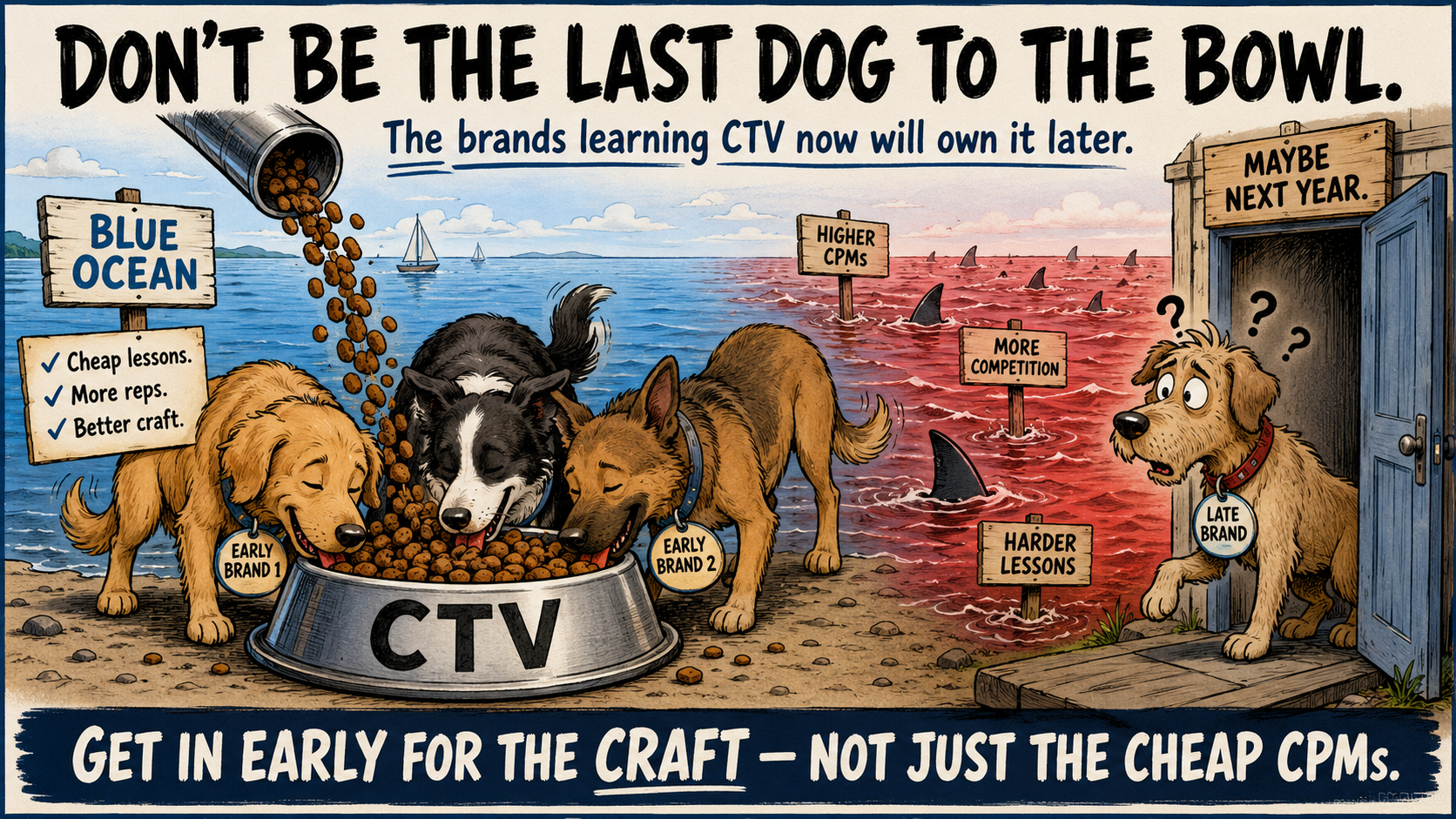
Picture a bowl getting filled.
The first dogs hear the kibble hit the metal and they are already there. They eat. They learn the sound. They learn the spot. They learn the exact moment the food drops and the fastest path to reach it.
By the time the last dog wanders over, the bowl is empty.
And here is the part the last dog never understood. The early dogs did not just eat better. They got trained. They know the routine now. They own the spot by the bowl. When the food comes again, they are faster, calmer, and more certain than the latecomer will ever be — because they have done it a hundred times and the last dog is still figuring out where the kitchen is.
That is Connected TV right now.
The bowl is full. The kibble is dropping. And most brands are still in the other room, waiting for someone to tell them it is dinnertime.
By the time they wander over, the brands who showed up early will not just have eaten. They will have mastered the meal.
The Blue Ocean Is Also a Classroom
There is a reason early markets are called blue oceans. Wide open. Uncrowded. Yours to swim in without fighting anyone for the water.
But the most valuable thing about a blue ocean is not the room. It is the forgiveness.
When a market is young, mistakes are cheap. The competition is thin, the CPMs are reasonable, the audiences are fresh, and a campaign that does not work costs you a lesson instead of a season. You can test. You can fail. You can learn what your creative needs to do, how your frequency should be capped, which audiences convert, how your measurement should be triangulated — all of it, while the stakes are low and the water is calm.
That is what the brands entering CTV right now are actually buying. Not just cheap inventory.
Reps.
They are logging the flight hours. They are learning the craft of the channel in the years when the channel forgives you for not knowing it yet. Every campaign teaches them something. Every test sharpens the next one. The knowledge compounds quietly, campaign after campaign, while the rest of the market is still calling CTV "the thing we should probably look into next year."
The blue ocean is not just a place to feed. It is a place to train. And the training is the part you cannot buy back later.
What You're Actually Learning
Here is what the early operator is building while the latecomer waits.
They are learning that CTV creative is not a linear TV spot with a new distribution plan — that it has to be decision-first, not entertainment-first, built to be remembered by a viewer who cannot click. They are learning the cadence of creative rotation, the precise week the same spot stops working and starts costing.
They are learning that frequency is not a number you set once and forget — that the same household seen across Hulu and Peacock and Tubi sees you fifteen times when your dashboard says five, and that the eleventh impression does not just waste money, it erodes the brand.
They are learning to read the metrics in the right order — cost per session before cost per order, the maturation curve over the first six to eight weeks, the difference between a campaign that is failing and a campaign that is still planting.
They are learning to measure what actually happened — to triangulate incrementality and media mix modeling and closed-loop matching instead of trusting a single instrument that lies. They are learning that branded search is the gateway, not the source. That the orders were not going to happen anyway. That the proof comes from the holdout, not the dashboard.
None of that is learnable from a deck. None of it transfers in a single quarter. It is craft, and craft is built one campaign at a time, in the forgiving years, before the water turns.
The brand learning all of this now will have it mastered by the time their competitor places their first buy.
The Craft Is the Moat — Not the Cheap CPMs
Most people who talk about getting into CTV early talk about the cheap CPMs. Get in now, lock in low prices, ride the cost advantage before it disappears.
That is real. It is also the least durable advantage on the table.
CPMs are temporary. The moment the market floods, prices rise, and the cost edge you entered for evaporates. If cheap inventory is the only reason you are here, you have built your advantage on sand, and the tide is already coming in.
The durable advantage is the craft.
When everyone is paying the same higher CPMs in a crowded market, the brand that wins is not the one that got in cheapest. It is the one that knows how to operate. The one whose creative is dialed. Whose frequency is managed across publishers. Whose measurement is honest. Whose audience strategy was refined across fifty campaigns instead of guessed at on the first.
Two brands can buy the exact same inventory at the exact same price and get wildly different results, and the entire difference is operational mastery. That mastery does not go on sale when the market crowds. It gets more valuable, because it becomes the only thing left that separates the winners from the spenders.
The cheap CPM is the bait that gets you to the bowl. The craft is what keeps you fed after the bowl gets crowded.
The Red Ocean Is Already on the Horizon
This window does not stay open. The data says it is closing faster than most brands realize.
Seventy percent of CTV advertisers say they are increasing their spend this year, by an average of seventeen percent. Sixty-eight percent of marketers now call CTV a must-buy. In 2026, CTV upfront commitments crossed primetime linear for the first time in history — the largest advertisers in the country formally reweighting their plans toward streaming. Eighty-nine percent of media planners say they intend to move more budget out of linear and into CTV over the next two years.
US CTV ad spend hit $33 billion in 2025. It crosses $38 billion in 2026 and passes traditional television entirely by 2028.
Read those numbers as a weather report. The flood is not a forecast. It has started. The blue ocean is taking on color at the edges, and every one of those statistics is another brand wading into the water you are standing in right now.
When that flood completes — when every competitor is in, when CPMs have climbed, when the audiences have been targeted a hundred times over and the inventory is fought for instead of waiting — the ocean will be red. Crowded. Contested. Unforgiving.
And on that day, the only brands that thrive will be the ones who learned to swim before the sharks arrived.
You Cannot Learn to Swim in a Red Ocean
Here is the trap waiting for the last dog.
The latecomer does not get to learn the way the early entrant did. They do not get the forgiving years, the cheap mistakes, the calm water to practice in. They arrive in the red ocean and they have to learn the craft and survive the competition at the same time.
That does not work.
You cannot learn frequency management while a dozen competitors are bidding up your audiences. You cannot figure out your creative cadence while CPMs punish every misfire. You cannot build measurement discipline from scratch while you are bleeding budget trying to keep pace with operators who mastered all of it three years ago.
The late entrant is trying to learn to swim in shark-infested water. They will spend more, learn slower, and lose to brands with smaller budgets and sharper craft — because the early brands made all their mistakes back when mistakes were cheap, and now they only make moves.
The blue ocean was the classroom. The red ocean is the exam. You cannot cram for it on the morning of the test.
The Compounding Nobody Sees
There is a quiet math underneath all of this, and it is the most important part.
Skill compounds.
The brand that runs its tenth CTV campaign is not ten percent better than the brand running its first. It is exponentially better, because every campaign taught it something that made the next one sharper, and those lessons stacked. The audience insight from campaign three informed the creative in campaign five informed the measurement in campaign eight. The knowledge did not add up. It multiplied.
By the time the latecomer runs campaign one, the early operator is on campaign fifty, carrying fifty campaigns of compounded, stacked, multiplied learning the newcomer cannot shortcut, cannot buy, and cannot catch.
That gap is not a head start. A head start can be closed. That gap is a compounding curve, and the longer the early brand runs, the wider it gets. Every quarter the latecomer waits, the distance does not grow by one. It grows by the whole accumulated rate of everything the early brand has learned since.
The brands entering CTV today are not just early. They are compounding. And compounding is the one advantage that cannot be caught by spending more later.
The Final Take
The bowl is full right now.
The kibble is dropping. The water is calm. The market is forgiving. The mistakes are cheap. Every condition that makes a channel learnable is present in CTV today, and every one of them has an expiration date.
The brands showing up now are not just getting fed. They are getting trained. They are logging the reps, building the craft, and compounding a kind of operational mastery that does not go on sale and cannot be bought back once the water turns red.
And it is turning. Seventy percent more spend. Upfronts crossing over. Eighty-nine percent of planners moving budget in. The flood has started, and every brand still waiting in the other room is one step closer to being the last dog to an empty bowl.
You do not want to arrive when the food is gone and the competition is trained and the water is full of sharks who learned to swim while you were waiting for permission.
You want to be early. Not for the cheap CPMs. For the reps. For the craft. For the compounding head start that turns into a lead nobody can close.
Enter the blue ocean now.
Because soon it will be red, and the only brands swimming in it will be the ones who learned how while the water was still calm.
Don't be the last dog to the bowl.
Cory Poccia CEO, CS & Co. Marketing Studio™