
General Marketing
Why CFOs Hate CTV — and Why They're Wrong About It
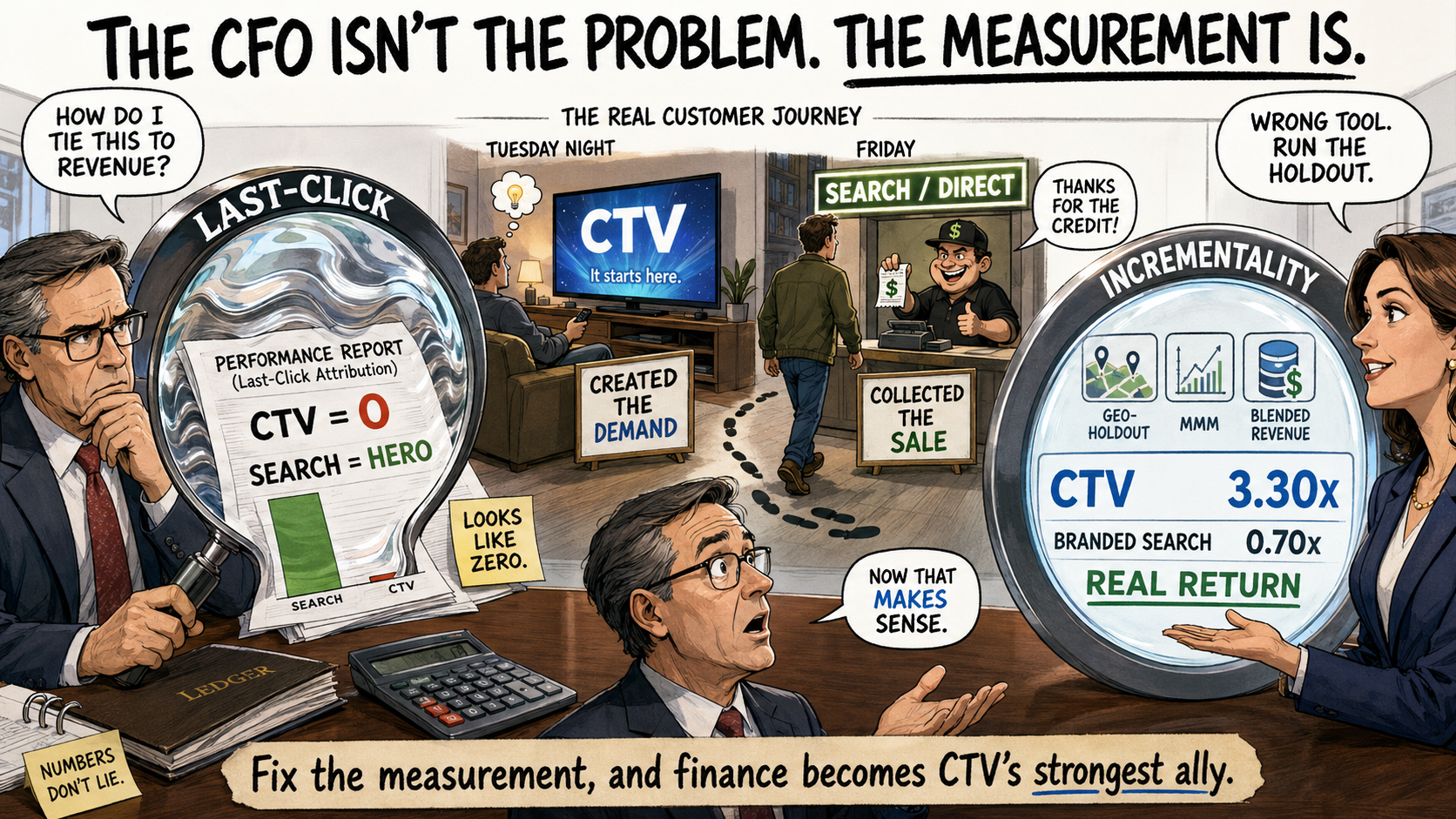
The CFO isn't the obstacle. The measurement is. Last-click under-credits the channel that creates demand and over-credits the one that collects it. Here's how to evaluate CTV with the controlled experiments and revenue-footed models.
Every CFO has the same reflex.
You bring them a CTV plan, and before you finish the sentence, you can see it on their face. The slight lean back. The pen going down. The question already forming.
"How do I tie this to revenue?"
And when you cannot answer that in the language they speak — clean, attributable, reconciled to the penny — the conversation is over. The budget goes to search. The budget goes to social. The budget goes to the channels that produce a number by lunchtime, even when the number is a lie.
Here is what I have learned after years of these meetings.
The CFO does not hate CTV.
The CFO hates not being able to reconcile it. And those are two completely different problems.
One is a problem with the channel. The other is a problem with the measurement. And once you understand that the CFO's resistance is a measurement problem wearing a media costume, you stop arguing about whether CTV works and start fixing the thing that actually broke.
The CFO Is Not the Villain
Let's start by giving the CFO their due, because the marketing industry loves to cast finance as the enemy of growth, and that framing is lazy and wrong.
The CFO's job is to allocate capital at the margin and know how fast it pays back. They live in historical facts, precision, and reconciliation. They have to foot the numbers to the penny because someone above them makes them foot the numbers to the penny. When a channel cannot be tied to revenue in a way that survives an audit, finance discounts it — not out of hostility, but out of discipline.
And the pressure is rising. In the most recent CMO Survey, sixty-three percent of marketing leaders reported increased pressure from their CFO to prove marketing's value — up from fifty-two percent two years earlier. Gartner is even blunter: it projects that by 2027, more than forty percent of CMOs who push for bigger brand budgets will lose influence with the C-suite because they cannot demonstrate the return.
So when a CFO squints at your CTV plan, they are not being difficult. They are doing their job. The questioning is not an attack. It is due diligence.
The mistake is not that the CFO asks the question. The mistake is that we keep trying to answer it with the wrong tool.
The Wrong Tool Is Last-Click
Here is the root of the entire conflict.
Most finance teams evaluate marketing through last-click attribution, because last-click produces the kind of number finance loves. Clean. Traceable. This dollar went in, this click came out, this sale closed. It looks like accounting. It feels like truth.
It is not truth. It is the single most misleading number in the building.
Last-click gives all the credit to whatever the customer touched right before they bought. Usually search. Usually direct. Usually the channel standing closest to the cash register. And it gives nothing to the channel that actually created the demand three days earlier, because that channel — CTV — cannot be clicked.
Watch how the distortion works. A customer sees your ad on a streaming service Tuesday night. Friday, they Google your brand, click the search result, and buy. Last-click hands Google one hundred percent of the credit. The television ad that put your brand in their head — the thing that started the entire journey — shows up in the report as a goose egg.
The CFO looks at that report and concludes CTV did nothing. The CFO is not wrong about the report. The CFO is wrong to trust the report.
Because measurable is not the same as valuable, and unmeasurable-by-last-click is not the same as worthless. Search did not create that customer. It collected them. And finance just gave the collector full credit for the sale the creator made.
The Number That Should Stop Every CFO Cold
If you want to change a CFO's mind, you do not argue. You show them the experiment.
When you measure CTV the right way — not by who got clicked last, but by what revenue actually happened because of the ad — the picture inverts completely.
In a 2025 study of two hundred seventy-four controlled incrementality experiments across sixty enterprise brands, CTV delivered a higher median incremental return than either Meta or Google. Higher than the two channels finance trusts most. And it did it while consuming just three and a half percent of those brands' budgets.
In a separate benchmark of two hundred twenty-five geo-tests, CTV produced the highest incremental return of any channel measured — about $3.30 of incremental revenue for every dollar spent.
And branded search — the hero of every last-click report, the channel finance keeps feeding — came in dead last. About seventy cents on the dollar.
Read those two numbers next to each other, because they are the whole argument.
The channel the CFO trusts most returns seventy cents of incremental revenue per dollar. The channel the CFO distrusts most returns three dollars and thirty cents.
The CFO is not protecting the business by starving CTV. The CFO is starving the best-performing channel in the building and overfeeding the one that mostly takes credit for work somebody else did. The skepticism, applied through the wrong lens, produces exactly the wrong decision.
Why the Lag Is a Feature, Not a Flaw
The second thing finance hates about CTV is the wait.
Search converts now. Social converts now. CTV plants something that converts later — days later, sometimes weeks. And a CFO judging the channel on day-two performance will always conclude it failed, because on day two, the work has not finished happening.
This is the trap that kills good CTV campaigns. The brand launches, checks the last-click dashboard on Thursday, sees nothing, and pulls the plug — right before the demand it created starts walking through the door.
The data on this is stark. In one analysis of Cyber Week campaigns, forty-one percent of the incremental value CTV produced showed up after the ad stopped running. Nearly half the return arrived in the window most brands had already stopped measuring. The campaigns that got cut on day-two numbers were cut while they were still working.
The fix is not complicated. You set the measurement window to match the channel. You judge search on a thirty-day payback and you judge CTV on something closer to ninety, because that is how long the channel actually takes to pay. A CFO who would never evaluate a capital investment on its first week of returns should not evaluate CTV on its first week either. The lag is not the channel failing. It is the channel working on the timeline brand demand has always worked on.
How a CFO Can Actually Start to Understand It
None of this requires faith. That is the part most marketers get wrong when they walk into the finance meeting waving a brand-lift study. CFOs do not run on faith. They run on evidence, controlled tests, and numbers that foot. So give them exactly that.
Here is the path that turns a skeptical CFO into a believer, and it is built entirely from things finance already trusts.
Start by redefining the question before a dollar is spent. Sit down with finance and agree, in advance, that the metric is incremental return, not last-click return, and that the measurement window respects the lag. Define what proof looks like — the lift, the confidence level — before the campaign runs. This single move turns the eventual finance meeting from an interrogation into a review, because you are not defending a surprise. You are reporting against a bar you both set.
Then run one controlled experiment. A geo-holdout. Turn CTV on in a set of matched markets, hold it off in a comparable set, and measure the difference in revenue. This is not a marketing dashboard. It is a controlled experiment — the exact form of evidence a CFO already respects in every other part of the business. It outputs the two numbers finance wants: incremental return and cost per incremental customer, both comparable against every other channel on the plan.
Then look at the blended truth instead of the attributed clicks. Watch total new customers, blended acquisition cost, and marginal revenue during the CTV flights. Watch whether branded search volume rises in exactly the markets where CTV is running. The fingerprints of a working CTV campaign are all over the aggregate numbers, even when the last-click report shows nothing.
Then, when the experiment proves out, commission a media mix model — a top-down, revenue-footed model that captures CTV's full contribution, direct and indirect, and survives an audit. Calibrate it with the geo-test you already ran. This is the artifact that wins the boardroom: not a dashboard, but a model that ties marketing to revenue the way finance ties everything else to revenue.
And then scale on proven incremental return, and keep testing, because incrementality is a snapshot, not a permanent constant.
Redefine the metric. Run the holdout. Read the blended numbers. Build the model. Scale on proof. That is not a marketing pitch. That is a finance process. And a CFO will follow a finance process to a conclusion they would never accept from a slide of awareness metrics.
The Money Is Already Voting
Here is the closing argument, and it is the one a CFO feels in their gut even before the data lands.
The smartest money in media is moving toward CTV as fast as it can.
Streaming passed half of all television viewing in late 2025 — the largest share ever recorded, ahead of broadcast and cable combined. CTV upfront commitments crossed primetime linear for the first time in 2026. And in June 2026, Fox agreed to pay roughly twenty-two billion dollars to acquire Roku — a legacy broadcaster spending twenty-two billion dollars to become a streaming platform, because that is where the audience, the data, and the future of television now live.
When the biggest, most financially disciplined players in the industry are writing checks that size to own the CTV layer, the question for any individual CFO is no longer whether the channel matters. It is whether their company will understand it before or after their competitors do.
A CFO who waits for perfect attribution will wait forever, because perfect attribution does not exist for any channel — not even the ones they trust. What exists is rigorous measurement: controlled experiments, revenue-footed models, honest incrementality. The CFO who adopts those tools gets to deploy capital into the highest-returning channel in the building while it is still underpriced. The CFO who waits gets to pay a premium to catch up, after the competitor who moved first has already mastered it.
The Final Take
CFOs do not hate CTV.
They hate a number they cannot trust, a return they cannot trace, and a channel that does not fit the dashboard finance has used for twenty years. Every one of those objections is fair. And every one of them is solved — not by asking finance to take marketing on faith, but by handing finance better tools than the broken one they have been using.
Last-click was always the wrong instrument. It under-credits the channel that creates demand and over-credits the channel that collects it, and it has been quietly steering capital in the wrong direction for years.
Replace it with the things a CFO already believes in. The controlled experiment. The revenue-footed model. The incremental dollar. Do that, and CTV stops looking like a leap of faith and starts looking like what it actually is.
The best-returning, most underpriced, fastest-growing channel in the building.
The CFO was never the obstacle. The measurement was. Fix the measurement, and the CFO becomes CTV's most powerful ally — because no one in the building is better at recognizing a great return than the person whose entire job is to find one.
Cory Poccia CEO, CS & Co. Marketing Studio™