
Monday Joe™ Series
Stop Blaming the Car Salesman When the Loan Gets Denied — Why Cost Per Session Is the Most Honest CTV KPI
Why CPS is CTV's real KPI. Stop blaming the car salesman when the loan officer denies the deal.

A car salesman gets the buyer onto the lot.
Walks them around the inventory. Hands them the keys for the test drive. Talks up the leather seats and the warranty. Earns the buyer's interest. Walks them inside. Sits them down in the office.
Then the loan officer takes over.
Pulls the credit. Runs the numbers. Decides whether to fund the deal.
If the loan gets denied, who do you fire?
In most car dealerships, the answer is obvious. You don't fire the salesman. The salesman did his job. The loan failed for reasons the salesman doesn't control — credit score, income verification, debt-to-income ratio, the bank's underwriting standards that week.
In CTV, brands fire the salesman every single day.
They run a CTV campaign. They check the dashboard at week three. Cost per order looks bad. They conclude the channel doesn't work and pull the budget.
What they have actually done is blame the salesman because the loan got denied.
This post fixes that.
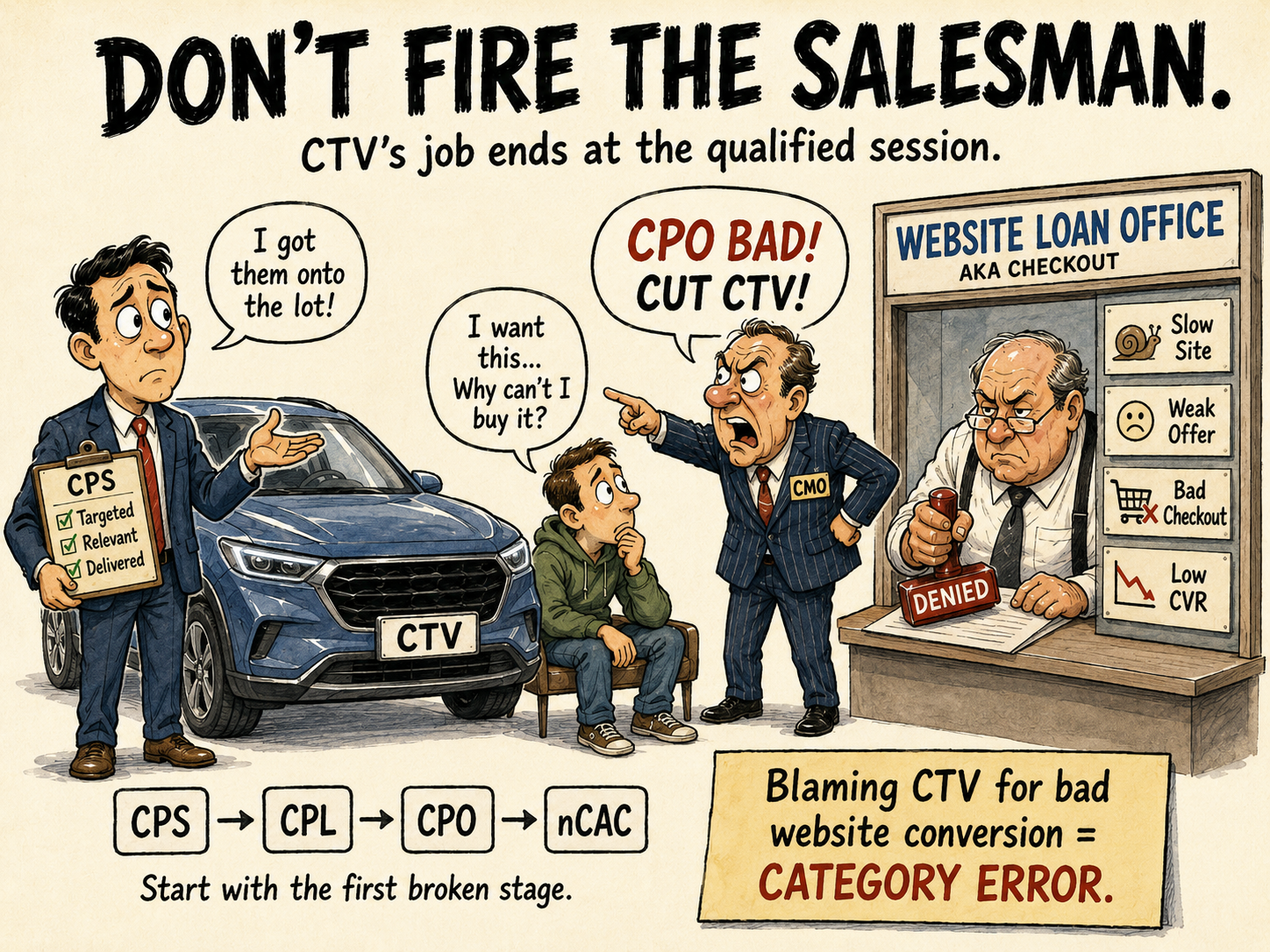
CTV's Job Ends at the Qualified Session
The single most important sentence in CTV measurement is this.
Once the user reaches your website, OTT's job is done.
Not nearly done. Not mostly done. Done.
CTV's contract with the brand is to drive a qualified, deterministic site visit at an efficient cost. Beyond that, the conversion is governed by:
The landing page
The offer
The price
The trust signals
The checkout flow
The site speed
The product detail page
The reviews
The shipping cost shown at checkout
The post-purchase experience
None of those things are CTV's job. None of them are within CTV's control. None of them can be optimized by changing CTV creative, CTV targeting, CTV inventory, or CTV frequency caps.
So when CPO comes back disappointing, the diagnostic question is not "is CTV working?"
The diagnostic question is "where in the funnel did this break?"
If the qualified visit arrived and the order didn't follow, CTV did its job. Something downstream — the loan officer — denied the deal.
The Number That Proves the Point
The single best piece of evidence that CPO is governed by the website, not by CTV, is the variance in DTC site conversion rates.
DTC Pages tracked 161 million sessions across 21 Shopify stores in 2025 and 2026. Conversion rates ranged from 2.14% to 3.54% across revenue tiers and seasonal windows. One store fell from 7.6% to 2.2% as it scaled traffic 4x. The correlation between session growth and CVR change was negative — meaning the more traffic, the lower the conversion rate.
Health and beauty DTC averages around 2.5% CVR, with well-optimized brands hitting 3 to 4%. Supplements typically run lower, around 1.5 to 2.5%. Subscription brands swing wildly based on the first-screen offer.
Now do the math.
Two brands run identical CTV campaigns with identical creative against identical audiences at identical CPMs. Both deliver $3.00 cost per session. Both deliver 10,000 sessions in week three.
Brand A has a 4% site CVR. They get 400 orders. Their CPO is $75.
Brand B has a 2% site CVR. They get 200 orders. Their CPO is $150.
Same CTV campaign. Same CTV cost. Same CTV everything.
Brand B's CPO is twice as bad as Brand A's — and the entire variance lives on the website.
Firing the channel for that result is a category error.
CPS Is the Spine of CTV Measurement
If CTV's job ends at the qualified session, then the metric that measures whether CTV did its job is cost per session.
Watched continuously over an eight-week flight, the CPS curve tells you everything that matters about whether the channel is working.
In week one, CPS will look high. The campaign is still finding its audience. The DSP algorithms are still calibrating. The creative hasn't been seen enough times to drive return visits or branded search.
By week three, if the targeting is right and the creative resonates, CPS starts trending downward.
By week six, the curve has either bent or it hasn't.
If it has bent — if your week six CPS is meaningfully below your week one CPS — your creative is working. People who saw the ad on the big screen are coming back to your site of their own accord. Branded search is filling in. Direct traffic is filling in. The campaign is compounding.
If the curve hasn't bent by week six, the creative is the problem.
That curve — not CPO, not ROAS, not view-through rate — is the only diagnostic that tells you whether CTV is doing its job.
A healthy CPS for DTC typically lands in the $2.50 to $5.00 range, depending on category, audience, and inventory tier. Premium FAST and AVOD pricing in the $30 to $55 CPM range with a 1% qualified visit rate from exposed households gets you there. Above $5.00 CPS suggests inventory or audience problems. Below $2.50 sustained over weeks 4 to 6 is exceptional.
CPO Is Structurally Rigged Against CTV
Here is the hard truth nobody in adtech wants to say out loud.
When you read CTV CPO from a platform dashboard, you are reading a number that has been systematically stolen from CTV by downstream channels.
The evidence is overwhelming.
Kochava's multi-touch attribution data, drawn from tens of millions of conversion paths, found that when CTV and search both appear in a path, CTV is first 96% of the time. When CTV and social both appear, CTV is first 94% of the time.
Translation: CTV originated nearly every one of those conversions. Search and social claimed them. The CPO that landed in the Google Ads dashboard or the Meta dashboard belonged to CTV. CTV's own dashboard showed nothing because the user converted on a different device, a different IP, or via a click that wasn't CTV's click to make.
Haus analyzed 190 YouTube incrementality tests and found that YouTube drove 3.4 times more incremental DTC sales than Google's platform reporting credited it for. They published a representative case showing one brand with a YouTube incrementality factor of 1.25 (under-reporting by 25%) and a branded search incrementality factor of 0.10 — meaning 90% of the conversions branded search claimed would have happened anyway.
Same brand. Same dollars. Last-click flipped the truth.
Stella's 2025 incrementality benchmark — 225 independent geo-holdout tests across all major DTC channels — found Tatari CTV at a 3.30x median iROAS, the highest of any channel measured. Google branded search came in at 0.70x median iROAS, meaning roughly 90% of the conversions branded search reported would have happened anyway.
If you optimize CTV on platform-reported CPO, you are firing the channel that originated the conversion in favor of the channel that finished it.
This is not a measurement opinion. This is the data.
The Sequenced KPI Ladder
The honest framework is not CPS-only. It is CPS-first, with CPL, CPO, and nCAC layering in as they earn statistical significance.
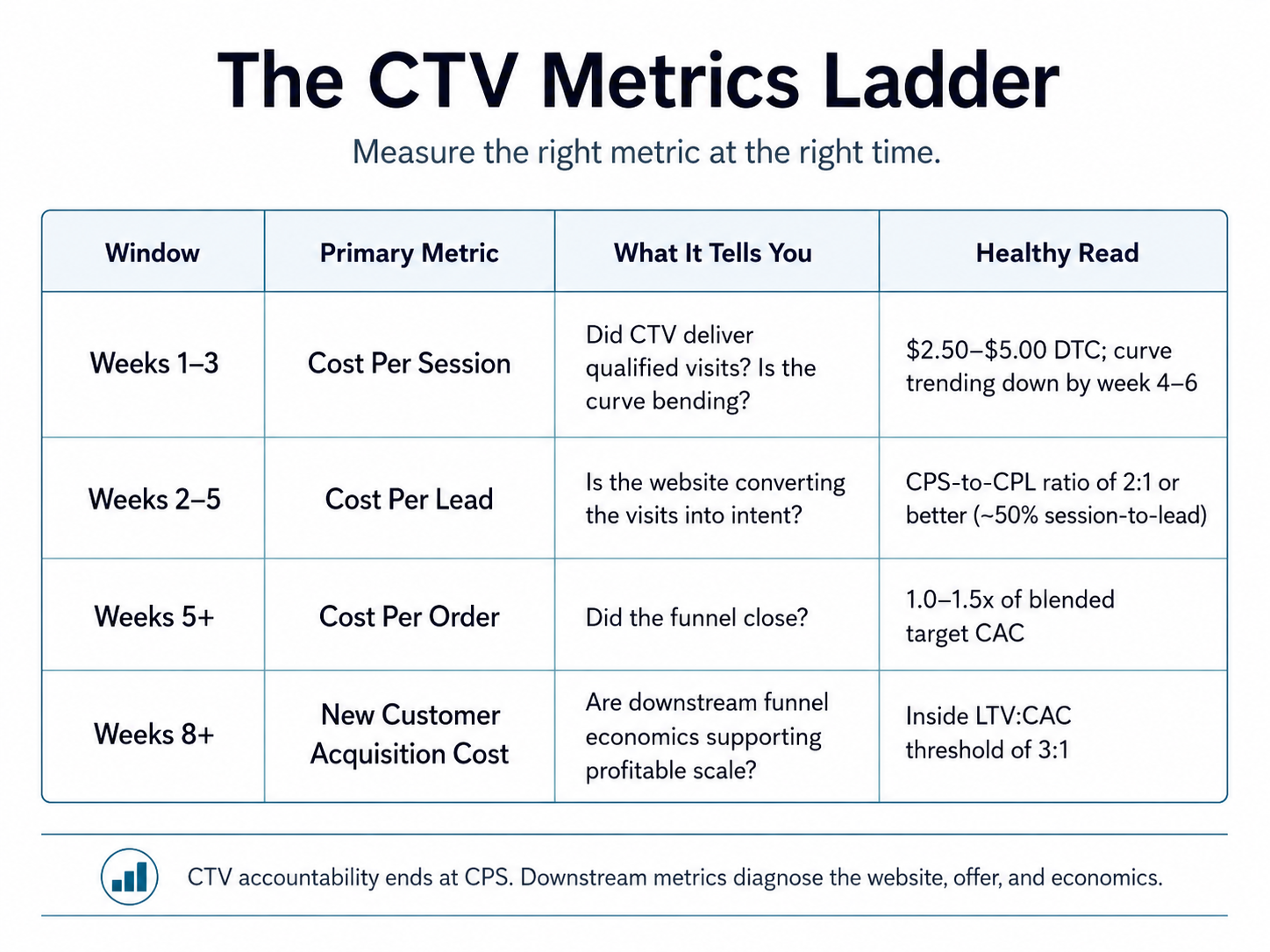
CPS is the spine. CPL is the website-quality diagnostic. CPO is the funnel-completion check. nCAC is the harvest.
Read each metric in its window. Stop reading the metrics that haven't matured yet. Use the gap between them to diagnose where the problem actually lives.
If CPS is healthy and CPL is bad, the website is the problem.
If CPS is healthy and CPL is healthy and CPO is bad, the offer or the price is the problem.
If CPS itself is bad, CTV is the problem.
This is the diagnostic logic. It works. And it depends on reading CPS first — because every other metric in the ladder is contaminated by variables CTV doesn't control.
The Strongest Counter-Argument, Honestly Engaged
The case for CPO as the primary KPI is real and it deserves a real answer.
Taylor Holiday and Common Thread Collective have built a sophisticated methodology around new-customer CAC at scale, with the position that upstream metrics are vanity unless they ladder up to first-purchase economics that hit the four-quarters P&L. CFOs want one number that maps to revenue. Eric Seufert's post-attribution framework on the Sub Club Podcast makes the case that incrementality is the only durable measurement, with everything else as noisy proxy.
The strongest specific version of the CPO argument: optimize purely on CPS and you'll eventually buy a lot of cheap, junk-quality traffic that visits but never converts. That's Goodhart's Law. The metric becomes the target. The target gets gamed.
The critique has merit.
The defense is not to abandon CPS but to fix the failure mode at its root.
Modern verified-visit methodologies prevent the junk-traffic failure mode. MNTN's Verified Visits explicitly excludes UTM-tagged traffic and credits only impression-to-visit chains that are deterministically verified. Tatari's IP-filtered device graph excludes the communal and mobile-ISP traffic that Inghelbrecht flagged. Northbeam's Clicks + Deterministic Views requires first-party deterministic match before crediting a visit.
In other words: CPS optimization fails when you let cheap junk visits count. It works when you require deterministic verification before a visit counts as a session.
Layer CPL and CPO downstream as guardrails — not primary KPIs. If CPS looks great and CPL collapses, you are buying junk visits. The diagnostic catches the failure mode without making CPO the primary KPI.
The synthesis position is straightforward.
CPS is CTV's job. CPO is the brand's job. Conflating them is the most common measurement mistake in the channel.
What This Means For Your Monday Morning
Three rules.
Rule one. Lead every CTV report with CPS, not CPO. Build the dashboard so the CPS curve is the first thing the executive team sees. CPO and ROAS go on page two. The discipline of reading CPS first reframes every conversation about CTV away from "is the channel working" and toward "is the curve bending."
Rule two. Separate CTV's accountability from CRO's accountability — in writing. When a CTV campaign delivers healthy CPS but disappointing CPO, the next conversation is not about cutting the channel. It is about diagnosing the website. Build that boundary into your reporting cadence. If your CFO is asking why CPO is bad, the right answer is "CPS is healthy at $3.40, the website is converting at 1.9% versus our 3.2% benchmark, and the cause is downstream of media."
Rule three. Run quarterly geo-holdouts to validate the whole stack causally. Stella, Haus, Measured, and other incrementality vendors will tell you what CTV's true contribution actually is independent of platform attribution. The Stella 2025 benchmark of 3.30x median CTV iROAS versus 0.70x branded search iROAS is the empirical proof that platform CPO is structurally rigged. Run your own version of that test once a quarter and you will never again have to defend CTV against a number that platforms invented.
Final Take
The car salesman gets the buyer onto the lot.
The loan officer decides whether the deal funds.
When the loan gets denied, the rational response is to fix whatever caused the denial — credit, income, debt ratio, lender choice. Not to fire the salesman who did his job.
In CTV, the salesman is the channel. The loan officer is the website.
Cost per session measures whether the salesman did his job.
Cost per order measures whether the loan officer closed the deal.
Conflating them is how good CTV programs get killed by bad website performance.
The brands that learn to read CPS first are the brands that scale CTV from six figures to seven without losing the ability to prove what is working.
The ones still leading with CPO are the ones blaming the salesman every single quarter, then wondering why their CTV programs never compound.
CTV works.
The accountability line is the discipline.
When CPO comes in disappointing, walk back up the funnel. In nine cases out of ten, the problem isn't CTV.
It's the loan officer.
CS & Co. Marketing Studio is a CTV-only performance agency. We build sequenced measurement frameworks for DTC brands scaling CTV from six figures to seven, with CPS as the spine and CPL, CPO, and nCAC layering in as they earn statistical significance.
CTV News | Measurement | Strategy | The Accountability Line