Are You Giving the Cash Register Credit for the Sale? Why Search and Direct Are Gateways for CTV — Not Competitors to It
Picture a store.
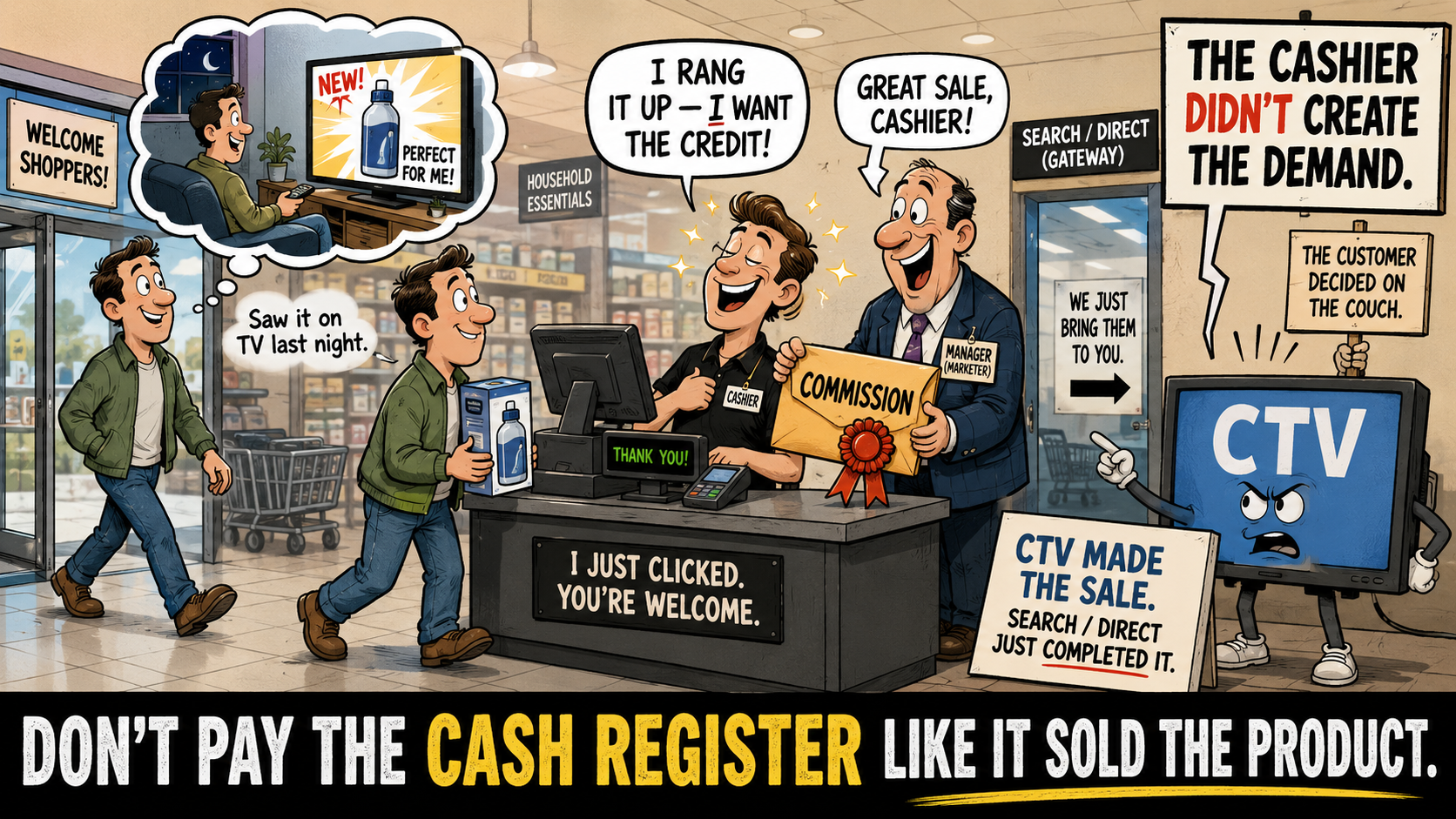
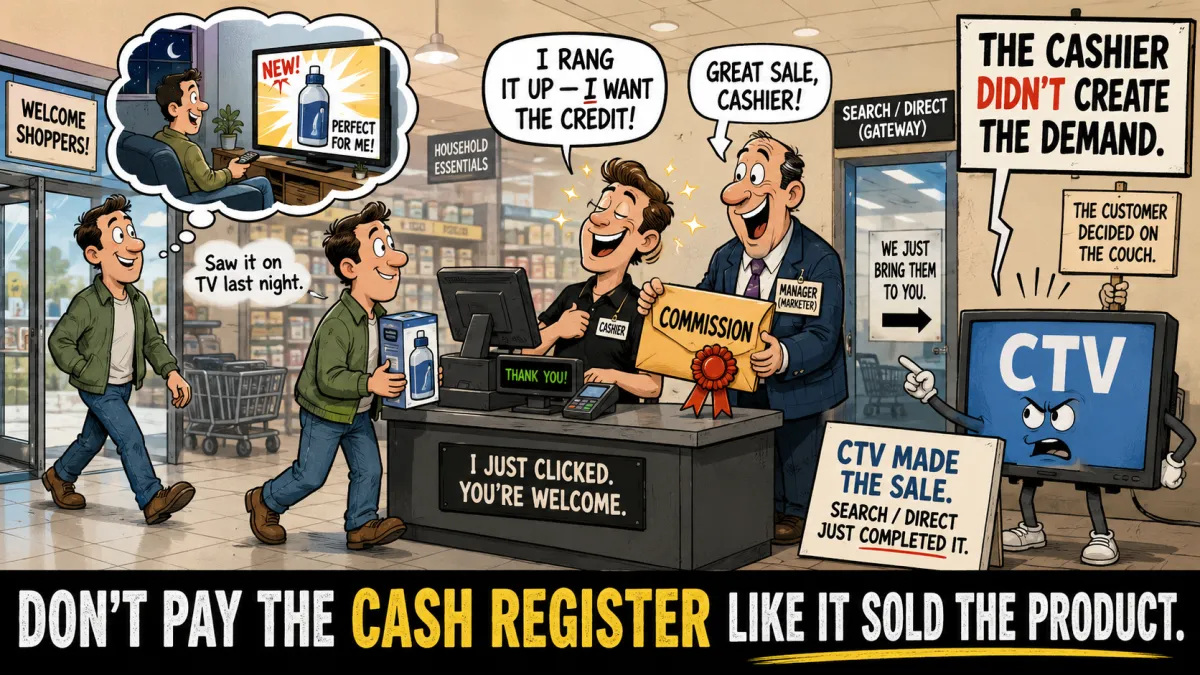
A customer walks in. They already know what they want. They saw it last night on their television, sitting on the couch, and something landed. They remembered the name this morning. Now they are here.
They walk to the shelf. They pick up the product. They carry it to the register. They pay.
The cash register rings up the sale.
Now answer one question.
Did the cash register sell the product?
Of course not. The register recorded the sale. It completed a decision that was made the night before, on a couch, in front of a screen. The register did not create the want. It collected the money.
So why do we pay it a commission?
The CMO of Bose, Jim Mollica, stood up at an ANA event, looked at his own branded search numbers, and asked the room the only question that matters. "Are we giving the cash register credit for the sale?"
That is the entire argument. Everything after this is just proof.
The Click That Is Not a Click
There is a structural fact about CTV that most attribution models were never built to handle.
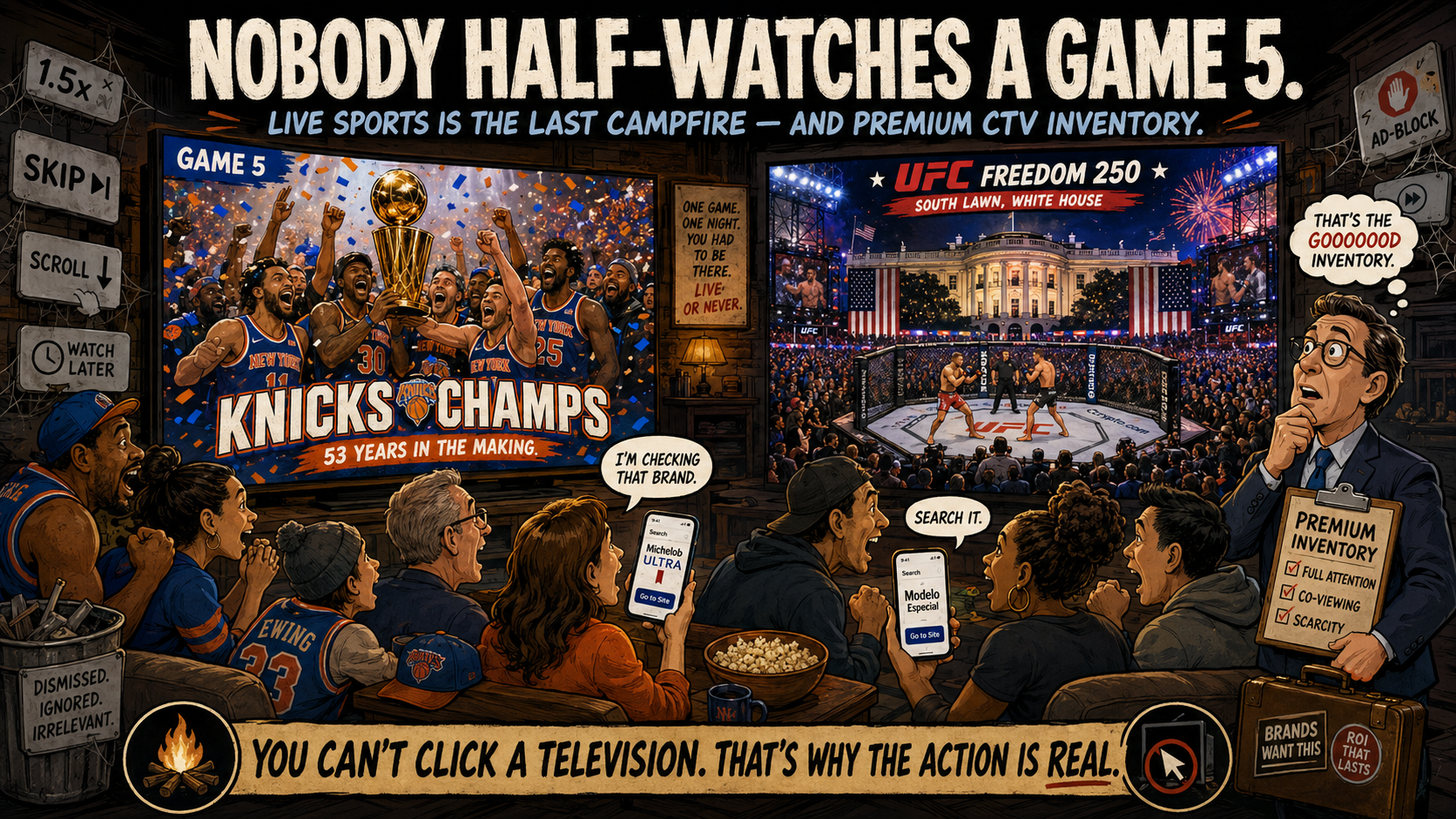
You cannot click a television.
There is no button on the screen. No cursor. No tap. The ad plays, the viewer absorbs it, and then the ad ends. If the viewer wants to act, they have to get up, pick up a second device, and go find you.
How do they find you? They search your name. Or they type your website directly. Or they click the paid ad sitting on top of the organic result for your own brand.
That search is not a separate decision. It is the only available mechanism to act on the decision CTV already produced.
It is the click for non-clickable inventory.
The viewer did not wake up wanting your brand by accident. They wanted it because the television told them to want it. The search is just the door they walked through to get to you. The door did not make them want to come inside. The door is a door.
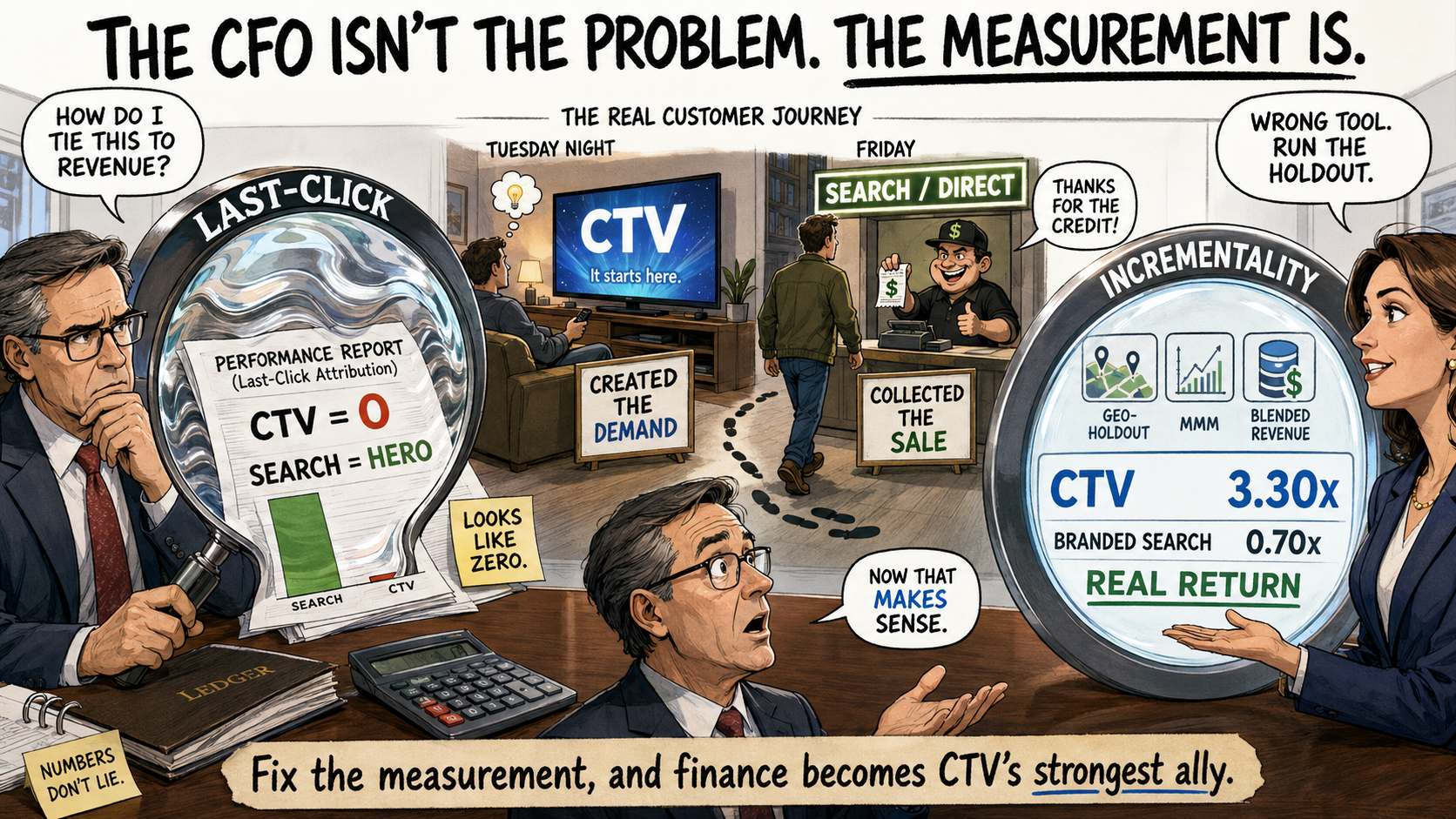
And yet, in a last-click model — and in most multi-touch models — the door gets the credit. The search gets the conversion. CTV, the thing that actually created the demand, gets nothing, because it could not be clicked.
We built a measurement system that rewards the channel the customer touched last, then handed it to the one channel that physically cannot be touched at all.
What eBay Proved When They Turned It Off
This is not opinion. It was tested, at scale, by people with no incentive to reach this conclusion.
In a series of large-scale field experiments, economists Thomas Blake, Chris Nosko, and Steven Tadelis — working inside eBay — shut off eBay's branded paid search across 68 markets in the United States. Sixty days. Real revenue on the line.
The hypothesis they expected to confirm was simple. Branded search drives sales. Turn it off, watch sales fall.
Sales did not fall.
When the paid brand ads disappeared, the traffic simply flowed through the organic results instead — to the exact same destination, at zero cost. The customers were already looking for eBay. They were always going to find eBay. The paid ad was charging eBay for a click eBay would have gotten for free.
The finding, published in Econometrica, was blunt. Brand-keyword ads have no measurable short-term benefit. The returns from paid search were a fraction of what the dashboards claimed. For the customers who already knew the brand, paid branded search was close to worthless — because natural search was a near-perfect substitute.
Read that again, because it is the load-bearing fact of this entire piece.
Branded search did not create the demand. It harvested demand that already existed. When you removed it, the demand did not disappear. It just walked through a different door to the same room.
The ad was the cash register. eBay was paying it a commission. And when they stopped, nothing was lost.
Navigational, Not Causal
There is a word for the kind of search a customer performs when they already know your name.
Navigational.
When someone types your brand into Google, they are not discovering you. They are locating you. The decision is already made. The search is the GPS, not the destination.
Tim Vanderhook, the CEO of Viant, put it on stage as cleanly as it can be put. "When a consumer searches for a branded term, the ad has already done its job. Search is generally navigational. By the time someone types your name, they have already made their choice."
By the time someone types your name, they have already made their choice.
The choice happened upstream. On the couch. In front of the television. The search is the residue of a decision, not the cause of it. And in a CTV-driven journey, that decision was manufactured by the impression the viewer absorbed days earlier.
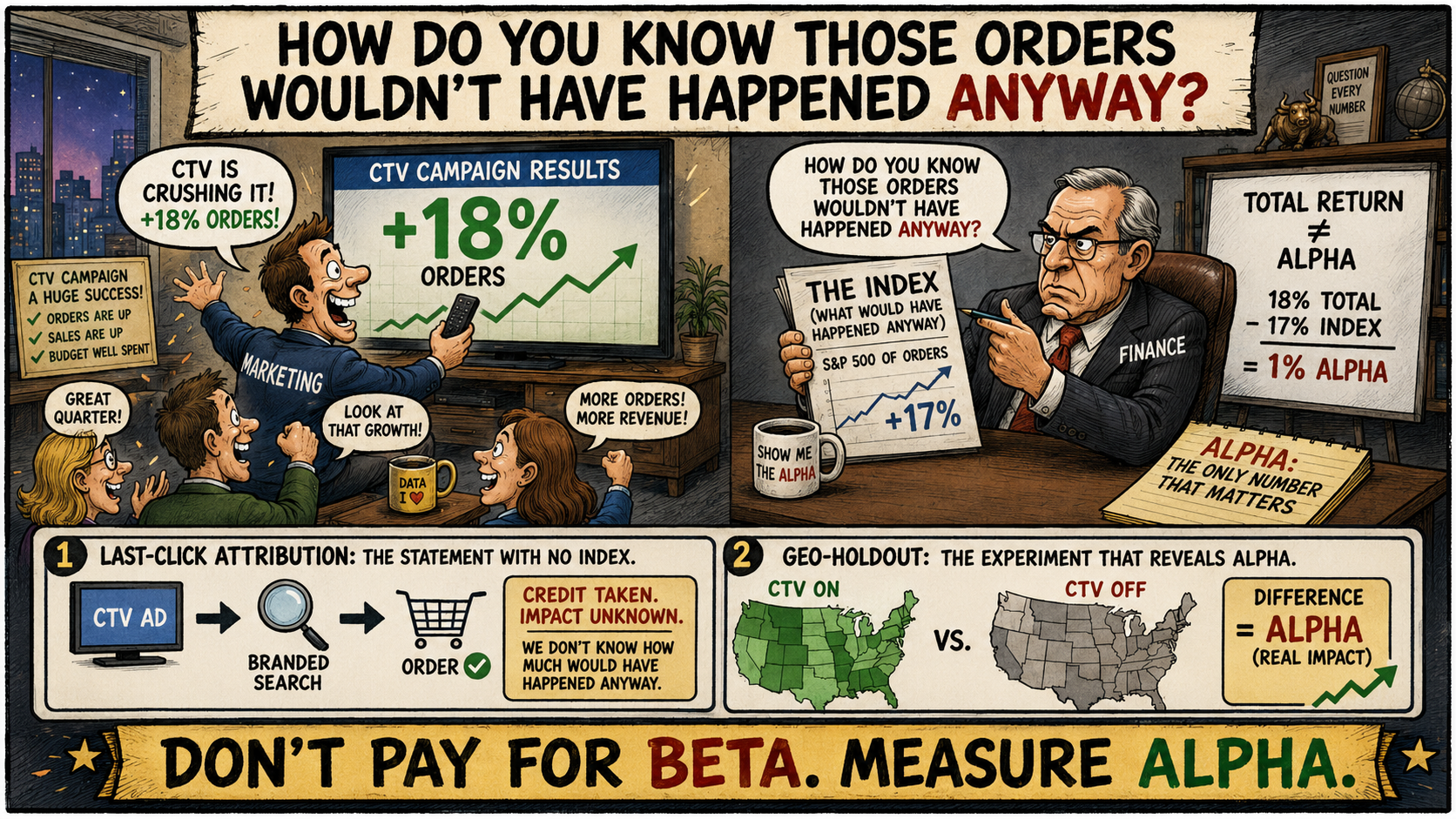
This is why the 2025 Stella benchmark — 225 controlled incrementality experiments — measured branded search at 0.70x incremental return while CTV came in at 3.30x. Branded search returns seventy cents on the dollar because it is not generating demand. It is collecting it. The dollar of demand was created somewhere upstream, and branded search is standing at the door taking credit for letting it in.
Seventy cents on the dollar is the financial signature of a cash register being paid like a salesman.
Why CTV Is Different From Facebook — And This Matters
Here is where the argument needs precision, because there is a real distinction and getting it right is what makes the position bulletproof.
Not all media is non-clickable. Facebook is clickable. Instagram is clickable. A paid social ad has a button. The customer can act on the impulse in the exact moment it strikes, without ever leaving the platform, without ever opening a second device.
So when a customer sees a Facebook ad, does not click it, and instead goes and searches for the brand later — that behavior carries information. They had the option to transact on the spot. They declined it. They chose to leave, comparison-shop, verify, think it over, and come back through a different door. That detour is meaningful. The customer's motive shifted somewhere between the impression and the search.
On clickable inventory, the search that follows is a partial signal. The platform deserves credit, but the search reveals that the journey was not a straight line, and the shared credit should reflect that.
CTV has no such ambiguity.
There is no button on the television. The customer could not have clicked even if every fiber of their being wanted to. The only path from "I want this" to "I bought this" runs through a search bar or a URL on another device. The detour is not a signal of hesitation. It is the only road that exists.
When a customer sees a CTV ad and then searches, they are not revealing a change of heart. They are doing the one and only thing the medium permits. Penalizing CTV for that search is like penalizing a highway billboard because the driver had to take the exit ramp to reach the store. The exit ramp did not sell anything. It was the only way off the highway.
Clickable inventory shares credit with the search because a click was possible and not taken.
Non-clickable inventory does not, because the search is not a competing path. It is the completion of the only path.
That is the distinction. It is defensible, it is precise, and it is the part most attribution conversations get lazily wrong.
Cost, Not Credit
None of this means branded search, organic, and direct are worthless. They are not. They have a real and necessary job.
They are the gateway. They complete the transaction. They make sure that when CTV sends a customer looking, the customer actually finds you, lands on a working page, and converts cleanly instead of bouncing to a competitor who showed up first.
That job has a cost. The paid branded click costs money. The SEO that protects your organic position costs money. The site infrastructure that catches direct traffic costs money.
So account for it as a cost.
If you want to assign the branded search spend as a line-item cost of fulfilling CTV-driven demand — a delivery fee, a tollbooth on the gateway — do it. That is honest. That is correct. The gateway is not free and pretending it is would be its own distortion.
But a cost is not a credit.
Charging CTV for the toll it takes to deliver a customer is fair. Crediting the tollbooth with creating the customer is not. The tollbooth did not build the car, fuel the trip, or choose the destination. It collected a fee at the end of a journey that started somewhere else.
Cost flows to the gateway. Credit flows to the channel that created the demand. Confusing the two is how brands end up defunding the thing that actually works in order to keep overpaying the thing that merely finishes.
What This Looks Like in an MTA Model
Multi-touch attribution is where this distortion does the most quiet damage.
A standard MTA model sees a customer journey and distributes credit across the touchpoints. CTV impression on Tuesday. Branded search click on Friday. Conversion on Friday. The model, trained to reward proximity to the conversion, hands the lion's share to the Friday search and a sliver — or nothing — to the Tuesday impression.
The model is not lying. It is doing exactly what it was built to do. It was just built on a clickstream assumption that breaks the moment a channel cannot be clicked.
A correct model inverts the default for CTV-driven journeys. When a CTV impression precedes a branded search or a direct visit, the search and the direct visit are not co-equal touchpoints competing for credit. They are the delivery mechanism. The credit belongs upstream, to the impression that set the journey in motion. The downstream navigational events are reclassified — from demand contributors to demand fulfillment.
This is not gaming the model. It is correcting a category error. Branded search and direct traffic are outputs of upstream demand, not inputs to it. A rising branded search volume is a symptom that CTV is working, the same way a rising fever is a symptom of an infection. You do not credit the thermometer with the fever.
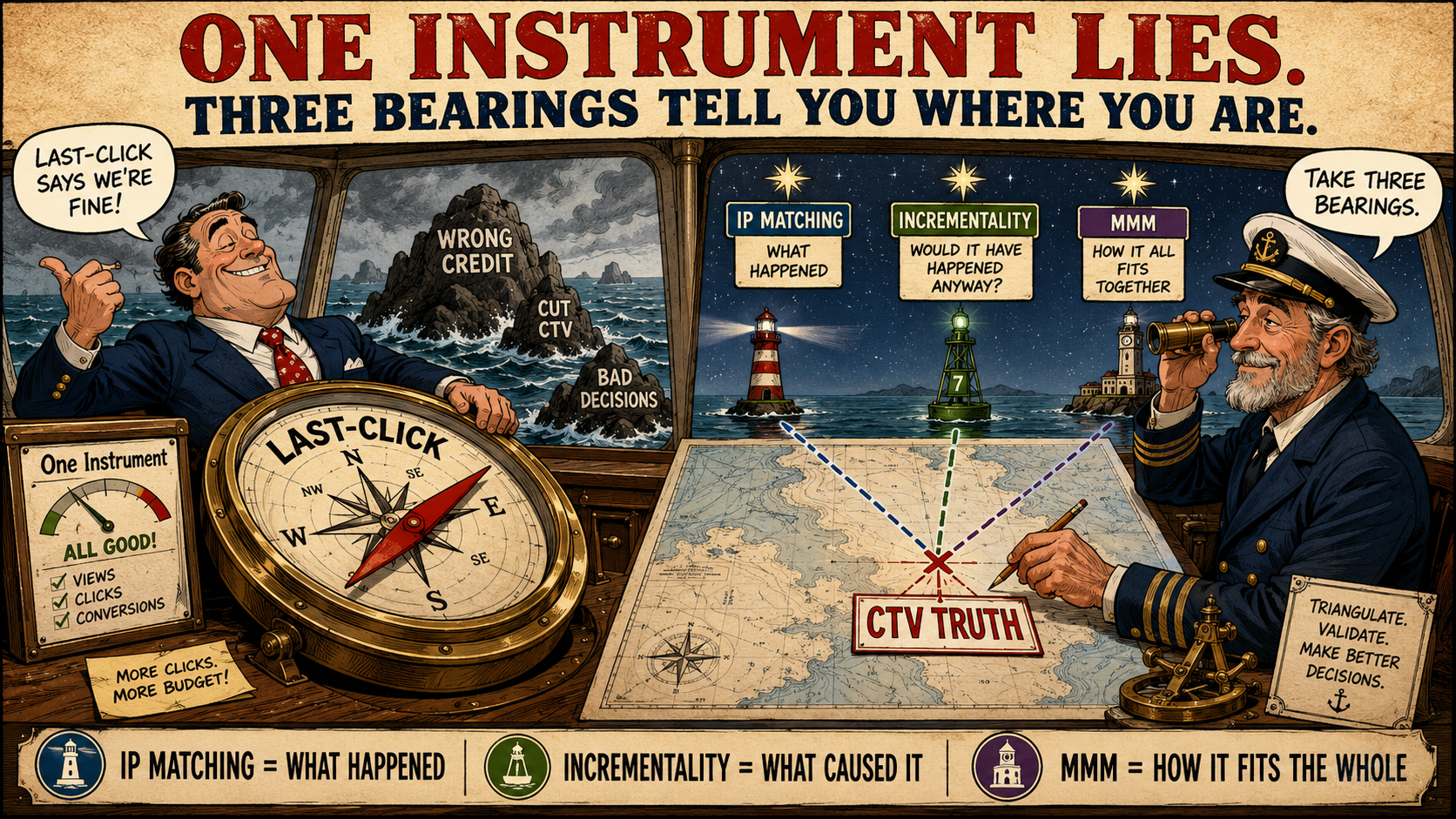
Treat branded search, organic, and direct as the instrument that reads the demand CTV created. Unify them into a single view. Then look honestly at what is actually driving net-new customers into the funnel — and in a CTV-led plan, the answer is almost never the search bar they walked through on the way in.
The Honest Caveat
One distinction keeps this airtight.
This applies to navigational traffic. Branded search — paid and organic — and direct-to-site. The searches where the customer already knows your name and is simply locating you.
It does not automatically apply to non-branded, generic search. When a customer searches a category term they have never associated with you — "best running shoes," "joint supplement for athletes" — and discovers you for the first time, that search may be doing real demand-capture work against demand you did not create. That is a different animal, and an honest model treats it differently.
The gateway argument is about the demand CTV created and search merely delivered. It is not a blanket claim that all search is worthless. It is a precise claim that navigational search, in a CTV-driven journey, is the cash register — not the salesman.
Make that distinction out loud, and no one can knock the position down. Skip it, and you hand the skeptics their counterargument for free.
The Final Take
A cash register is essential. No store runs without one. It completes the sale, takes the money, prints the receipt, and sends the customer home happy.
But no one has ever confused the cash register with the reason the customer walked in.
CTV is the reason the customer walked in. The television ad on the couch on Tuesday is the thing that created the want. Branded search, organic, and direct are the register at the front of the store — the gateway the customer passes through to hand you their money for a decision that was already made.
Charge CTV for the gateway if you like. The toll is real. Account for it honestly.
But stop crediting the gateway with the sale.
Stop letting a last-click model defund the channel that created the demand in order to keep overpaying the channel that merely collected it.
And the next time a dashboard tells you branded search drove the conversion, ask the only question a Fortune 500 CMO already had the nerve to ask out loud.
Are we giving the cash register credit for the sale?
Cory Poccia CEO, CS & Co. Marketing Studio™