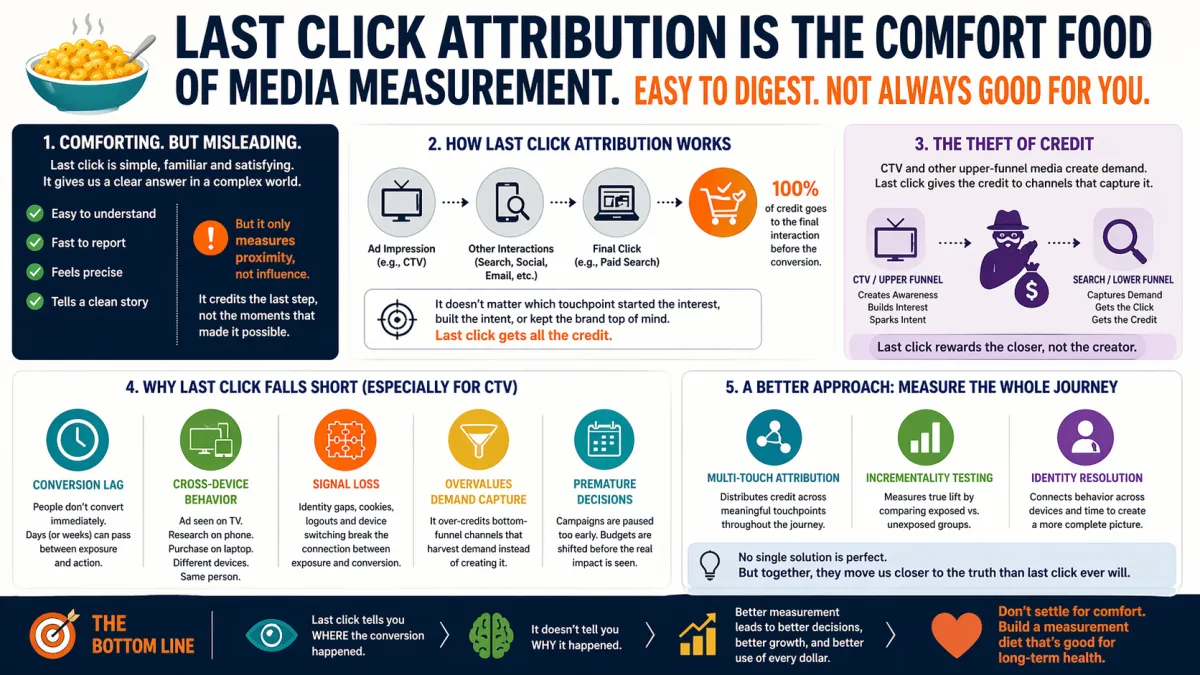
Last Click Attribution Is the Comfort Food of Media Measurement
Last Click Attribution Is the Comfort Food of Media Measurement
Easy to digest. Not always good for you.
(Thank you Lupe Jimenez inspiring this insight)
In performance marketing, few ideas are as widely accepted—and as quietly misleading—as last click attribution.
It’s simple. It’s fast. It produces clean answers.
And that’s exactly the problem.
Last click attribution, a model that assigns 100% of conversion credit to the final interaction before a purchase, has long been the default across digital platforms. It tells a straightforward story: a user clicks an ad, takes an action, and that interaction gets the credit.
But as advertising shifts toward channels like Connected TV, that story is breaking down.
A Model Built for a Different Era
Last click attribution was designed for an environment where exposure and response happened in the same place—typically on a desktop browser.
That’s no longer how consumers behave.
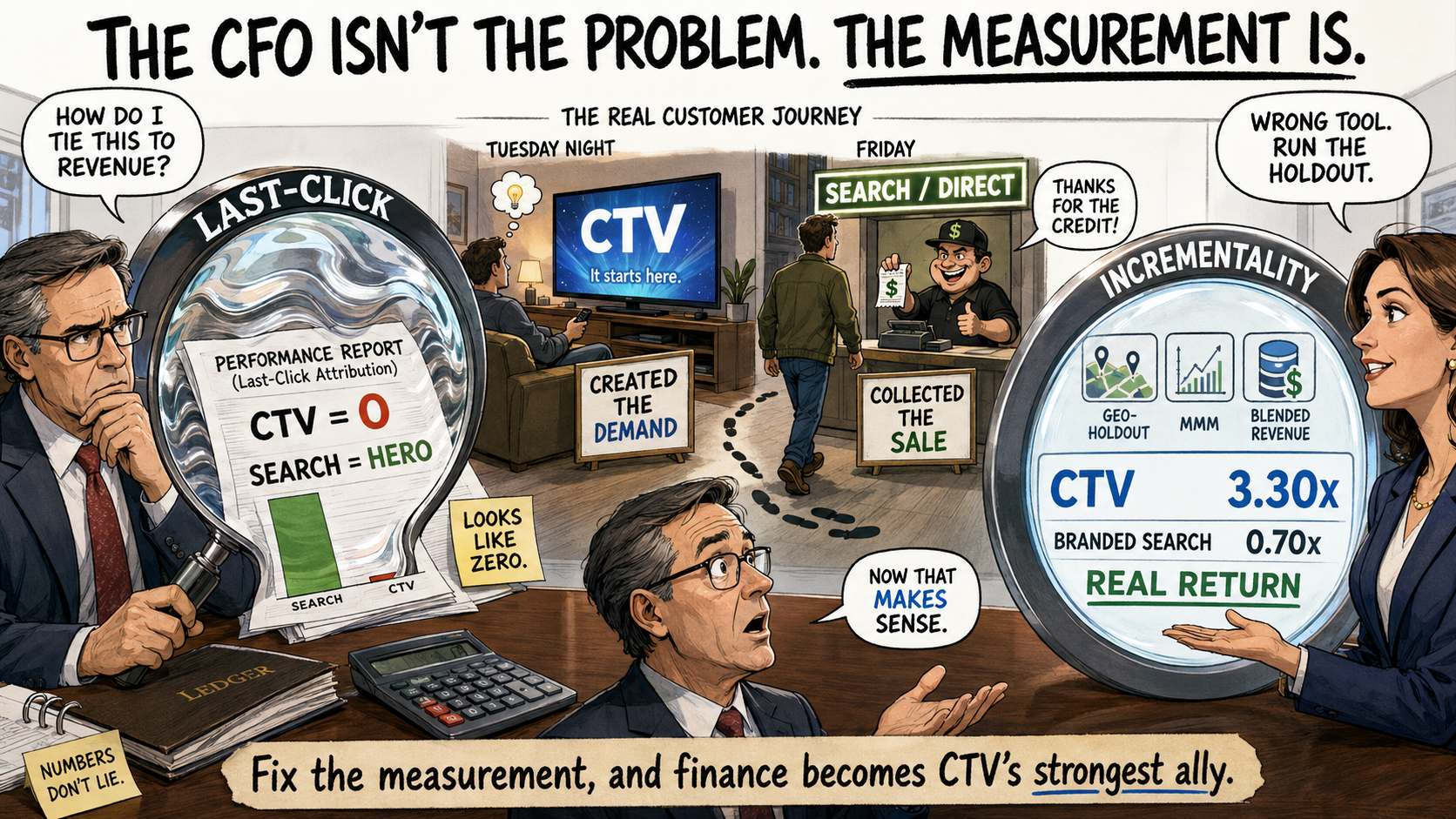
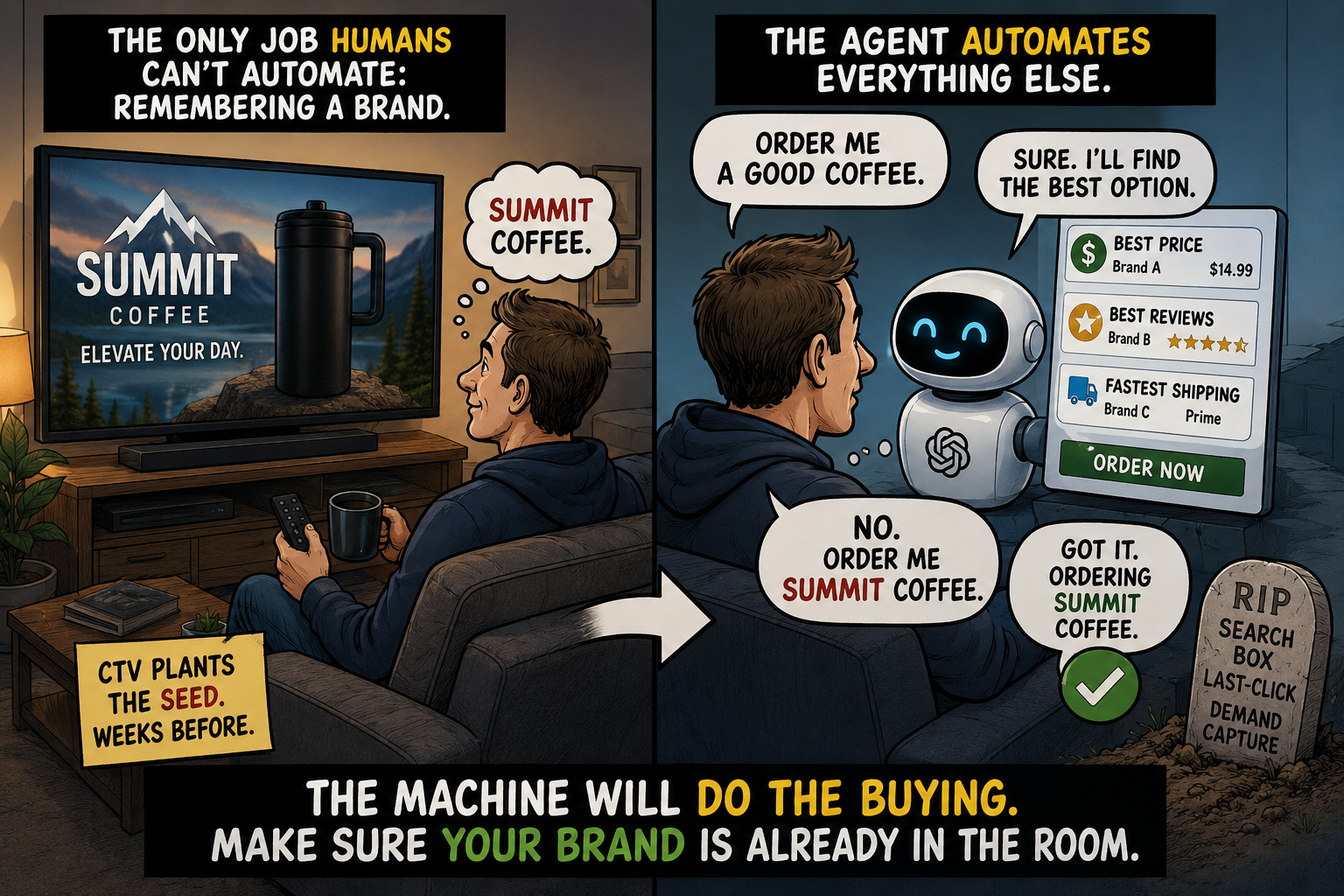
Today, a user might see an ad on a television screen, search for the product later on a phone, and complete a purchase days afterward on a laptop. The journey is fragmented, cross-device, and often delayed.
In that reality, the final click is rarely the full story.
Yet the model persists—largely because it remains easy to interpret.
The Illusion of Precision
Last click creates a sense of clarity in an increasingly complex ecosystem.
Search campaigns appear highly efficient. Retargeting looks indispensable. Bottom-of-funnel channels consistently “win.”
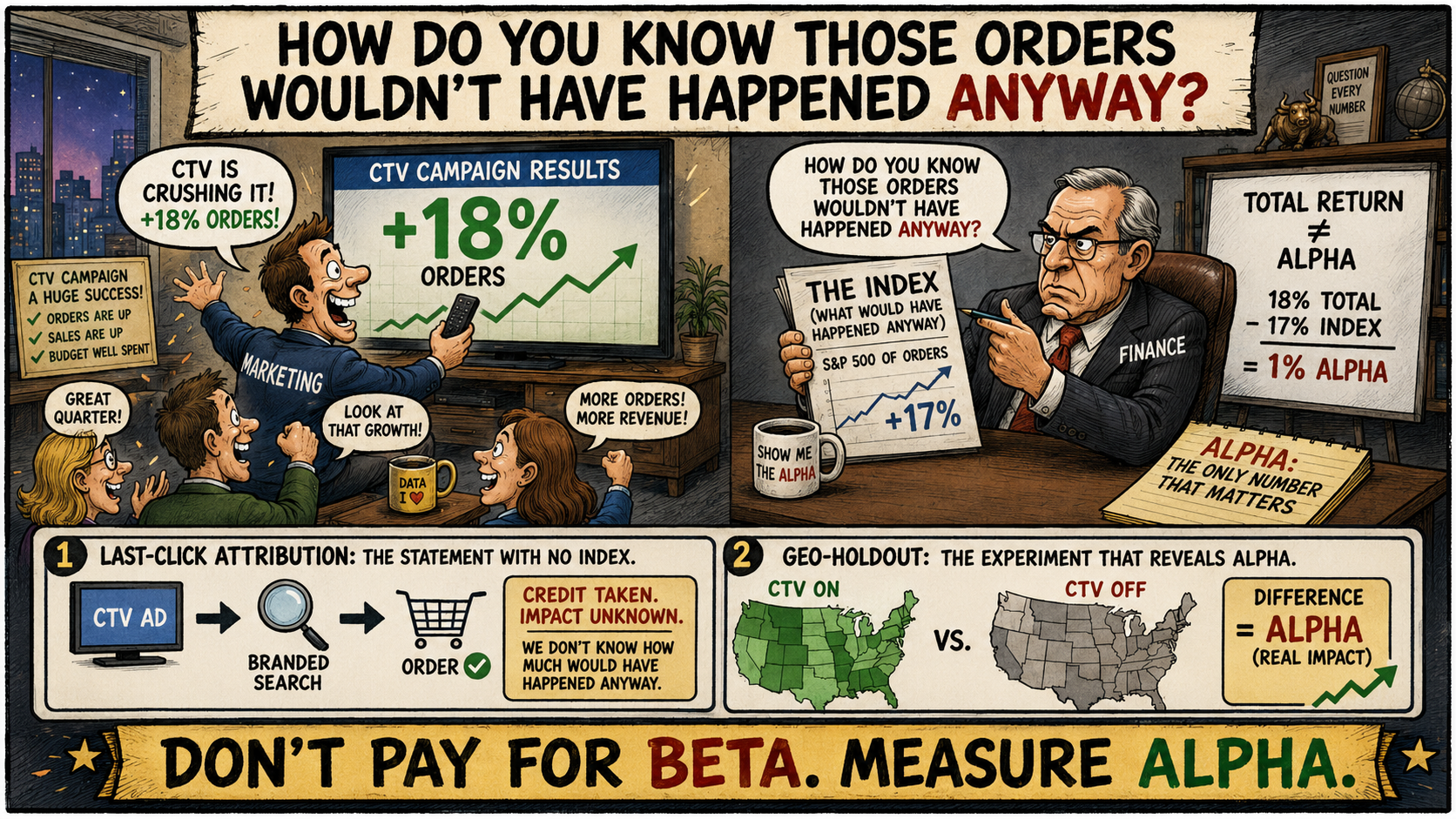
But what those numbers often reflect is not true performance—it’s proximity to the conversion.
In other words, last click doesn’t measure what influenced the customer. It measures what happened last.
That distinction becomes critical in channels like Connected TV, where ads are designed to create awareness, build intent, and drive future action—not immediate clicks.
CTV’s Measurement Challenge
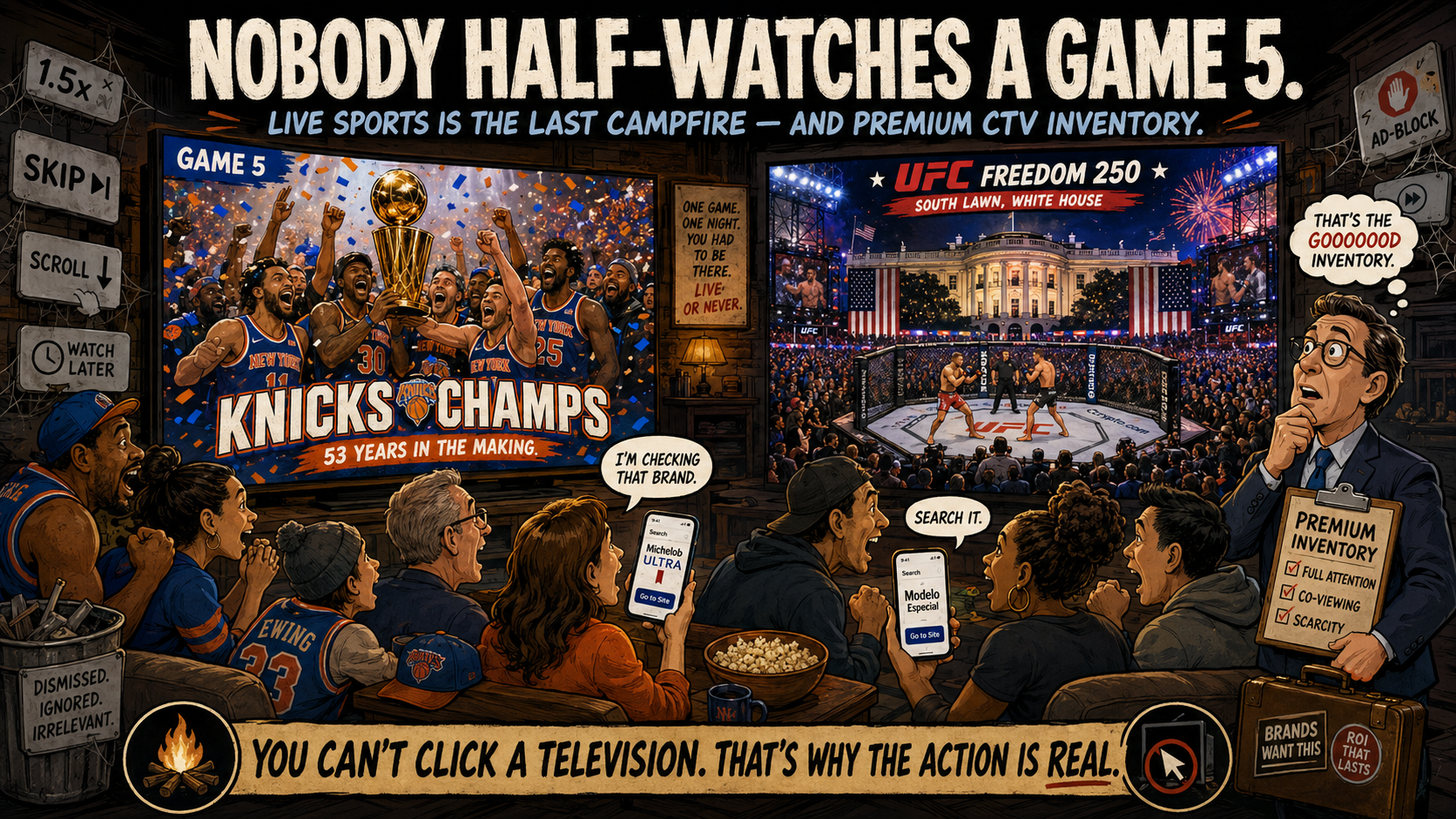
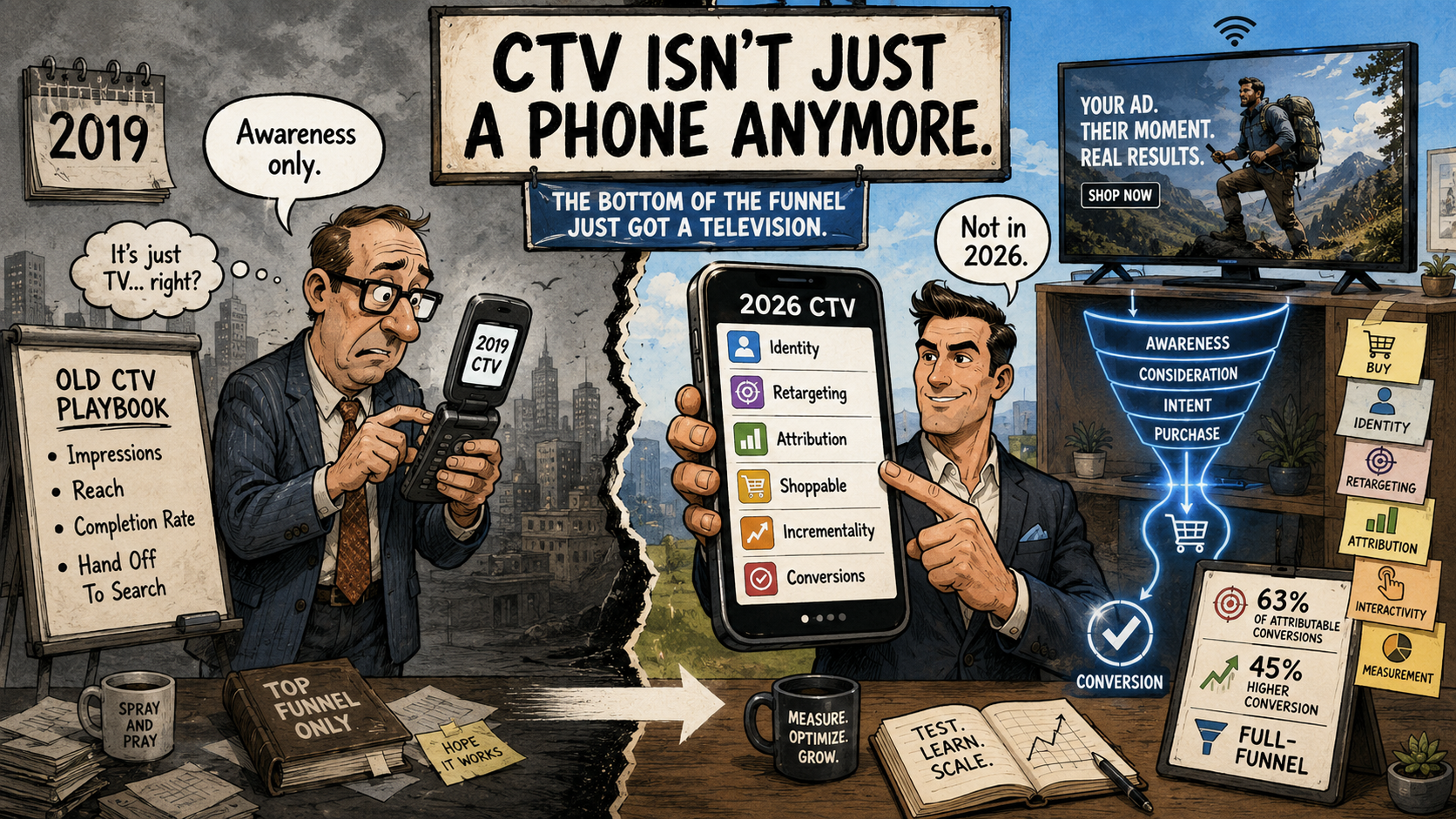
Unlike traditional digital formats, CTV ads are typically not clickable. Viewers are exposed to messaging in a lean-back environment, often far removed from the moment of response.
When they do take action, it frequently occurs on a separate device and at a later time.
This creates what marketers refer to as an “attribution gap”—a disconnect between the channel that influenced the decision and the channel that receives credit for the outcome.
As a result, CTV can appear underperforming in last click models, even when it is actively driving demand.
The Timing Problem
Another limitation of last click attribution is its inability to account for conversion lag.
Consumers rarely act immediately after exposure—particularly in categories that require consideration. Days or even weeks can pass between the initial impression and the final purchase.
In fast-moving reporting cycles, that delay can lead to premature conclusions.
Campaigns are paused. Budgets are shifted. Channels that require time to perform are judged too early—and often incorrectly.
Cross-Device Behavior Complicates the Picture
The rise of multi-device usage further challenges last click attribution.
A consumer might encounter an ad on television, research the product on a smartphone, and complete the transaction on a desktop. Without robust identity resolution, these interactions can appear unrelated.
The result is signal loss—where meaningful touchpoints are disconnected from the final outcome.
For channels like Connected TV, where cross-device behavior is the norm rather than the exception, this fragmentation can significantly distort performance measurement.
Why Marketers Still Rely on It
Despite its limitations, last click attribution remains widely used.
Part of the reason is operational: it’s fast, accessible, and easy to explain to stakeholders.
But there’s also a psychological component.
In a complex media landscape, last click provides a sense of control. It offers definitive answers in a system that is anything but definitive.
It simplifies decision-making—even if that simplification comes at the cost of accuracy.
A Shift Toward Better Measurement
As the limitations of last click attribution become more apparent, marketers are exploring alternative approaches.
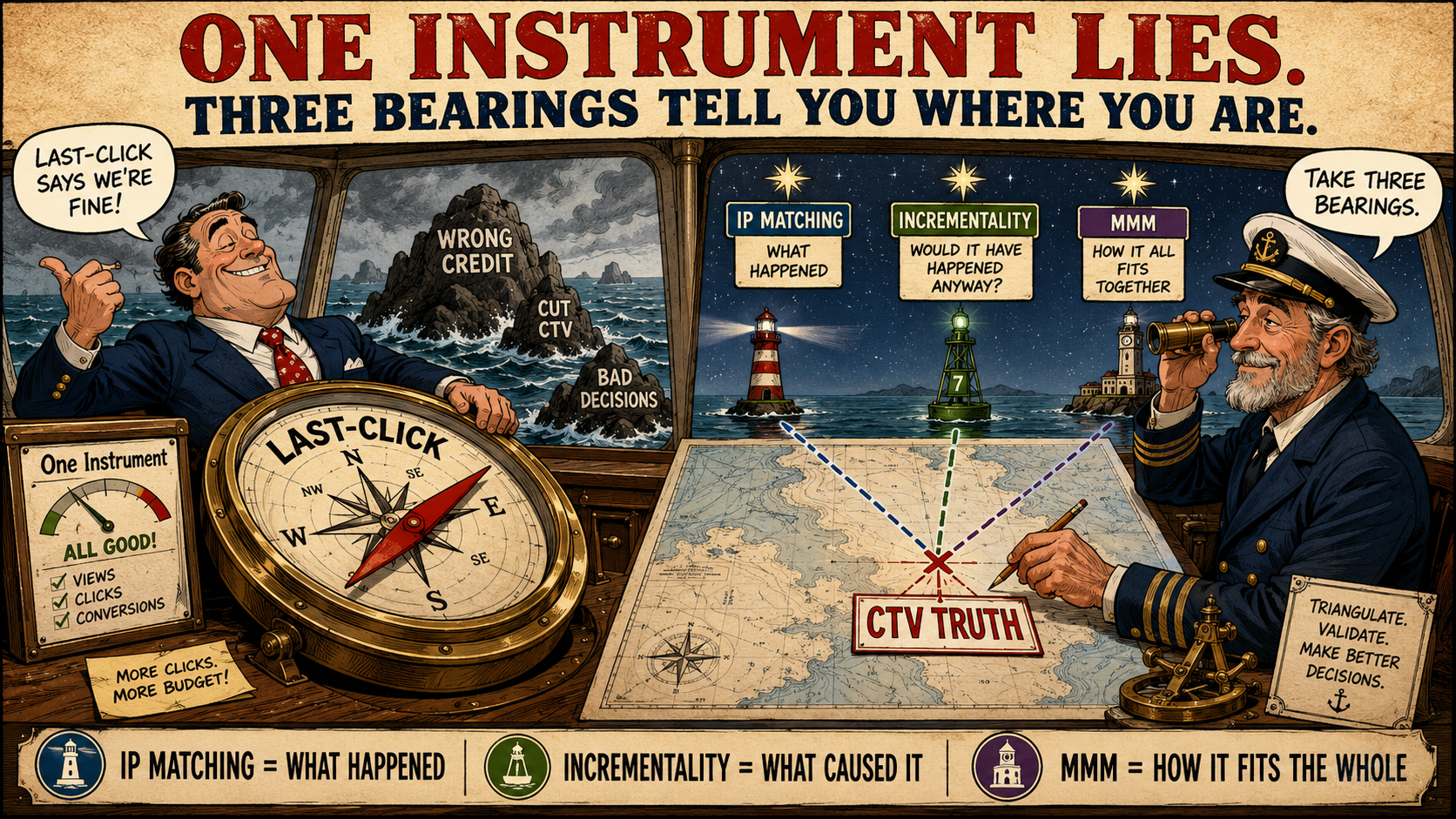
Multi-touch attribution models attempt to distribute credit across the customer journey. Incrementality testing focuses on measuring true lift by comparing exposed and unexposed groups. Identity graphs aim to connect behavior across devices.
None of these methods are perfect. Each comes with its own assumptions and trade-offs.
But they reflect a broader shift: a recognition that modern media cannot be measured through a single interaction.
The Bottom Line
Last click attribution isn’t inherently wrong.
It’s incomplete.
It provides a useful view of where conversions end—but offers little insight into where they begin or what drives them.
In an ecosystem increasingly shaped by channels like Connected TV, where influence often precedes action by days and devices, that limitation is becoming harder to ignore.
The model still works as a directional tool.
But treating it as the full picture may be costing marketers more than they realize.
In the end, last click attribution behaves a lot like comfort food.
It’s easy to consume.
It feels satisfying.
But it doesn’t always deliver the nutrition needed for long-term growth.