
General Marketing
Gary Vee Just Described the Biggest Mistake Brands Make With CTV — Without Ever Mentioning It
Gary Vee gets 50 emails a day from people ready to quit after four months. Every CTV operator gets that email after four weeks. The early quiet isn't failure, it's demand being built underground. Play the long game and measure it right.
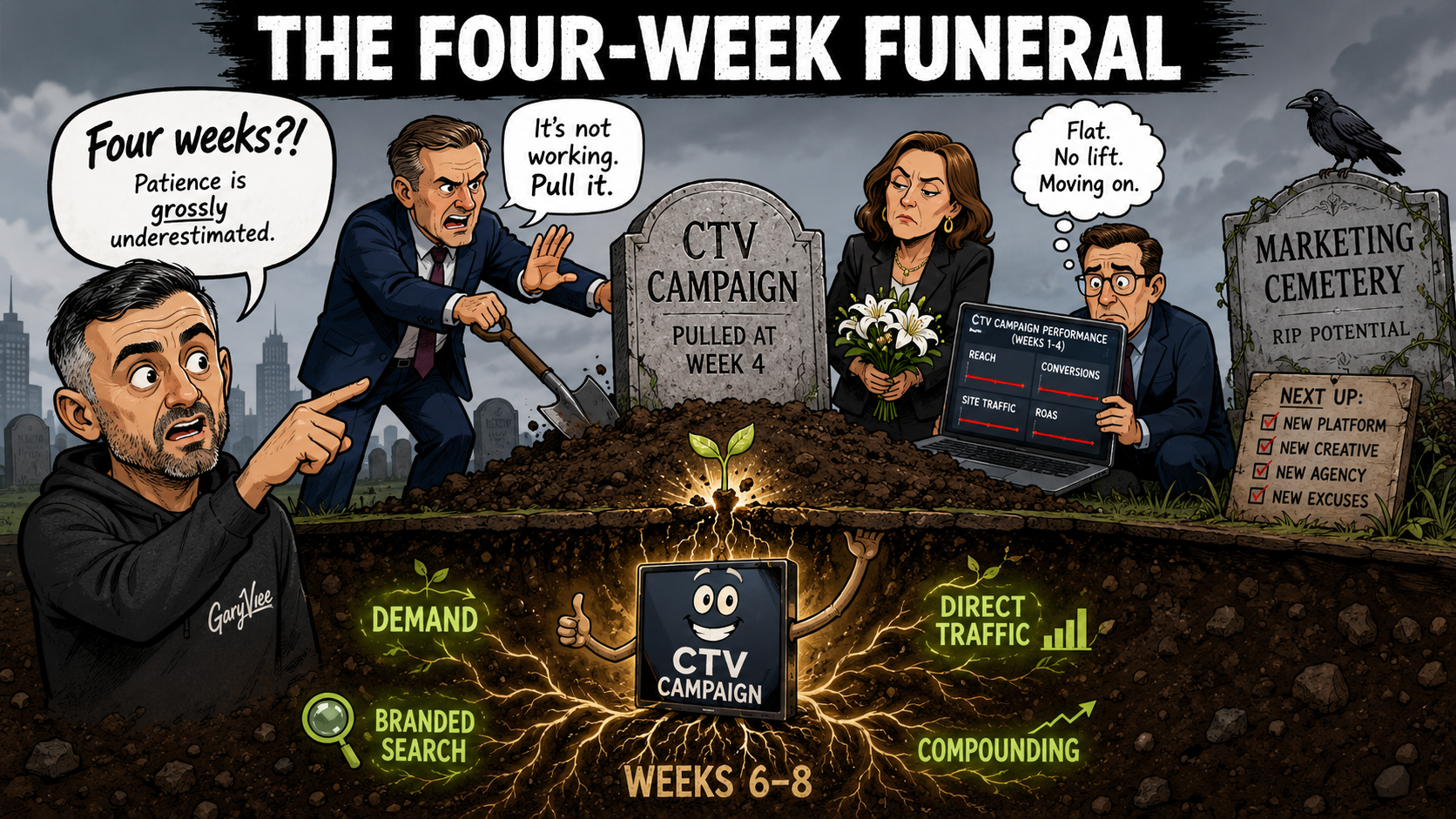
Gary Vaynerchuk posted something on LinkedIn this week that has nothing to do with advertising and everything to do with it.
He said he gets fifty emails a day from people asking whether they should quit — the thing isn't working, there's no traction, should they give up and try something else. So he asks them one question back: how long have you been doing it?
The answer, over and over, is some version of "four months."
His response is unprintable in polite company, but the point underneath it is the most important thing anyone can tell a marketer right now. As he put it: <cite>"Patience is grossly underestimated. There is no quick cure."</cite>
He was talking about building a business. A life. A career.
But swap "four months" for "four weeks," and he just described the single most expensive mistake brands make with Connected TV.
The Four-Week Funeral
Here is how it happens, and it happens constantly.
A brand launches a CTV campaign. Real budget, real creative, real intent. They're excited. They believe in it.
Then they open the dashboard on day three.
Nothing. A few impressions, a completion rate, and no flood of conversions tied neatly back to the ad. Day seven, still quiet. By week two, the doubt sets in. By week four, someone in a meeting says the words that kill more good campaigns than bad strategy ever has:
"It's not working. Let's pull it."
And they pull it. Four weeks in. Right before it would have started to work.
That is the four-week funeral, and it is the CTV version of the exact email Gary gets fifty times a day. Same impatience. Same premature surrender. Same fatal misunderstanding of how long real things take to compound.
The campaign didn't fail. It got buried alive.
Why CTV Specifically Punishes Impatience
Every channel rewards patience to some degree. CTV demands it, because of how the channel actually works.
You cannot click a television. There's no button on the screen, no instant tap-to-buy, no click that fires a conversion the second the ad ends. So CTV does not produce the immediate, traceable response that trained an entire generation of marketers to expect results by lunchtime.
What CTV does instead is plant demand.
The viewer sees your ad on a Tuesday. Nothing happens that you can measure that day. Then three days later, or a week later, or two weeks later, they search your brand, or type your URL, or walk into a store, or finally buy the thing they've been circling. The impression did its work. The work just showed up on a delay.
This is not a flaw. It is the nature of demand creation. CTV builds the wanting, and wanting takes time to convert into buying. A channel that plants seeds cannot be judged on the schedule of a channel that harvests them.
But here's the trap. Because the payoff is delayed, the day-two dashboard always looks like failure. Always. Even for the campaigns that will go on to be the best-performing money the brand spends all year. The early numbers on a working CTV campaign and a failing one look nearly identical — because the working one hasn't had time to pay yet.
So the brand that judges CTV on the first snapshot will pull the winners and the losers at the same time, for the same reason, and never know the difference. They're not measuring performance. They're measuring their own impatience.
The Data Rewards the Ones Who Wait
This isn't a motivational argument. It's a measurable one.
A meaningful share of the value a CTV campaign creates arrives after the impression, sometimes well after. In analysis of holiday-season campaigns, a large portion of the incremental conversions showed up in the days and weeks following exposure — value that any brand judging the campaign in real time would have thrown away as a failure.
The channel rewards a maturation curve. Cost per session starts high and trends down as the creative resonates and the audience builds. The first few weeks are the most expensive and the least productive by design — you are paying to establish presence before you see return. Brands that expect week one to look like week eight will always be disappointed, and always for the wrong reason.
The ones who stay in are the ones who get paid. Not because they're more patient as a personality trait, but because they understood the timeline of the channel and refused to bury a campaign that was still doing its job underground.
Gary said it about business: <cite>"This is a long, long game."</cite> CTV is the same game, on a compressed timeline, with the same rule. The people who quit early don't lose because the strategy was wrong. They lose because they quit before it could be right.
How to Actually Play the Long Game With CTV
Patience alone isn't a strategy. Blind waiting is just slow failure. The goal is disciplined patience — staying the course while measuring the right things, so you know the difference between a campaign that needs more time and one that genuinely isn't working. Here is how you do that.
Set the measurement window to match the channel. Judge search on a short payback because search harvests existing demand. Judge CTV on a longer one — think in terms of the full six-to-eight-week arc, not the first weekend — because CTV creates demand that surfaces on a delay. Deciding this before launch, ideally with your finance team in the room, turns the inevitable early-quiet period from a panic into an expected phase.
Watch the leading indicators, not just the lagging ones. While you wait for conversions to mature, watch the signals that tell you the campaign is working before the sales show up. Is branded search rising in the markets where CTV is running? Is direct traffic climbing? Is cost per session trending down week over week as the creative finds its audience? Those are the vital signs of a healthy campaign in its early weeks, and they move before the revenue does.
Measure incrementality, not just attribution. The last-click dashboard will always undercredit CTV, because the conversion happens somewhere the ad can't be clicked. The only honest read is a holdout — turn CTV off in one market, leave it on elsewhere, and compare. That tells you what the ad actually caused, and it's the number that gives you the confidence to stay in when the dashboard is trying to talk you out of it.
Give the creative time to breathe, then rotate it. A CTV spot doesn't hit its stride on the first impression, and it doesn't stay fresh forever. Let it run long enough to establish presence, watch for the point where the same creative starts to fatigue, and rotate before it goes stale. Patience is not the same as neglect. You stay the course and you tend it.
Do those four things, and patience stops being a leap of faith. It becomes a discipline backed by evidence — you stay in because the leading indicators tell you to, not because you're crossing your fingers.
Stop Looking for the One Move
There's a line in Gary's post that every marketer should tape to their monitor. He tells people to stop looking for the short game, stop looking for the miracle algorithm, stop looking for the one move that changes the outcome.
That is the whole disease of modern marketing in a sentence.
The brand hunting for the miracle campaign, the one channel, the single tactic that fixes everything — that brand will never build anything durable, because durable results don't come from one move. They come from the right moves, made consistently, given time to compound.
CTV is not a miracle. It's a compounding asset. Every week it runs, the audience builds, the data sharpens, the creative learns, the demand accumulates. The brand on its tenth week of a well-measured CTV program is not ten percent ahead of the brand on its first week. It's exponentially ahead, because the learning stacked and the demand compounded, and none of that can be bought back by the latecomer who wants it all in a month.
The one move you're looking for doesn't exist. The long game is the only game that ever worked.
The Final Take
Gary Vee gets fifty emails a day from people ready to quit after four months.
Every CTV operator gets the marketing version of that email after four weeks. The channel's quiet, the dashboard's flat, the doubt creeps in, and someone reaches for the plug — right before the demand they planted starts walking through the door.
Don't be that brand. The early quiet on a CTV campaign isn't failure. It's the sound of demand being built underground, before it breaks the surface. Judge it on the day-two dashboard and you'll bury your best campaigns alive.
Set the right window. Watch the leading indicators. Measure what the ad actually caused. Give it time to compound. And when the marketplace and the dashboard and the doubt are all telling you it's not working, remember that they said the same thing to every brand that eventually won.
Patience is grossly underestimated. There is no quick cure. This is a long, long game.
Play it. Put on your helmet. Get to work.
Cory Poccia CEO, CS & Co. Marketing Studio™