
General Marketing
The Empty House Myth: Why a Holiday Weekend Like the Fourth of July Is One of the Most Overlooked Windows in CTV
Comscore found streaming's share of ad time RISES through the holidays while cable's falls. So why do advertisers still go dark on the Fourth of July? The empty-house myth, and the cheap, captive CTV audience it leaves on the table.
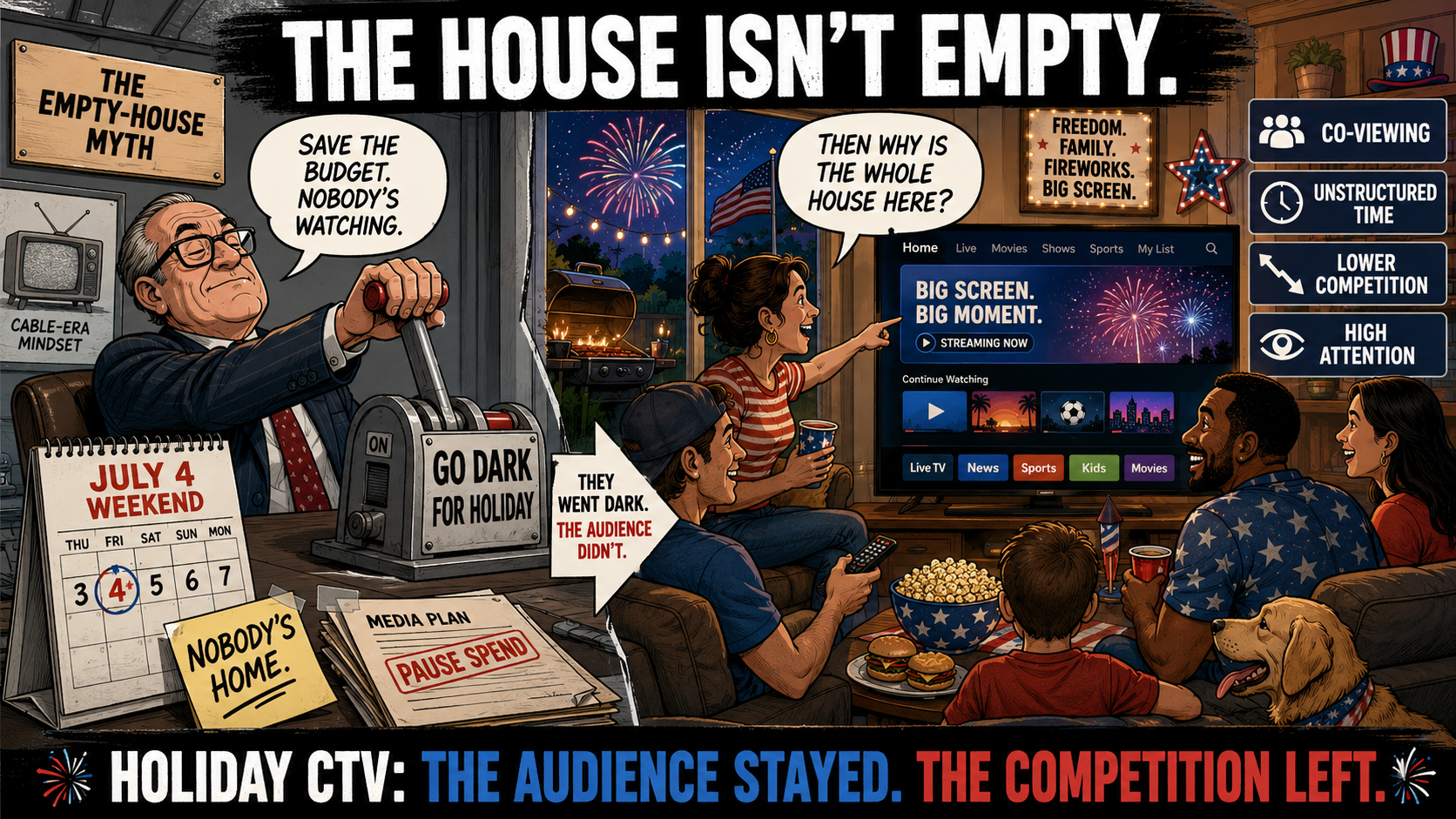
There's an old reflex in advertising that dies hard.
The holiday weekend approaches, and the media plan goes quiet. Pull back the spend. Nobody's home. Everyone's at the barbecue, at the beach, at the lake. Save the budget for a Tuesday when people are back at their desks paying attention.
It's a reasonable instinct. It's also, in the age of streaming, mostly wrong.
Because the picture in your head — the empty house, the abandoned screen, the country outdoors and unreachable — is a picture from a different era. It was true when television meant a cable box and appointment viewing. It is not true anymore. And the Fourth of July is the perfect place to see why.
The house isn't empty. It's just watching something different than it used to.
What Actually Happens to a Screen on a Holiday
Start with the thing nobody accounts for. Holidays change how people watch, and streaming is built for exactly the way they watch on a holiday.
A holiday weekend is unstructured time. No 9-to-5 rhythm. No school schedule. People are home in the middle of the day, up late at night, drifting in and out of the living room between the cookout and the fireworks. And when they sit down, they do not turn on linear TV and take what's scheduled. They open a streaming app and choose. A movie in the afternoon heat. A binge at midnight when the kids are down. A FAST channel running in the background while the family floats around the house.
That is streaming's home field. On-demand, choose-your-own, any-hour-of-the-day viewing is precisely what CTV delivers and precisely what linear cannot. So when the calendar frees people from their weekday structure, viewing does not disappear. It shifts — toward the platforms built for unstructured time.
And the data backs this up in a way that should stop every media planner who still goes dark on holidays. Comscore tracked national ad-time share across the back half of 2025 and found that streaming's share of ad time rose through the holiday period — climbing from 16 percent to 18 percent across a single quarter — while cable fell from 39 percent to 35. Their finding, stated plainly, is that the holiday period systematically lifts streaming's ad-time share.
The holidays don't empty the streaming house. They fill it.
The Fourth of July Is a Streaming Holiday Specifically
Now layer on what makes the Fourth different from any random summer weekend, because it compounds the effect.
The Fourth of July is a co-viewing holiday. It is families and friends gathered in groups, and groups gather around the biggest screen in the house. That matters enormously for CTV, because more than half of viewers already prefer to watch on the big screen, and a holiday pushes that behavior to its peak. One impression served into a Fourth of July living room is not one set of eyes. It is the whole party.
It is also a summer holiday, and summer is one of the longest, highest-spending stretches of the entire year. Even against inflation, a majority of Americans plan to travel over the summer, with budgets averaging in the thousands, and a sharpening focus on experiences over things. The Fourth sits right in the middle of that spending season — the weekend when people are actively deciding where to go, what to buy, what to grill, what to wear, and how to make the most of the time off. These are not checked-out consumers. They are consumers in active decision-making mode, with money allocated and choices still open.
And the country is nearly all streaming now. Roughly nine in ten US households have a connected TV device. Almost three-quarters of all TV viewing is ad-supported. Ninety-five percent of connected TVs now show advertising on the home screen the instant the set turns on — before the viewer picks anything. On a holiday, when the TV goes on early and stays on late, that is a lot of first impressions.
Put it together. A co-viewing holiday, in the highest-spending season, in a country that streams by default, watching in exactly the unstructured, on-demand way streaming was built for. That is not a weekend to go dark. That is a weekend the reach is unusually cheap and unusually captive, because half your competitors just pulled their spend on the empty-house reflex.
The Opportunity Hiding in Everyone Else's Retreat
Here's the part that turns an insight into an advantage.
Advertising is an auction. When demand drops, price drops. And when a large share of advertisers pull back on a holiday weekend — because they're still operating on the empty-house assumption — they take their demand out of the auction with them. The brands that stay in are bidding against a thinner field for an audience that did not leave.
That is the opening. Lower competition for premium inventory, in front of an audience that is home, relaxed, co-viewing on the big screen, and in an active spending mindset. The reflex to go dark on holidays was built for a world where the audience actually left. In the streaming world, the audience stayed and the competition left instead. The advertisers who understand that inversion get premium attention at a discount, precisely when their rivals have vacated the field.
You do not want to be the brand that went quiet during one of the few weekends the whole household is gathered around the screen with time to spare and money to spend.
But Only If the Creative Fits the Moment
Here is the discipline that separates a smart holiday CTV play from a wasted one. Showing up is not enough. You have to show up right.
A holiday audience is in a specific mood — relaxed, social, celebratory, present. Creative built for a stressed Tuesday commuter lands wrong in that room. The work that performs on a holiday weekend matches the version of the holiday the viewer is actually having. It sells the feeling, not the spec sheet. It reads the room.
That does not mean every brand needs a flag-waving, fireworks-and-sparklers spot. Leaning too hard into the holiday can be as tone-deaf as ignoring it. It means the creative should feel like it belongs in the moment — summer, gathering, ease, celebration — without pandering to it. The brands that win the holiday screen are the ones whose message feels native to the mood of the person watching, not transplanted from a different week.
And because a holiday weekend is a distinct moment, it rewards fresh creative rather than the same tired flight you've been running since May. The same spot shown for the tenth time does not get more persuasive because it's the Fourth of July. Match the moment, keep it fresh, and the captive holiday audience becomes a genuine advantage instead of wasted frequency.
The Measurement Reality Check
One honest note, because it protects the whole strategy.
A holiday weekend will not always produce a clean, same-day spike you can point to in a dashboard. CTV rarely does — it creates demand that surfaces days later, and a holiday adds its own timing quirks, with some purchases happening in the moment and others waiting until the trip is booked or the workweek returns. If you judge a Fourth of July CTV flight by Saturday morning's last-click numbers, you will almost certainly misread it.
Measure it the way CTV should always be measured. Watch the lift across the full window, not the holiday itself. Watch branded search and direct traffic in the days during and after. If you can, read it against a market or audience you held out. The holiday impression does its work on the holiday. The result often shows up when the fireworks are over and the wallet comes back out.
The point is not that the Fourth produces instant conversions. The point is that it produces cheap, captive, high-attention reach into a spending-minded audience — and that reach pays off across the window if you measure the window.
The Final Take
The empty-house myth is one of the most expensive reflexes left in advertising.
It made sense once. In the cable era, a holiday meant the audience got up and left the television behind. So the money left too, and everyone learned to go quiet on the long weekends.
But the audience does not leave anymore. It just changes what it's watching and how. On the Fourth of July, the country is home in unstructured time, gathered in groups around the biggest screen in the house, streaming by default, in the middle of the highest-spending season of the year — and half the advertisers have vacated the auction on an instinct that expired a decade ago.
That is not dead air. That is a captive, co-viewing, spending-minded audience available at a discount, on the exact channel built for the way people watch on a holiday.
The house isn't empty. It never was. It's full of people on the couch, remote in hand, deciding how to spend a long weekend and the money that comes with it.
The only question is whether your brand is on the screen when they look up — or whether you went dark because you were still picturing a living room from twenty years ago.
Cory Poccia CEO, CS & Co. Marketing Studio™