CTV News
Cannes Lions 2026: The Year the Machine Learned to Sit Down and the Human Stood Back Up
The full Cannes Lions 2026 recap: the Grand Prix winners, the dominant themes, the AI moment that split the room, and the quiet place streaming finally showed up — not as a category, but as the canvas everything else now runs on.
Every June, the advertising industry packs itself onto a strip of French coastline, fans itself against a heatwave, and tries to answer one question without ever asking it out loud.
What is creativity worth now?
This year the question had an edge to it, because the thing everyone was whispering about could, for the first time, hold the pen itself. AI was no longer the topic at the edge of the room. It was in the room, on the stage, and in some cases on the trophy.
And yet, when the dust settled on the 73rd Cannes Lions International Festival of Creativity, the work that won was not a monument to the machine. It was a monument to the human. A village pub. A pair of old friends in two chairs. A running shoe built for a community the industry had ignored for decades.
The machine learned to sit down at the table. The human stood back up.
Here is what actually happened — the winners, the themes, the AI moment, and the quiet place where streaming finally showed up.
First, a Festival That Got Harder to Win
Something changed this year before a single Lion was handed out.
Entries were down roughly 25 percent from last year. Part of that was the lingering shadow of last year's controversy, when a Grand Prix was withdrawn after AI-generated content turned out to have fabricated a campaign's results. But a bigger part was deliberate. Cannes toughened its awards criteria, raised the bar, and tightened the rules.
The industry should welcome that. A Cannes Lion is one of the most coveted prizes in commercial creativity, and scarcity is the whole point of a prize. When fewer entries clear a higher bar, the win means more. The festival did not get smaller this year. It got harder. And harder is the right direction for an award that wants to keep meaning something in an age when anyone can generate a thousand executions before lunch.
That single decision — make it harder, not bigger — turned out to be the quiet theme under all the others.
The Winners: Where the Gold Actually Went
The Grand Prix is the crème de la crème, the top of each category, and this year's list told a clear story about what the industry chose to celebrate.
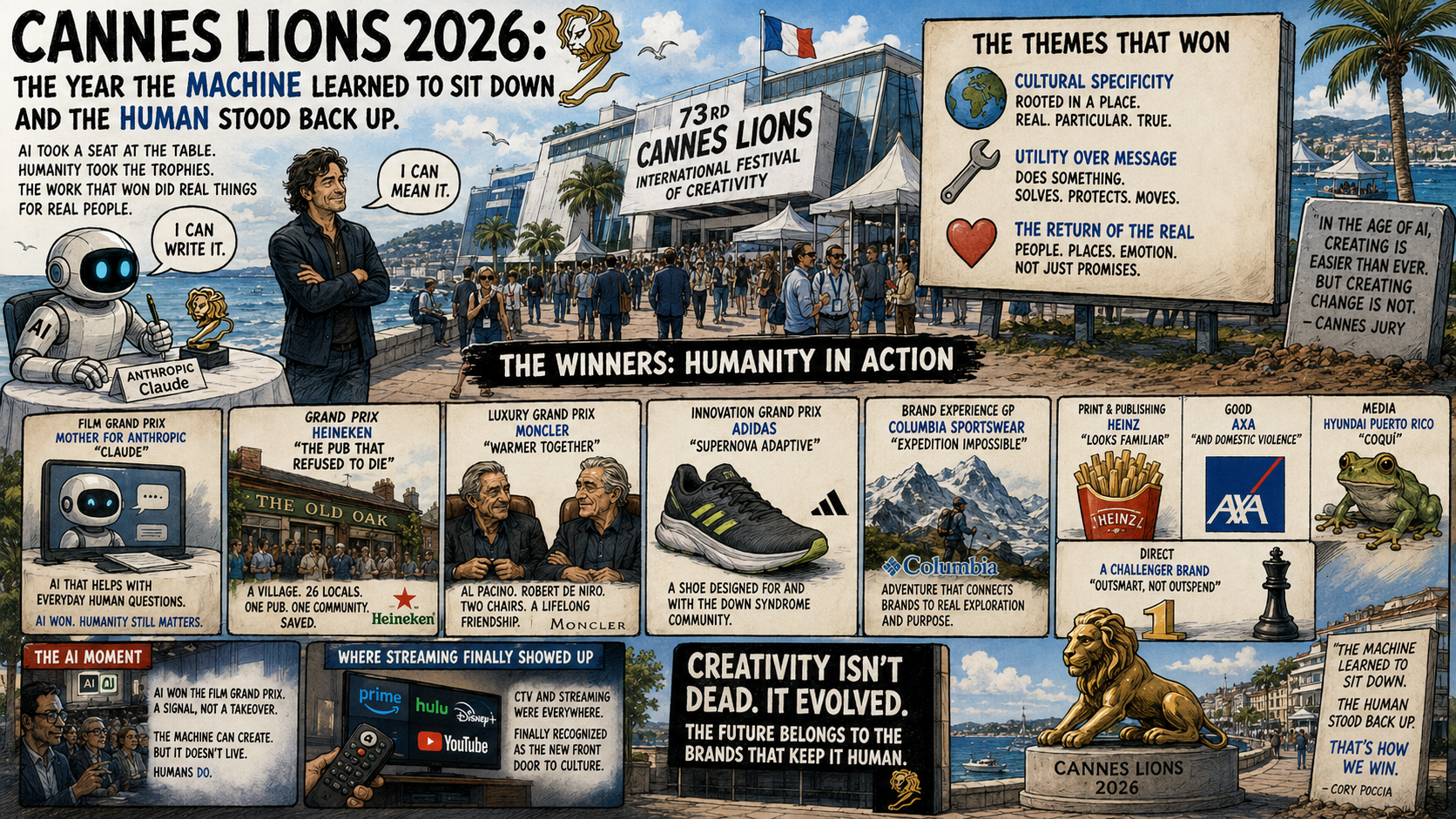
The Film Grand Prix went to Mother for Anthropic's Claude — two ads showing how an AI chatbot helps with the small, ordinary questions of everyday life. Hold that one. We will come back to it, because the most cinematic, most human category at the entire festival handing its top prize to an AI company is the single most loaded result of the week.
Heineken won big again, as Heineken does. "The Pub That Refused to Die," a documentary tracing the last pub in an Irish village saved from closure by twenty-six residents who bought it back themselves, took a Grand Prix — a story about community, physical place, and people refusing to let something human disappear.
Luxury went to Moncler's "Warmer Together," built on nothing flashier than Al Pacino and Robert De Niro in two chairs, two lifelong friends, the warmth coming entirely from the bond between them. The jury president called it proof that simplicity, when deeply human, is the ultimate expression of luxury.
Innovation went to adidas for "Supernova Adaptive," a running shoe designed with and for the Down syndrome community, a group with genetic foot differences that make sport difficult. The jury framed it perfectly for the moment: in the age of AI, creating is easier than ever, but creating change is not. They judged on a shift from proof of concept to proof of change.
The Brand Experience Grand Prix went to Columbia Sportswear's "Expedition Impossible." Heinz took Print and Publishing for "Looks Familiar," the gorgeously simple observation that fry boxes around the world already look like the Heinz logo. AXA returned to win for adjusting insurance policies to cover domestic violence with three added words — "and domestic violence" — across every contract it held. Hyundai Puerto Rico replaced its rental-car unlock beep with the song of the Coquí frog to defend a piece of local culture. A challenger brand won Direct by choosing the most expensive advertising day of the year not to outspend the competition, but to outsmart it.
Look at that list as a whole and a pattern jumps out. Almost none of it is about technology. It is about place, community, disability, dignity, culture, and human connection. The work that won was work that did something in the real world for real people.
The Themes: Culture, Utility, and the Return of the Real
Three currents ran under the whole festival.
The first was cultural specificity. The work that traveled best was the work most rooted in a specific place — an Irish village, a Puerto Rican frog, a Brazilian football pitch turned into a scannable barcode for discounts. In a year when AI can generate infinite generic content at zero cost, the most valuable thing a brand could be was specific. Particular. From somewhere. The global winners were intensely local, and that is not a coincidence. Specificity is the one thing the averaging machine cannot fake.
The second was utility over message. Jury presidents kept rewarding work that did something rather than just said something. The Media Grand Prix jury praised work that turned the product itself into the communications platform and "collapsed the traditional funnel." The Innovation jury demanded "proof of change," not proof of concept. The industry is tiring of campaigns that are merely clever and rewarding campaigns that are useful — that solve a real problem, protect real people, or move society an inch forward.
The third was the return of the real. The pub. The two chairs. The factory floor where the adidas shoe got built. After a few years of metaverse promises and AI demos, the work that won this year was grounded, physical, tactile, and emotionally true. The pendulum swung back toward the human, hard, and the trophies followed it.
The AI Moment: More Nuanced, Less Polarized, More Loaded Than Ever
AI was, in the words of one on-the-ground report, on the menu in lashings. It was the dominant conversation of the week. But something had shifted in how the industry talked about it.
The conversation got more nuanced and less polarized. Last year, AI at Cannes was either salvation or apocalypse, a fight between true believers and doomsayers. This year the tone matured into something more useful — less about whether AI is good or evil, more about where it actually helps and where it actively hurts.
But the peace was uneasy, and the festival exposed the fault line in real time. When it was announced that Google DeepMind would invest 75 million dollars into the indie film company A24, the backlash was immediate. DeepMind's Demis Hassabis took the stage to argue the investment would enable more creative risk-taking. Plenty of creatives in the audience heard something else entirely — a technology company buying its way into the last places human storytelling still felt safe. The divide is not healed. It is just quieter, and more complicated.
And then there is the result that says everything. The Film Grand Prix — the most cinematic, most emotionally demanding, most human category at the entire festival — went to a campaign for an AI company. Mother's work for Anthropic's Claude won not by showing off what the machine can generate, but by showing the machine being quietly, humanly useful in everyday life.
Sit with the layers of that. The industry's most prestigious storytelling prize went to an AI brand, for a story about AI being helpful, made by humans, judged by humans, celebrated for its humanity. AI did not win Film by replacing the filmmakers. It won by being the subject the filmmakers made human.
That is the whole tension of 2026 in a single trophy. AI is the tool. AI is the subject. AI is the threat. AI is the client. And the winning move was not to fight that or surrender to it, but to make it human — to put the machine in the service of an ordinary, recognizable, deeply human moment.
The lesson the smartest brands took home from Cannes is not "use more AI" or "use less AI." It is that AI is now part of the story, and the brands that win are the ones who keep a human hand on the pen.
Where Streaming and CTV Showed Up
Here is the part the trophy lists mostly buried, and the part that matters most for where advertising actually lives now.
CTV did not win a Grand Prix named after it, because there is no Grand Prix named after it. And that, ironically, is the tell. Streaming has stopped being a category you single out and become the substrate the work simply runs on. The question at Cannes is no longer "is this a CTV campaign." The question is whether the idea is good, and then it runs on the biggest screen in the house as a matter of course, the same way it runs everywhere else.
Look at how the winning work was actually built. Heinz extended "Looks Familiar" across print, out-of-home, digital, social, influencer, Uber Eats integrations, and restaurant tie-ins — a connected system, not a single spot, with video living across every screen including the living room. The Novartis prostate-cancer campaign ran, in the jury's own words, "from the Super Bowl to Social to PR" — a sentence that quietly describes the modern video funnel, anchored by premium streaming-era television and rippling out from there. The Media Grand Prix went to work that "collapsed the traditional funnel" by turning the product into the platform.
That phrase — collapsing the funnel — is the streaming story in disguise. The old model separated brand television at the top from performance digital at the bottom. The work winning at Cannes in 2026 refuses that separation. It is full-funnel by design, and CTV is the connective tissue, the place where the brand-building emotional impression and the measurable, addressable, data-rich delivery finally live on the same screen.
The Film Grand Prix itself makes the point. Where does a film ad for Claude actually reach people at scale in 2026? Not primarily on linear appointment television. On streaming. On the connected screen. The most awarded film work of the year is, in its natural habitat, CTV inventory — it just isn't labeled that way anymore, because it no longer needs to be.
That is what arrival looks like. Not a category of its own. The default canvas under everyone else's.
What a Brand Should Actually Take Home From Cannes
Strip away the rosé and the yacht parties and the heatwave, and the festival left a few hard, usable lessons.
Be specific, because specificity is the one thing the machine cannot counterfeit. The work that won was rooted in a real place, a real community, a real human truth. In a world drowning in infinite generic content, particularity is the new premium.
Be useful, not just clever. The juries rewarded proof of change over proof of concept, products that became platforms, campaigns that solved a real problem. Cleverness is now cheap. Usefulness is the differentiator.
Keep a human hand on the pen. AI is in the work now, permanently, as tool and subject and collaborator. The winners did not pretend it away and did not surrender to it. They put it in service of something human. The brands that win the next decade will be the ones who use the machine without letting it averaging-out the soul of the thing.
And build for every screen as one, because the funnel has collapsed and the living-room screen is where the emotional and the measurable now meet. The best work of 2026 was not a TV idea or a digital idea. It was one idea, told everywhere, anchored on the screen people actually watch. That is the canvas now. Plan for it on purpose.
The Final Take
Cannes Lions 2026 was supposed to be the year the machine took over.
Instead, it was the year the machine learned to sit down at the table and the human quietly stood back up. The trophies went to a village pub, two old friends in two chairs, a shoe built for a community the industry forgot, and an AI brand celebrated for making the machine feel human.
The festival got harder to win, and the work got more human to compensate. AI moved from the edge of the conversation to the center of it, and the smartest response was not to fight it or worship it, but to keep a hand on the pen. And streaming stopped being a category and became the canvas — so woven into how great work reaches people that nobody bothered to name it anymore.
That is the real story of Cannes 2026. Not the rise of the machine. The reassertion of the human, on the biggest screen in the house, with the machine finally in its proper place.
In service. Not in charge.
Cory Poccia CEO, CS & Co. Marketing Studio™