
General Marketing
Are You Ready for Prime Day, or Are You Just Bidding Against Everyone Who Is?
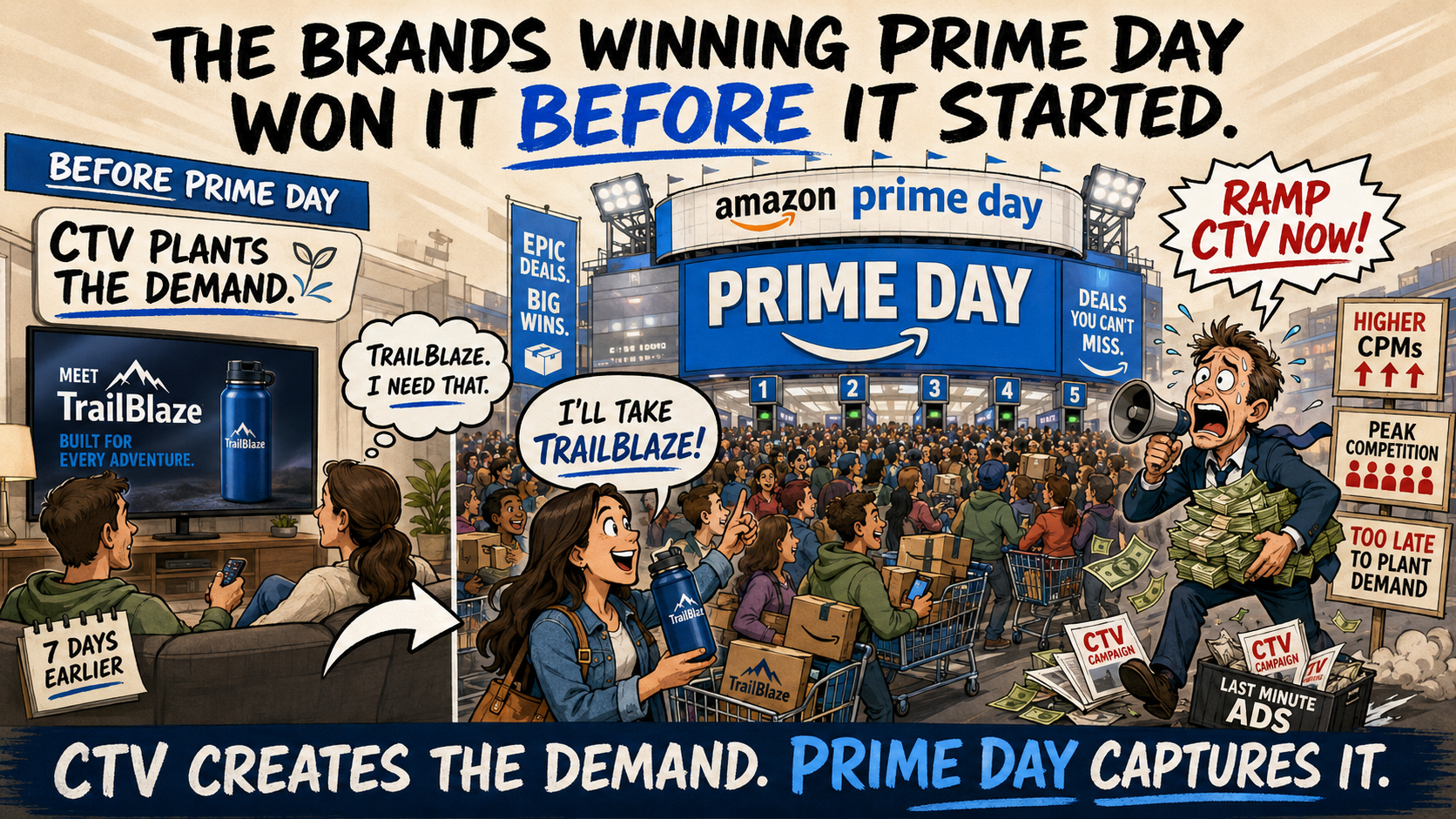
Prime Day is the largest demand-capture event in retail — a cash register the size of a stadium. But the register doesn't decide whose product the crowd reaches for. CTV does, on the couch, before the deals go live.
Prime Day is live right now. June 23 through 26. Four days, the earliest Prime Day on record, and the most competitive retail media moment of the year.
And here is the uncomfortable truth most brands are discovering at exactly the wrong time.
If you are reading this and just now ramping your CTV spend for the event, you are late. Not fatally late. But late in the way that costs you margin you did not have to spend and customers you did not have to lose.
Because Prime Day is not a moment. It is the visible peak of a curve that started weeks ago. The brands quietly winning these four days did not show up when the deals went live. They showed up before, planted the demand, and are now simply collecting it while their competitors bid each other into oblivion for the scraps.
This is the long version of why. If you run marketing for a brand that sells on Amazon, this is the case for CTV as the most undervalued weapon in your Prime Day arsenal — and the framework for using it correctly, this time and every time.
Let's get into it.
First, Understand What Prime Day Actually Is
Prime Day is the largest demand-capture event in retail.
Sit with that word. Capture. Not creation. Capture.
On Prime Day, tens of millions of shoppers arrive at Amazon already in buying mode. Deal-hunting. Comparing. Adding to cart. The 2025 event drove a record $24.1 billion in US online sales over four days, with more than 200 million Prime members shopping. The intent is already in the building. These people came to spend.
Amazon did not create that intent. Amazon built the greatest machine in commercial history for capturing it — the listings, the reviews, the one-click checkout, the Prime logistics — but the wanting itself, the decision to buy a thing in a category, largely arrived with the shopper.
So picture what Prime Day really is. It is a cash register the size of a stadium. The most efficient transaction-completion environment ever built, with a crowd of ready buyers pouring through the doors.
And a cash register, no matter how magnificent, does not create customers. It rings them up.
Which raises the only question that actually decides your Prime Day. When a shopper is standing in your category on Prime Day, looking at you and three competitors selling something similar at a similar discount — whose name did they walk in already wanting?
That decision is not made on Prime Day. It is made before it. And the channel that makes it is CTV.
Why CTV Is the Demand-Creation Engine
Here is the principle that governs everything that follows.
You cannot click a television.
There is no buy button on a streaming ad. No cursor, no tap, no instant checkout. The ad plays on the biggest screen in the house, in a lean-back moment of full attention, and then it ends. If the viewer wants to act, they have to get up, pick up another device, and go find you.
Most marketers see that as CTV's weakness. It is actually the entire point.
Because CTV cannot capture a transaction, it is built to do the one thing the cash register cannot — create the want in the first place. It plants the brand in the customer's memory days before they are anywhere near a checkout. It does the upstream work. It manufactures the preference that every downstream channel then competes to fulfill.
On Prime Day, that sequence is everything. The customer sees your product on Prime Video, or Hulu, or a streaming app the week before the event. Nothing happens that you can track in the moment. No click. No conversion. Just a name, lodged in a head.
Then Prime Day arrives. That same customer opens Amazon, and instead of searching a generic category term and meeting the lowest bidder, they search for you. By name. They walk into the stadium already carrying your brand, and Amazon's machine does what it does best — it rings them up.
The demand was created on the couch. It was captured at the register. And the brands that understand the difference are the ones who win.
Amazon's own ad guidance, buried in its Prime Day playbook, says the quiet part plainly: video and streaming TV exist to generate the branded search demand the rest of the ad stack converts on. Amazon is telling you, in its own documentation, that the top of the funnel feeds the bottom. Most brands just are not listening.
The Trap: Ramping On Prime Day Instead of Into It
Here is the mistake that costs brands the most, and it is the most common one on the board.
They ramp CTV during Prime Day. Heavy spend, concentrated into the 48 to 96 hours of the event itself, all of it landing while the deals are live.
It feels right. The traffic is peaking, so put the money where the traffic is. But it misreads how CTV actually works, and the misread is expensive.
CTV does not convert in real time. It plants demand that converts later — days later, sometimes a week or more. So an impression you serve on Prime Day morning does not drive a Prime Day purchase. It lands after the customer has already bought, or after the event has already ended. You will have paid the single highest CPM of the year to create demand for a sale that is already over.
And the CPMs really are the highest of the year. Prime Day advertising costs are projected to climb 15 to 25 percent over last year. Daily ad spend across the ecosystem spikes 300 to 500 percent. Every competitor floods the auction at the same moment, bidding each other up on the same keywords and the same audiences. Showing up on Prime Day with fresh demand-creation spend means paying peak prices to start a job that does not have time to finish.
The data on timing is unambiguous. Brands that started awareness campaigns two weeks early caught CPMs that were meaningfully lower before costs spiked nearly 60 percent as the event approached. The efficiency was sitting there, in the weeks before, for anyone willing to show up early.
The brands that win do not ramp during Prime Day. They ramp into it. They use CTV in the one-to-two weeks before the event to manufacture the preference, so that when the deals go live, the demand is already built, the branded searches are already coming, and Amazon's job is simply to capture what CTV created.
Spend during the event captures demand. Spend before the event creates the demand worth capturing. The brands doing only the first thing are discounting to people who were already going to buy, and losing the shopper who walked in carrying a competitor's name — because that competitor got to them first, on the big screen, before Prime Day ever started.
Think in Windows, Not Days
The single most important reframe for a CMO is this: Prime Day is not a four-day event. It is a multi-week window with three distinct phases, and CTV plays a different role in each.
The pre-event window, the two-plus weeks before, is the demand-creation phase. This is where CTV does its heaviest lifting. You are not asking for the sale here. You are building the memory, planting the preference, and seeding the branded-search demand that will surface when the deals go live. CPMs are lower. The auction is calmer. And every impression has time to mature into intent before the event arrives. This is the phase most brands skip, and it is the phase that decides the outcome.
The event window itself, the four days, is the capture phase. Here, your lower-funnel Amazon stack does the work — Sponsored Products, Sponsored Brands, the deal pricing, the retargeting. CTV's role shifts to reinforcement and to catching the late deciders, but the demand it is converting was largely created in the phase before. If you built nothing upstream, these four days become a bidding war you fight at a disadvantage, paying peak prices to capture demand a competitor created.
The post-event window, the weeks after, is the phase almost everyone ignores entirely. The customers acquired during Prime Day are not one-time transactions. They are the beginning of a relationship — repeat buyers, subscribers, lifetime value. CTV in the post-event window keeps your brand present for the audience that just discovered you, turning a single deal-driven purchase into a customer who comes back at full price. The momentum you build on Prime Day either compounds or evaporates in these weeks, and CTV is how you make it compound.
A CMO who plans for one four-day spike is planning to lose to the CMO who plans for the whole window.
Why Amazon's Own Stack Makes the Case Stronger Than Ever
There is a reason this argument is more powerful in 2026 than it has ever been, and it is Amazon itself.
Amazon's advertising business reached $68.6 billion in net sales for full-year 2025, up 22 percent year over year, and the growth is not coming from the old Sponsored Products workhorses. It is coming from streaming — Prime Video ads, Sponsored TV, and the Amazon DSP — stitched together with Amazon Marketing Cloud audiences. Amazon has spent the last eighteen months lowering the barriers to every one of these, with self-serve Sponsored TV and no-code audience building.
What that means for a CMO is something CTV has rarely been able to offer. A closed loop.
Normally, CTV's great frustration is that the impression and the conversion live in different houses. The ad runs on one platform; the sale happens somewhere else; and connecting the two requires incrementality testing and modeling because the click trail does not exist. That is still true, and still the right way to measure CTV broadly.
But when you run CTV through Prime Video and the Amazon DSP during Prime Day, the impression and the purchase live in the same house. Amazon served the streaming ad. Amazon recorded the purchase. Amazon's first-party shopping and streaming data connect the two with a fidelity almost no other CTV environment can match. You can build audiences from real shopping behavior, serve them premium streaming inventory, and measure the downstream purchase inside one system.
For a brand that sells on Amazon, that is the closest thing CTV has to a clean, closed-loop, demand-to-purchase measurement story. The demand-creation power of streaming, with the measurement clarity of retail media, in a single stack, during the highest-intent shopping event of the year.
This does not mean Amazon's stack is the only place to run Prime Day CTV. Reaching audiences off Amazon — on Roku, on other streaming apps — still expands your reach and creates demand that flows back to your listings. But the in-house Amazon path gives you something rare and worth using: proof, not just faith.
How to Measure It Without Fooling Yourself
A warning, because this is where good CTV programs get killed by bad measurement.
Prime Day spikes everything. Sales, traffic, conversions, branded search — all of it surges at once. And in that surge, last-click attribution becomes a liar of the highest order. It will credit Amazon search, the deal price, and the final click for conversions that CTV spent two weeks setting up. Your streaming campaign will look like it did nothing, because the conversion happened at the register and the register took the credit.
If you ramp CTV for Prime Day and then judge it on last-click ROAS the day after, you will reach exactly the wrong conclusion. You will conclude the channel failed, when in fact it created the demand that everything else converted.
Measure it correctly instead. Watch branded search volume in the weeks around the event — if CTV is working, searches for your brand on Amazon rise during and after your streaming flights. Watch new-to-brand metrics, which Amazon reports directly, to see whether streaming brought you customers who had never bought from you before. Run a pre-and-post read, or a holdout if you can structure one, comparing the lift in markets or audiences exposed to CTV against those that were not. And give it a window that respects the lag — judge the campaign over the full pre-event-to-post-event arc, not on the morning-after dashboard.
The brands that measure Prime Day CTV on last-click kill their best channel and never know it. The brands that measure incrementality and branded-search lift see the truth — that streaming was the upstream engine making the whole stack run.
What This Looks Like for a CMO Right Now
So what do you actually do with this?
If you are reading this mid-event, in the live window, the lesson is partly for this Prime Day and partly for the next one. For right now: keep CTV running as reinforcement, shift your aggressive capture spend to the lower-funnel Amazon stack where it converts in real time, and do not pour fresh demand-creation budget into peak CPMs expecting same-day returns. Catch the late deciders, defend your branded terms, and protect margin.
But mark the real lesson for the calendar. Prime Day happens at least twice a year now, plus the holiday tentpoles that behave the same way. The next one is already coming. And the brands that win it will be the ones who treated CTV as the opening move, not the closing one.
For the next event, build backward from the date. Start CTV demand creation two-plus weeks out, while CPMs are calm and the auction is quiet. Layer Amazon's first-party audiences onto premium streaming inventory. Seed the branded-search demand early. Then let the lower-funnel stack capture it during the event, and keep streaming present in the post-event window to turn deal-buyers into repeat customers.
Plan for the window, not the spike. Create the demand before you try to capture it. And measure the whole arc, not the morning after.
The Final Take
Prime Day looks like a four-day sprint. It is actually a multi-week campaign with a four-day finish line, and the race is mostly decided before the finish line is even in sight.
The cash register is the size of a stadium, and the crowd is already pouring in. But the cash register does not decide whose product the crowd is reaching for. That was decided earlier — on the couch, on the big screen, by the brand that took the time to plant its name before anyone went looking for a deal.
CTV is how you plant that name. Not during the event, when the CPMs peak and the demand has no time to mature. Before it, when the work is cheaper, the auction is quieter, and the preference has time to set.
Spend on Amazon captures the demand.
Spend on CTV creates the demand Amazon captures.
The brands that win Prime Day are not the ones who spent the most during it. They are the ones who showed up before it, made the customer want them first, and let the biggest cash register in the world do the rest.
The register is ready. The only question is whose name the customer brings to it.
Cory Poccia CEO, CS & Co. Marketing Studio™