MONDAY JOE™ SERIES 5/04/2026: The 2015 Academic Paper Every CTV Skeptic Should Read Before They Cancel Your Budget
There is a paper.
It was published in The Quarterly Journal of Economics in November 2015.
Volume 130, Issue 4, pages 1941 through 1973.
Two authors. Randall Lewis and Justin Rao. Both PhDs. Both with Yahoo Research at the time. Both rigorous to a fault.
The title is "The Unfavorable Economics of Measuring the Returns to Advertising."
The paper costs nothing to find. Google Scholar has it. SSRN has it. Oxford Academic gates the full text behind a paywall but every working economist on the planet has a copy.
And almost nobody in our industry has read it.
Which is a shame.
Because it is the single most important academic paper ever written about why your CTV budget keeps getting questioned by people who don't know what they don't know.
The Setup
Lewis and Rao did something most researchers can't.
They got their hands on 25 large-scale, randomized field experiments run with major U.S. retailers and brokerages.
Most of these experiments reached millions of customers each.
Collectively they represented $2.8 million in digital advertising spend, fully randomized, fully controlled.
Real money. Real ads. Real consumers. Real conversion data.
Then they did the math.
What they found cracked the foundation of how the marketing industry argues about ROI.
The Finding That Should Stop Every CMO Cold
Here is the headline result.
Across 25 randomized field experiments, the median confidence interval on the return-on-investment estimate was more than 100 percentage points wide.
Read that again.
Even with proper randomization. Even with millions of users. Even with $2.8 million in spend across the dataset.
The best academic measurement methodology available to humanity, applied to the cleanest possible test conditions, produced ROI estimates with confidence intervals so wide they spanned more than 100 percentage points.
Translation in plain English:
If your reported ROAS is 3.0x, the honest statistical truth is somewhere between 0.5x and 5.5x.
Not because the math is wrong.
Because the underlying signal is genuinely that noisy.
Why This Happens — The Coefficient of Variation Problem
Lewis and Rao identified the structural reason.
Individual-level sales — what any single customer spends in any given period — are extraordinarily volatile relative to the per-capita cost of advertising.
The technical metric is called the coefficient of variation.
For most digital advertising, the coefficient of variation is around 10.
That is enormous.
In practical terms it means: if your ad costs you $1 per exposed user, the natural variance in what those same users spend without any advertising at all is roughly $10.
You are trying to detect a $1 signal inside $10 of noise.
Which means to prove your advertising works at any reasonable level of statistical confidence, you need a sample size that is, mathematically, enormous.
How enormous?
Lewis and Rao calculated it.
To run a properly powered field experiment that can detect a real ad effect, you need on the order of 10 million person-weeks of exposure.
For most brands, that is operationally and financially infeasible.
For Purity Products at $80,000 a month in CTV, it would take years to accumulate.
For most DTC brands running geo lift studies on six-figure budgets, the test is statistically underpowered before it begins.
The Insight Nobody Talks About
Here is the part of the paper that matters.
Underpowered tests do not fail randomly.
They fail in one direction.
Underpowered tests systematically fail to reject the null hypothesis.
In English: when you don't have enough data, your test will tell you "we couldn't prove the ads worked" — even when the ads are working.
Absence of evidence becomes evidence of absence.
Not because that's true.
Because that's how statistics work when the noise dwarfs the signal.
Why This Matters For CTV
The standard CTV skeptic argument runs like this:
"I don't see clean proof that CTV drove these specific orders, therefore I'll assume coincidence. Double the CPO. Discount the channel."
That argument has a name in the academic literature.
It is called conflating absence of evidence with evidence of absence.
And Lewis and Rao spent a 32-page paper in QJE explaining exactly why that conflation is the most dangerous statistical mistake an executive can make.
The structural bias of underpowered measurement is not "ads don't work."
The structural bias of underpowered measurement is "we can't see the ads working — even when they are."
The honest, rigorous, statistically literate posture in the absence of overwhelming evidence is not to discount your CTV reporting.
It is to treat your CTV reporting as a directionally conservative estimate.
Which is the exact opposite of what every CTV skeptic in your boardroom is telling you.
What Lewis and Rao Did Not Say (But Should Have Been Quoted On Anyway)
The paper does not mention CTV.
CTV did not exist as a meaningful ad channel in 2015.
What the paper does say, and what applies with even more force to CTV in 2026, is this:
The harder a channel is to measure, the more likely it is to be misjudged in both directions.
Some buyers will under-credit it because the signal is hard to extract.
Some will over-credit it because they are looking at the wrong metrics.
Both groups will be statistically wrong.
The right answer is not to throw up your hands.
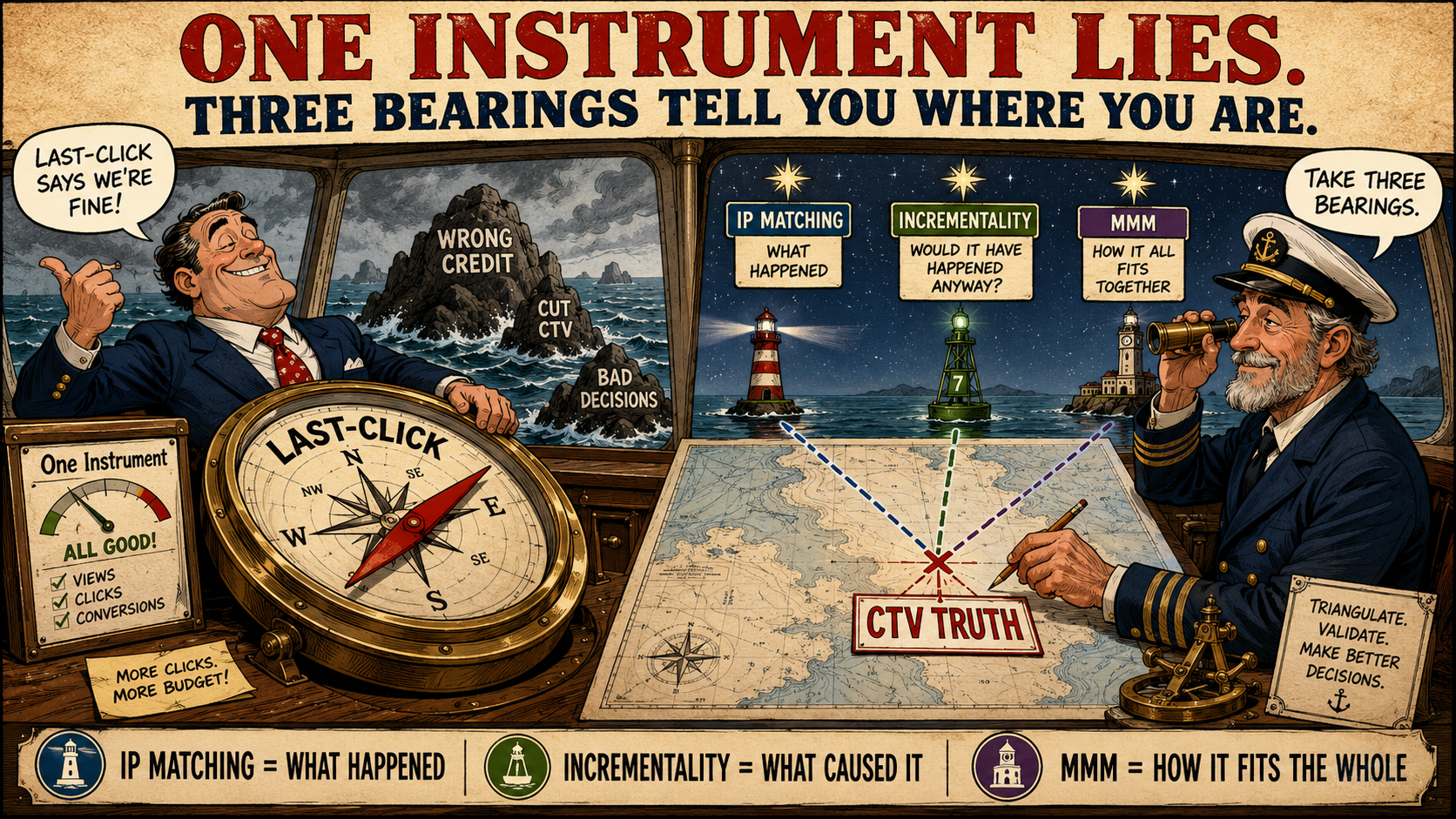
The right answer is to triangulate. Multiple methods. Multiple data sources. Multiple time windows. Multiple geographic cuts.
When four imperfect methods agree, the convergence is the truth.
When they disagree, you investigate.
This is the same logic the FDA uses to approve drugs.
Multiple trials. Multiple endpoints. Multiple patient populations.
No single experiment is the answer.
The convergence is.
The Asymmetric Standard Problem
Here is what Lewis and Rao did not directly say but is the unavoidable conclusion.
If your VP or CFO applies the "I need clean proof or I'll assume the worst" standard to CTV, they should be applying it to every channel in your stack.
Apply it to Meta retargeting.
Apply it to branded search.
Apply it to email.
Apply it to direct mail.
Apply it to your trade-show budget.
Every single one of those channels has the same coefficient-of-variation problem.
Every single one of them produces ROAS estimates with massive confidence intervals.
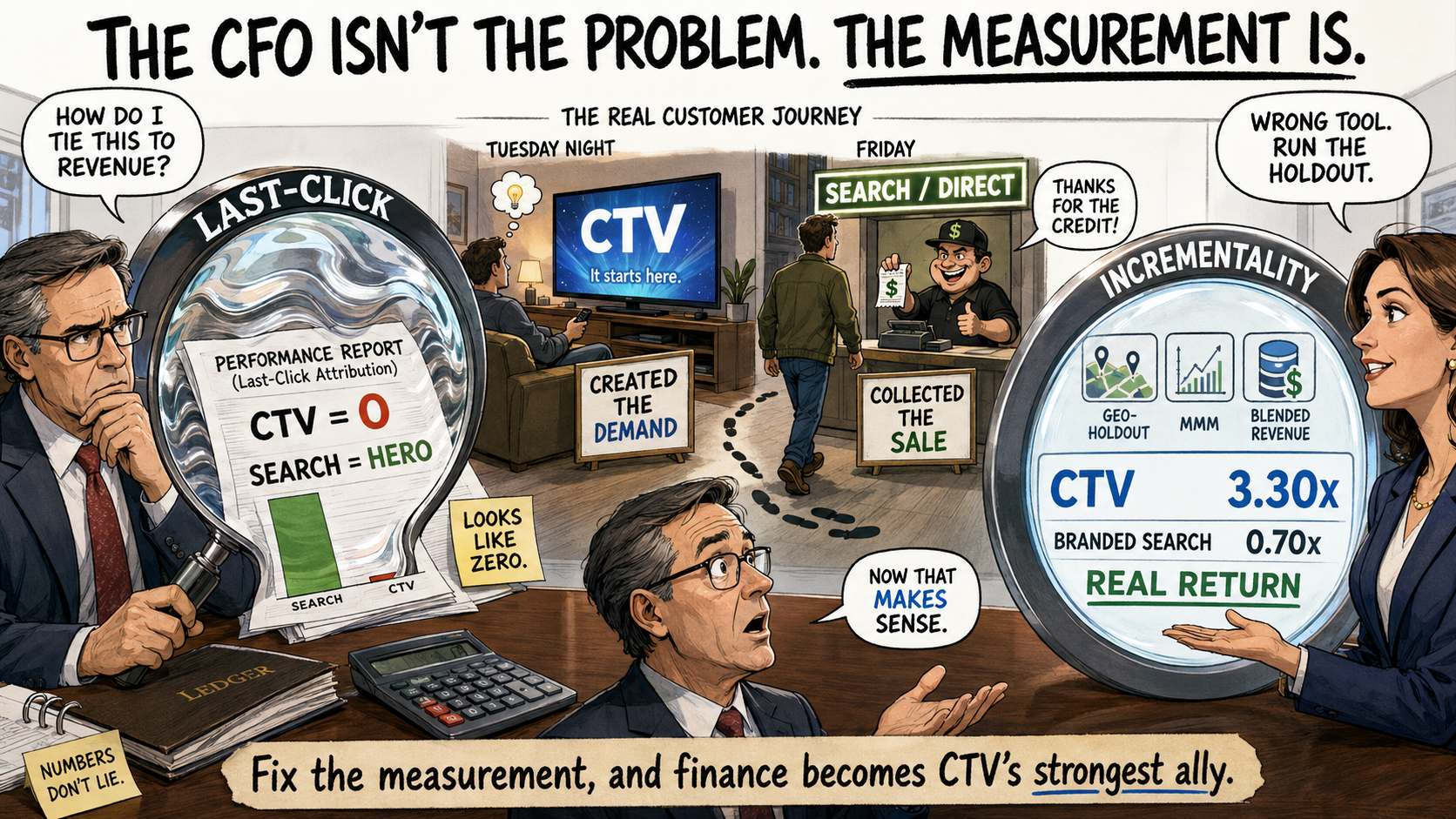
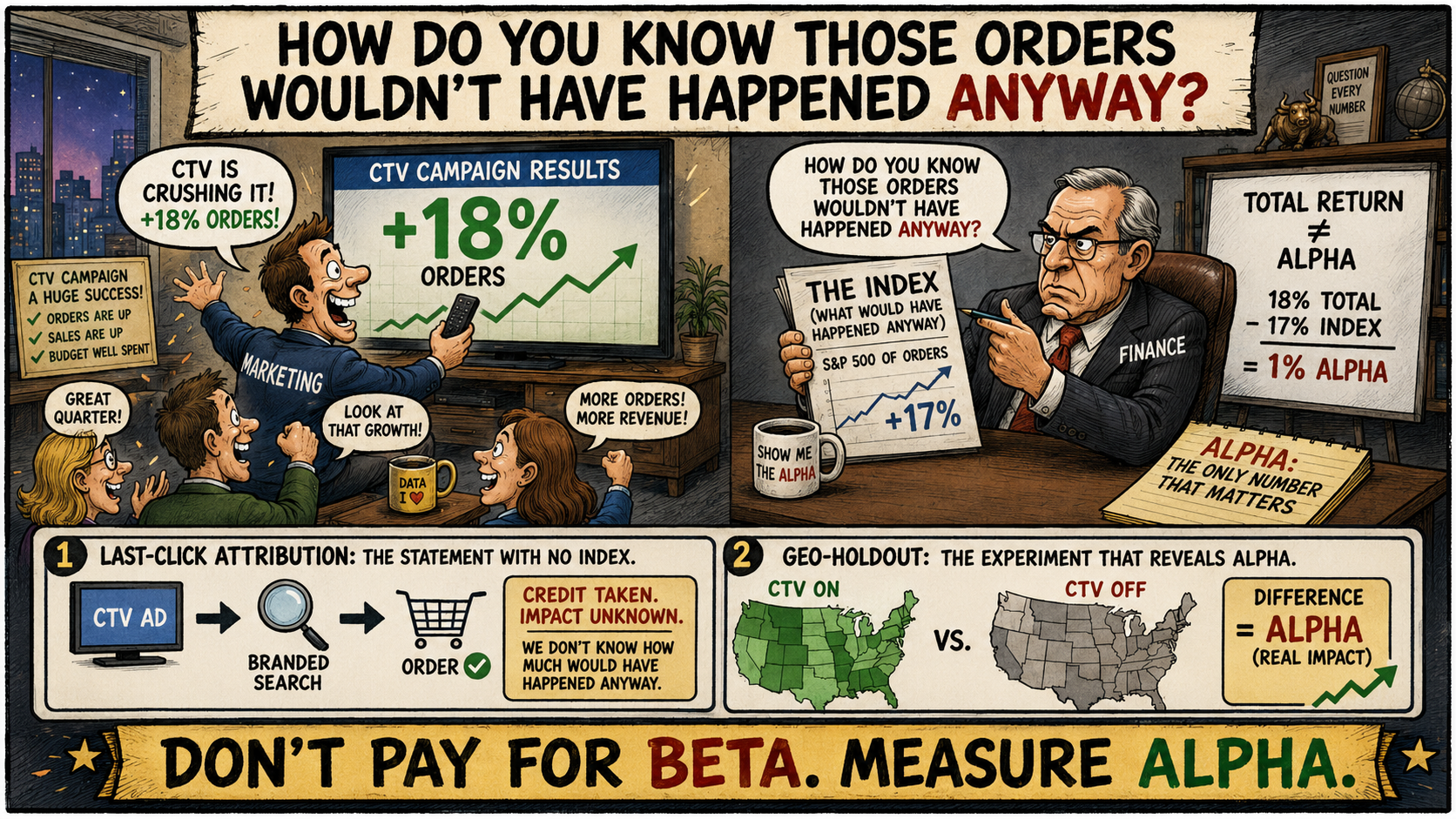
The Stella 2025 incrementality benchmark — 225 independent geo-holdout tests across all major DTC channels — found that branded search produced a median incremental ROAS of 0.70x.
Meaning roughly 90% of the conversions branded search claims would have happened anyway.
If your CFO applied the "double the CPO because half is coincidental" standard consistently, branded search CPO would need to be multiplied by ten, not doubled.
Meta retargeting would need to be tripled.
Most of your "performance" stack would collapse under the weight of its own scrutiny.
The skeptics never apply the standard symmetrically.
They apply it to the channel they don't understand.
That is not statistics. That is bias.
Lewis and Rao would have called it by name.
What This Means For Your Monday Morning
If you are a CMO defending a CTV budget against a skeptical CFO, you have a paper to forward.
It is peer-reviewed.
It is published in the most prestigious economics journal in the English-speaking world.
It was written by two PhDs with no commercial interest in CTV.
It explains, mathematically, why your skeptic is making a statistical error.
Use it.
You can find it free at SSRN: search "Lewis Rao Unfavorable Economics 2014" — the working paper version is identical to the published version.
Or pay Oxford Academic the $34 for the published version. It will be the cheapest measurement consulting your brand has ever bought.
What This Means For Us
At CS & Co. we have spent the better part of three years explaining to clients why CTV underperforms in last-touch dashboards while overperforming in blended CAC.
We have shown the geo-holdout data.
We have walked through the cross-device cannibalization math.
We have presented the Stella benchmark, the Haus benchmark, the Kochava multi-touch data.
All of it true. All of it relevant. All of it dismissible by a sufficiently determined skeptic as "vendor self-promotion."
What is not dismissible is a 32-page paper in The Quarterly Journal of Economics by two researchers with no skin in the CTV game, written in 2015, before any of the modern CTV vendors existed, that proves the underlying mathematical structure of why your skeptic's intuition is wrong.
That is the document we hand to the CFO.
That is the document the CFO actually reads.
And that is the document that ends the argument.
Final Take
Most measurement debates in adtech are not actually about measurement.
They are about who has the authority to declare a channel real.
Vendors don't have that authority.
Agencies don't have that authority.
Internal analytics teams don't have that authority — at least not against a determined VP with a strong opinion.
Peer-reviewed economists writing in 100-year-old academic journals do.
Lewis and Rao gave us the document.
We just have to be the ones who read it first.
The next time someone tells you to cancel your CTV budget because they don't see clean proof in the dashboard — hand them page 1956.
That is where the coefficient of variation calculation lives.
That is where the argument ends.