General Marketing
Fox Just Bought the Front Door to Free TV. Here’s What Changes for Your CTV Buy.
Fox closed its $22 billion Roku deal today, months ahead of schedule. One company now owns the Roku home screen, The Roku Channel and Tubi. Here's what that means for brands buying CTV, and the one move to make this quarter.
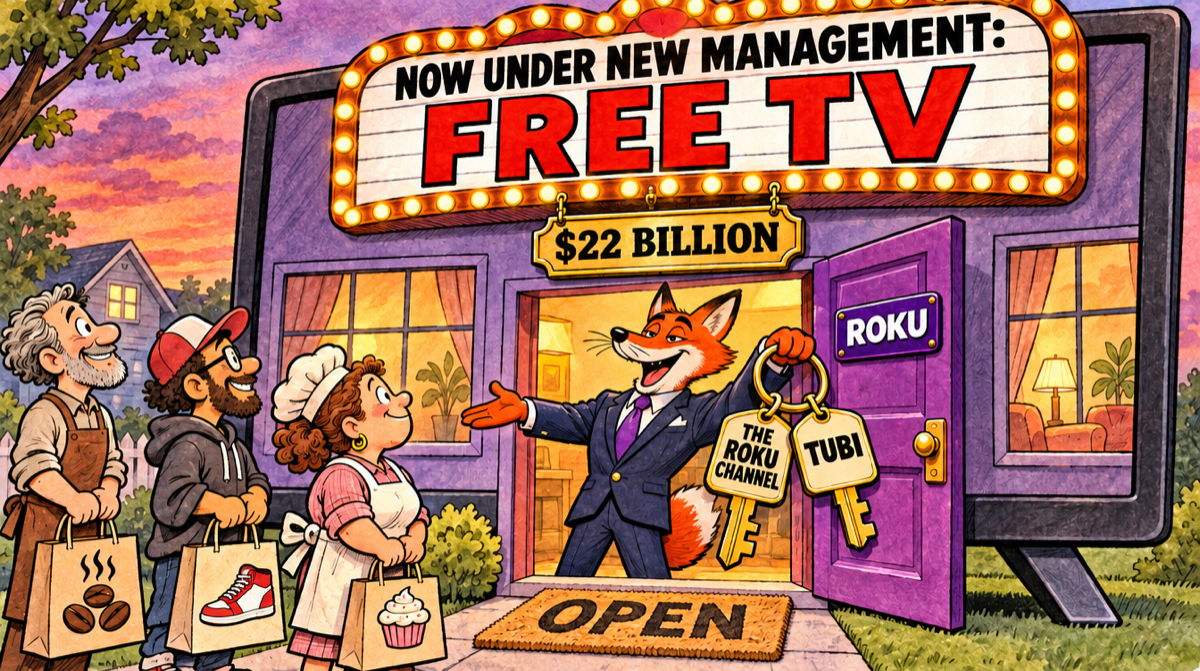
This morning, Fox told the world it had closed its $22 billion deal for Roku.
Nobody expected it today. When the deal was announced in June, Fox said it expected to close in the first half of 2027. Variety's first word on the news was "Surprise!" And Fox says Roku shares stop trading on the Nasdaq as of today.
So the trade press will spend the weekend on Wall Street angles: the price, the synergies, who's leaving and who's staying. That's fine. I want to talk about the person who actually pays for all of this, and that's you, the brand buying ads on the TV.
Because one company now owns the front door to streaming in tens of millions of American living rooms, plus two of the biggest free TV services behind it. That changes how you should think about your CTV plan. It doesn't change whether you should have one.
What Did Fox Actually Buy?
Three things, and as a buyer you should think about them separately.
The front door. Roku's open connected TV platform reaches more than 100 million households, according to Fox. When Fox announced the deal in June, it said that includes more than half of all U.S. broadband households. The Roku home screen is where a huge share of America decides what to watch tonight.
A free channel. The Roku Channel is Roku's own free, ad-supported service. In Roku's Q3 shareholder letter, it ranked as the No. 2 app on the platform by engagement.
A second free channel, already in the family. Fox has owned Tubi since 2020. According to Business Insider, The Roku Channel and Tubi are now the second- and third-largest free streaming services by U.S. TV viewership, behind YouTube.
All of it now sits in a new division called FOX Digital Platforms, which includes Roku, Tubi, FOX One and Red Seat Ventures. Roku founder Anthony Wood co-chairs it with Paul Cheesbrough, who also serves as its CEO.
Add Fox's live sports and news, and in June Fox said the combined company would become the third-largest player in U.S. television by share of viewing.
That's a lot of the free TV audience under one roof.
Will Roku Stay Open to Everyone Else?
This is the first question I'd ask, and Fox answered it in the first lines of its announcement.
In Fox's words: "Roku will continue to play its role as a leading open ecosystem for the broader streaming industry." Lachlan Murdoch said the company's top priority is "reinforcing the openness and choice that is the essence of the Roku platform." Anthony Wood said Fox "wholly shares our commitment to staying open to every content partner."
Variety read that pledge plainly: Fox won't automatically give its own Fox News or FOX One better placement on Roku. And it noted Fox has every reason to keep the promise, because Roku's value is being the front end to Netflix, YouTube, Disney+, HBO Max and everyone else.
For advertisers, that's good news. The audience on Roku is there because everything is there. A walled-off Roku would be a smaller Roku, and Fox didn't spend $22 billion to shrink it.
What I'd tell a brand: take the promise at face value, and keep your plan built so it doesn't depend on it.
What Does This Mean for Free Streaming Scale?
Free, ad-supported TV just got a heavyweight owner.
Variety put it simply: the deal gives Fox the chance "to increase scale in the free, ad-supported streaming space through Fox's Tubi and the Roku Channel." Business Insider reported that the new leadership's goals for the combined business include to "Lead in Free Ad-Supported Streaming."
That matters, because free TV is where a big part of the audience has moved. We wrote last week about how the TV audience moved to streaming, and about how free TV brings reach at a fraction of the cost of premium streaming in our CPM breakdown.
More investment in free TV usually means more content, more viewing, and more ad inventory in front of real households. That's the part of this deal that works in your favor.
The part to watch is quality. Not all free inventory is equal, which is why we use a two-bucket rule for FAST: good free TV for reach, premium for attention, and a hard look at where every impression actually ran.
Will It Be One Ad Stack? Will Prices Go Up?
Honest answer: nobody outside Fox knows yet.
Here's what's on the record. Business Insider reported a goal from the leadership memo to "Win in Performance Advertising: Invest in AdTech, data and go-to-market capabilities to become the premier advertising partner at scale." Fox also expects about $400 million in run-rate cost savings within two years and says there's "additional potential revenue upside."
Fox hasn't said how or when it will combine the ad sales for Roku and Tubi. Variety and Business Insider reported that Roku Media president Charlie Collier, Tubi CEO Anjali Sud and an EVP of Fox's AdRise ad tech platform are leaving. So expect new faces and some reshuffling on the sales side.
On pricing, I won't guess. What I will say is this: when one seller controls more of what you want to buy, your best protection is not needing any single seller.
And today you don't. In Q3, Roku said more than 80% of its in-stream video ad impressions were delivered programmatically, with integrations to every major DSP and SSP. That's open buying. It gives you options, and options keep prices honest.
What Should a Mid-Size Brand Do Next?
Nothing dramatic. The audience didn't move this morning. Roku said its advertising revenue grew 23% to $727 million in Q3, and the households are still on the couch tonight.
But a deal this size is a good moment to tighten the plan:
Buy households, not logos. Pick who you want to reach first, then buy them across Roku, Tubi, premium apps and the open market. Your strategy shouldn't belong to one owner.
Buy the content on purpose. Know which shows and apps your ads run in. We call it buying the show, not the app.
Keep your buying flexible. Keep programmatic access through your own platform, so if terms change on one side of the market you can move budget in a day, not a quarter.
Watch the Q1 changes. New owners mean new packages, new reps and new rate cards. Ask your partners now what's changing in January.
Measure in your own sales. Whatever happens to the ad stacks, read results by geography against your own orders, with holdouts. That's how you triangulate what's really working, no matter who owns the platform.
The Final Take
Fox bought the front door to free TV, and it promised to leave the door open.
For brands, that's mostly good news. More money is going into free streaming, the audience keeps growing, and the biggest owners in the business are betting their future on CTV advertising. When a media giant pays $22 billion to get closer to your customer's living room, it's telling you where the audience is.
Your job is to show up in that room on your own terms: the right households, the right shows, measured in your own sales, with no single seller holding your whole plan.
We walked through the holiday window Roku's Q3 numbers opened up earlier this week. Nothing about today closes it.
That's how we plan every campaign at CS & Co., with the CS Method™. Want to know what this deal means for your next buy? Find out if CTV is a fit.
Cory Poccia
CEO, CS & Co. Marketing Studio™