
General Marketing
Stop Buying the App. Start Buying the Show.
For decades, TV advertising started with one question: what show? Streaming programmatic lost that. New OpenX data says buyers are getting it back. Buy the show. Then read the results in your own sales.
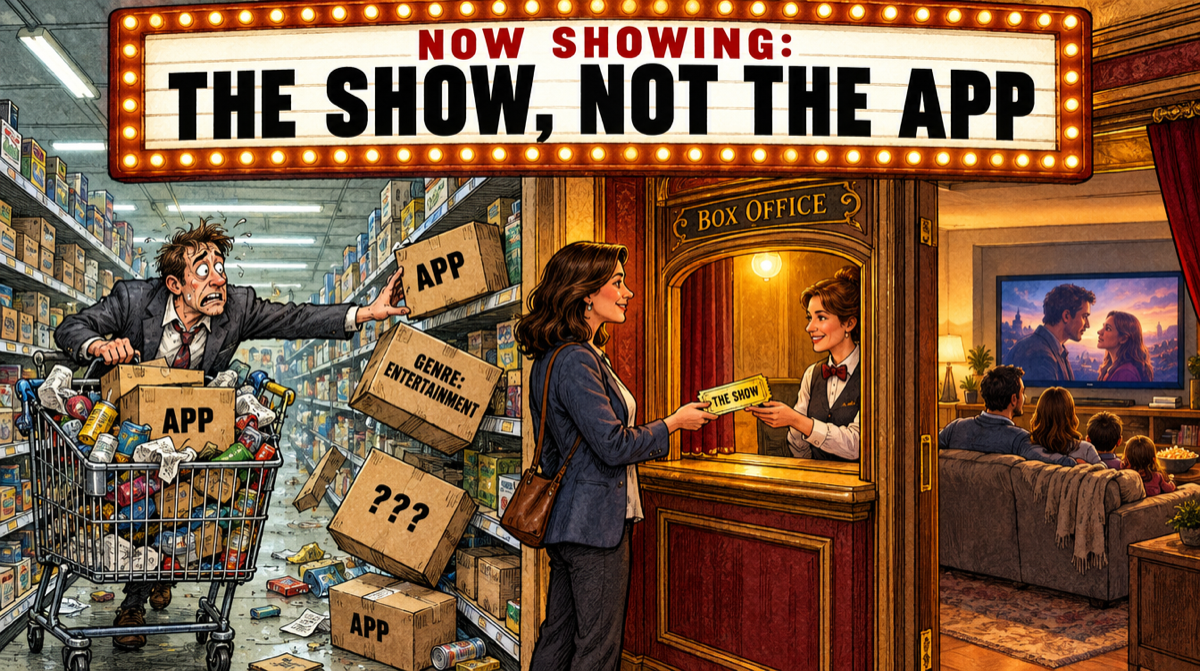
Ask anyone who bought broadcast TV what the first question was.
It was never "which network?" It was "which show?"
You bought the game. You bought the finale. You bought the cooking show for the kitchen brand and the late-night slot for the beer. The show told you who was on the couch and what mood they were in.
Then TV moved to streaming, and for a lot of programmatic buyers, that question quietly disappeared.
New numbers say it's coming back. Fast.
The Number That Flipped
OpenX, one of the big supply-side platforms, released its annual trend report on October 15. PPC Land dug through it, and one chart tells the whole story.
In 2022, curation (packaging inventory by app lists, site lists and viewability) made up 76% of CTV spend on OpenX. Supply-side targeting, which uses signals about the content itself, was just 9%.
By 2025, those positions had reversed. Supply-side targeting rose to 51% of CTV spend. Curation fell to 41%.
In OpenX's own release, CTV spend using supply-side targeting grew 500% from H1 2022 to H1 2025, "as buyers make greater use of content signals such as genre and rating to identify relevant inventory."
Here's the part that matters.
Buyers didn't just spend more on CTV. They changed what they were buying. They stopped buying the app and started buying what's playing inside it.
Why "Which App?" Was Never Enough
Streaming has no browser cookies. So for years, a lot of CTV buyers knew one thing about an impression: which app, publisher or package it came from.
That's like buying "a broadcast network" with no idea what's on.
The OpenX report puts it plainly: "Two impressions from the same streaming service can represent radically different environments depending on the show, episode, genre, rating, and other content characteristics."
Think about it. The same streaming app can run a kids' cartoon in the afternoon and a gritty crime drama after bedtime. Same app. Completely different room.
The fix is something called content objects: the metadata that describes the title, genre, episode and rating of the programming around an ad. That's the show, coming back into the buy.
And it's carrying real money. According to PPC Land's read of the report, quality targeting made up 35% of all U.S. supply-side targeting spend in 2025, "driven overwhelmingly by CTV," and in CTV "virtually all of that quality spend involved content objects."
The Audience List Is Getting Out of the Way
Here's the other shift hiding in the data.
Third-party audience data fell from 78% of supply-side targeting spend in 2022 to roughly 40% in 2025.
That's a big turn. For years the pitch was that the audience segment was everything and the show was a detail. Buyers are now saying the opposite: what someone is watching tells you a lot about who they are and what they'll pay attention to.
Audrey Elman, Media Director at Polaris, put it this way in PPC Land's coverage: "A lot of the tools that I traditionally would go to the DSP for, I'm now bypassing and going straight to an SSP."
Wade Wilkinson of Sojern framed it well in the OpenX release: "The important distinction is between simply packaging inventory and using intelligence within that packaging to make better decisions."
Packaging is the app list. Intelligence is the show.
Buyers Have Wanted This for a While
This isn't one company's wish list.
In Gracenote's 2026 CTV advertising report, a survey of 500 U.S. media professionals, 86% of media planners said they would move more linear TV budget into CTV if show-level targeting and reporting were consistently available.
Among programmatic traders, 80% said they would shift budget from audience-targeted to contextually targeted CTV if actionable content signals were available.
Read that again. What's holding linear TV budgets back from streaming isn't the audience. The audience is already there. It's the buyer's ability to know what show the ad runs in.
That's one of the most bullish CTV data points out there. The demand is there. The show data is catching up to it.
The Honest Asterisk
Now the fine print, because the headline won't give it to you.
It's one company's data. These numbers come from OpenX's own marketplace, sorted by OpenX's own rules. As PPC Land points out, the report leans on interviews with 8 people, all of them OpenX clients. It has no dollar figures and no data on fees, CPMs or campaign performance.
The climb isn't a straight line. PPC Land notes the supply-side targeting share of CTV peaked around 56% in Q3 2025 and dipped to about 47% in Q4 2025. Still way up from 9%. Just not a rocket.
The show labels are still messy. This is the big one. A Wurl analysis covered by Digiday looked at a two-hour prime-time window on free ad-supported streaming channels in August. Only 11% of CTV ad requests had a usable show name. 93% had a genre label, but about 35% of those labels didn't match what the program actually was, and 22% were vague catch-alls like "entertainment." In two hours, Wurl counted more than 3,600 different genre labels.
Even TV's own labels get weird. Digiday's favorite example: FX submits "The Bear" as a comedy at awards time.
Peer39 found something similar earlier this year: only 40% of CTV bid requests carry usable program-level content signals.
Most deals still don't check the result. OpenX says only 17% of deals in 2025 included measurement that validated audiences against real-world outcomes. So most didn't.
None of that is a knock on CTV. It's a knock on lazy labels. The screen, the audience and the attention are all there. The data describing the show just needs to grow up.
How to Buy the Show (and Prove It Worked)
So what do you actually do with this?
Ask what show, every time. When you plan a CTV buy, ask your partner what content, genre and rating your ad will run against, not just which apps. If nobody can answer, that's your answer. Here's what can go wrong when nobody's minding the buy.
Don't trust one label. A genre tag of "entertainment" tells you nothing. Spot-check where your ads actually ran. Push for show-level reporting, not a pie chart of categories.
Watch for empty seats. Buying the right show only matters if people are watching it during your flight. A sign-up isn't a viewer, which is why we wrote about ghost audiences.
Read the result in your own sales. This is the part the 17% figure should burn into every marketer's brain. Better targeting is a promise. Your orders are the proof. Compare sales where the ads run against each area's own baseline, keep a few holdout areas dark, and triangulate instead of trusting one dashboard. That's how you see the alpha CTV actually creates.
Buy the show going in. Read your sales coming out. Do both, and you're not guessing on either end.
The Final Take
TV always sold the show.
That's what made it work. The right ad, in the right program, in front of the right room.
Streaming programmatic lost that for a while. Buyers were stuck buying the app and hoping. Now the show is coming back into the buy, and the people who plan TV budgets are telling us that's exactly what would move more money into CTV.
The labels aren't perfect yet. The data comes with an asterisk. And most deals still aren't checking against real sales.
So do what great TV buyers always did: pick the show on purpose. Then do what the best performance marketers do: let your own sales tell you if it worked.
That's how we plan and measure every CTV campaign at CS & Co. It's built into the CS Method™. Want to know if your brand belongs on the big screen? Find out if CTV is a fit.
Cory Poccia
CEO, CS & Co. Marketing Studio™