
General Marketing
TV Ads, No Agency Required. Also No One Watching the Money.
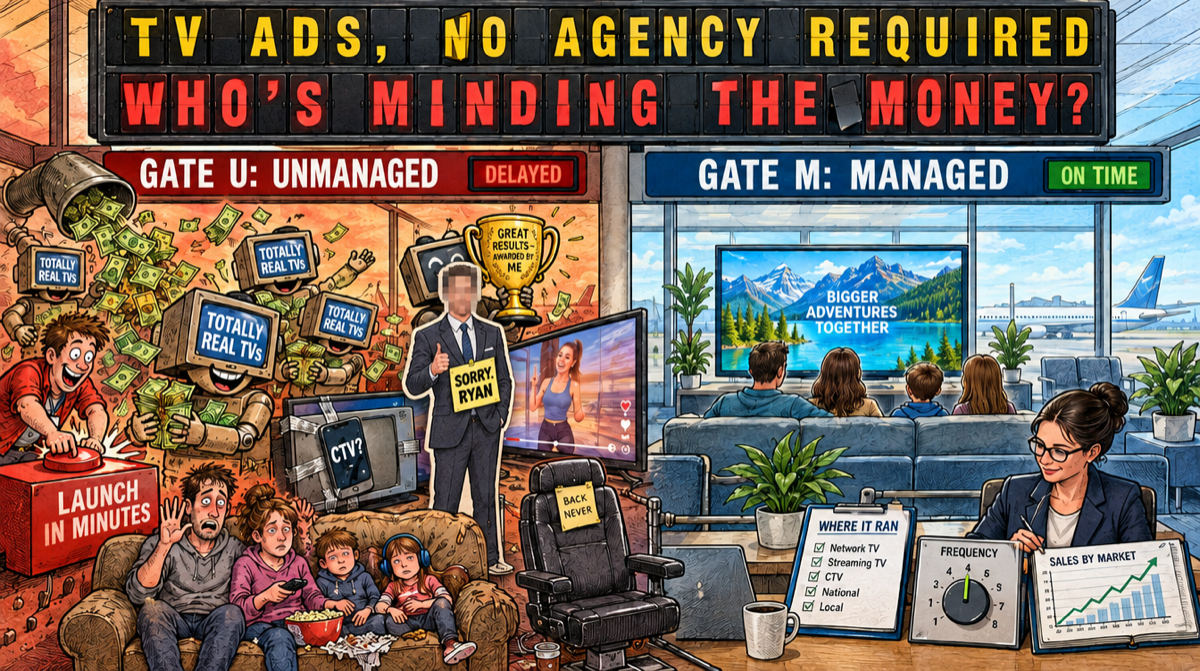
A search ad promised TV ads with no agency required. CTV works. The danger is a buy nobody is managing: bad inventory, wasted frequency, self-graded results and spots made for a phone. Here's what goes wrong, and what managed looks like.
I was on Google last week when this popped up at the top of my results:
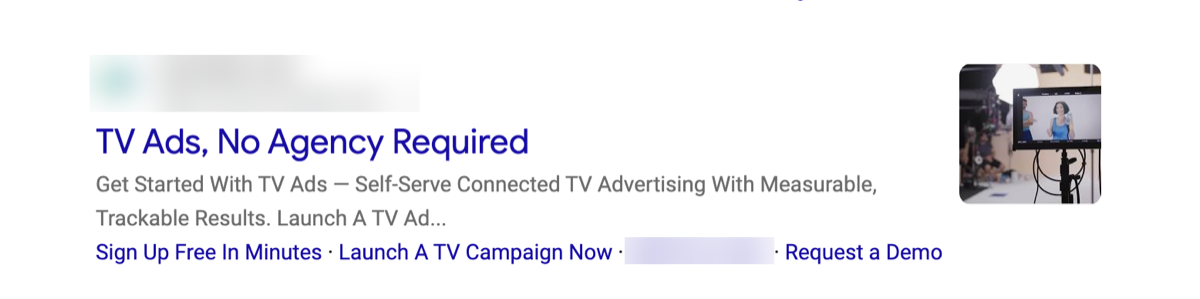
"TV Ads, No Agency Required."
"Self-Serve Connected TV Advertising With Measurable, Trackable Results."
"Sign Up Free In Minutes." "Launch A TV Campaign Now."
We blurred the brand. Sorry, Ryan Reynolds.
Look, I get the appeal. TV used to need a big agency, a big budget and a six-week flowchart. Now somebody's telling you it takes a credit card and a coffee break.
And here's the thing. They're not wrong about the first part. You really can launch a TV ad in minutes.
Here's the part the ad leaves out.
Launching is the easy part. Everything that decides whether the money comes back happens after you click "Launch."
CTV Isn't the Problem. Nobody Minding the Buy Is.
Let me be really clear before anyone screenshots this.
CTV works. It's the biggest screen in the house, full screen, sound on, in front of a real household. We've built our whole company on it. And the self-serve tools themselves aren't evil. Plenty of smart teams use them well.
The danger is the word that headline leaves out: unmanaged.
A TV campaign with nobody owning the strategy, the inventory, the frequency, the creative and the scorekeeping isn't a cheaper version of a managed one. It's a different product. And it's the one that teaches brands, wrongly, that "CTV didn't work for us."
We've written before about how self-serve platforms can quietly erode performance. Here's the field guide to exactly where the money leaks.
Leak #1: You Don't Really Know Where It Ran
"Connected TV" sounds like one thing. It isn't.
It can mean a premium streaming show on a 65-inch screen in someone's living room. It can also mean a long-tail app nobody's heard of, a stream nobody is watching, or a "TV" impression that ran on a phone.
And some of it isn't real at all.
DoubleVerify's fraud lab found that without adequate protections, more than 1 in 4 CTV video impressions would fail to meet the minimum criteria for fraud-free, viewable, brand-safe and brand-suitable delivery. In 2024, bots made up 65% of all CTV fraud, and DV found 12 new CTV bot variants in a single quarter.
One of those schemes, CycloneBot, could spoof roughly 1.5 million devices and up to 250 million fake ad requests a day, at an estimated cost of up to $7.5 million a month to unprotected advertisers. It even faked long viewing sessions so it would look like a real family on the couch.
Notice the word that keeps coming up. Unprotected.
Good FAST is one of the best values in television right now. Bad FAST and mystery apps are where cheap CPMs go to hide. A managed buy knows the difference, and we use a simple two-bucket rule for telling good FAST from bad. An unmanaged buy just sees a low price and says yes.
Leak #2: The Same Household Sees You Again. And Again.
Frequency is the most underrated lever in CTV.
Too little, and nobody remembers you. Too much, and you're paying full price to annoy the same family on a Tuesday night.
Default settings rarely know your product, your buying cycle or your price point. A $40 impulse buy and a $4,000 mattress don't want the same frequency. If nobody's watching the cap, the platform will happily keep finding the households that are easiest to reach, which are often the ones who've already seen you plenty.
That's not reach. That's a rerun.
We've laid out how we think about frequency caps for brands. The short version: frequency is a strategy decision, not a checkbox.
Leak #3: "Measurable, Trackable" Can Mean the Platform Grading Its Own Homework
This is the one I'd underline twice.
"Measurable, trackable results" usually means the platform's own dashboard. The same company that sold you the impressions is telling you how well the impressions did.
That's not a crime. It's just not proof.
A lot of platform reporting leans on view-through and last-click style attribution: someone in a household that saw the ad later visited your site or bought something, so the ad gets credit. Some of those people were coming anyway. Your best customers, your repeat buyers, the folks who were already searching your name. Credit them to the TV ad and the dashboard glows.
The dashboard looks great. Your bank account has questions.
The honest test is simple: did sales move where and when the ads ran, measured against your own numbers? If nobody is checking that, nobody actually knows.
Leak #4: A Phone Ad on a 65-Inch Screen
The creative is half the battle on TV, and it's the half "launch in minutes" makes easiest to skip.
What you usually see: a vertical social video stretched sideways. Tiny text nobody can read from the couch. No sound design, because it was built for a muted feed. A 60-second brand film where the offer shows up at second 52.
TV is a different room. Viewers are leaning back, sound on, across the room. The brand needs to show up early, the offer needs to be big and clear, and the whole thing needs to land fast. At CS & Co., we keep CTV spots at :30 or less, because that's what fits the breaks and holds the room.
Great media can't save creative that wasn't made for the screen it's on.
Leak #5: Nobody Owns the Plan
Here's what "no agency required" really removes. It's not the paperwork. It's the person whose job it is to ask, every week, "What did we learn, and what are we changing?"
Which markets are working? Which creative is pulling? Is the inventory mix drifting cheap? Is frequency creeping up? Should we be spending more, or less, or somewhere else?
Without that person, campaigns don't fail loudly. They just run. The dashboard fills in. The spend goes out. And three months later somebody in finance asks what you got for it.
The ANA's latest Programmatic Transparency Benchmark puts a number on how much management matters. In Q1 2026, the top-performing advertisers turned 54.0% of their programmatic spend into fraud-free, measurable, viewable impressions, compared with 32.1% for the lower performers. Their quality-adjusted cost was $7.46 per thousand good impressions, versus $19.04 for the bottom group.
Same market. Very different results. The gap is how the buy is run.
Leak #6: "In Minutes" Is Also How Fast a Budget Can Go
Speed is a feature. It's also a risk.
The same button that launches a campaign in minutes can spend a monthly budget before anyone checks whether the first week worked. There's no test plan, no learning budget, no "let's prove it in two markets before we go national."
Good CTV is built in steps. Start focused. Read the results against your own sales. Scale what's working. Cut what isn't.
Fast is great. Fast and unwatched is expensive.
The Honest Asterisk
Not every self-serve campaign goes badly, and not every agency is worth its fee.
Some brands have a sharp in-house team who know inventory, frequency and measurement cold. For them, a self-serve tool can be exactly right. And we've seen agencies collect a full commission and do less managing than a smart founder with a free login.
So this isn't "agency good, self-serve bad."
It's "managed good, unmanaged expensive." Somebody has to own the buy. The only question is who.
What Managed CTV Actually Looks Like
If you're going to put real money into TV, here's what someone should be doing for you, whatever tool you use:
Inventory you can name. Premium streaming and good FAST on real TV screens, with fraud protection on, and a clear answer when you ask where the ad ran.
Frequency set on purpose. Matched to your product, your price and your buying cycle, and watched every week.
Creative built for the couch. :30 or less, brand early, offer big, sound on.
Proof in your own sales. Results read from your orders, by geography, against your own baseline, not just a platform's dashboard.
A test-and-scale plan. Start in focused markets, learn, then grow what works.
One owner. A person who's accountable for the outcome, not just the launch.
That's what we do at CS & Co. We're a CTV-only agency. We don't take a commission on your media, and we don't charge a monthly retainer. You're not paying us more because you spend more. You're paying for the part the search ad left out.
The Final Take
"TV Ads, No Agency Required" is a great headline. Honestly, I'm a little jealous of it.
But TV ads were never the hard part. Getting them on the right screens, at the right frequency, with the right creative, and proving they sold something, that's the job.
CTV is still the most powerful place to put your brand in front of a real household. Don't let an unmanaged buy convince you otherwise.
Launch it in minutes if you want. Just make sure somebody's minding it for the months after.
That's how we plan, buy and prove every campaign at CS & Co. It's built into the CS Method™. Wondering whether your CTV is being managed or just running? Find out if CTV is a fit.
Cory Poccia
CEO, CS & Co. Marketing Studio™