
General Marketing
B2B Just Got a Remote: LinkedIn CTV Is Now a Normal Line Item
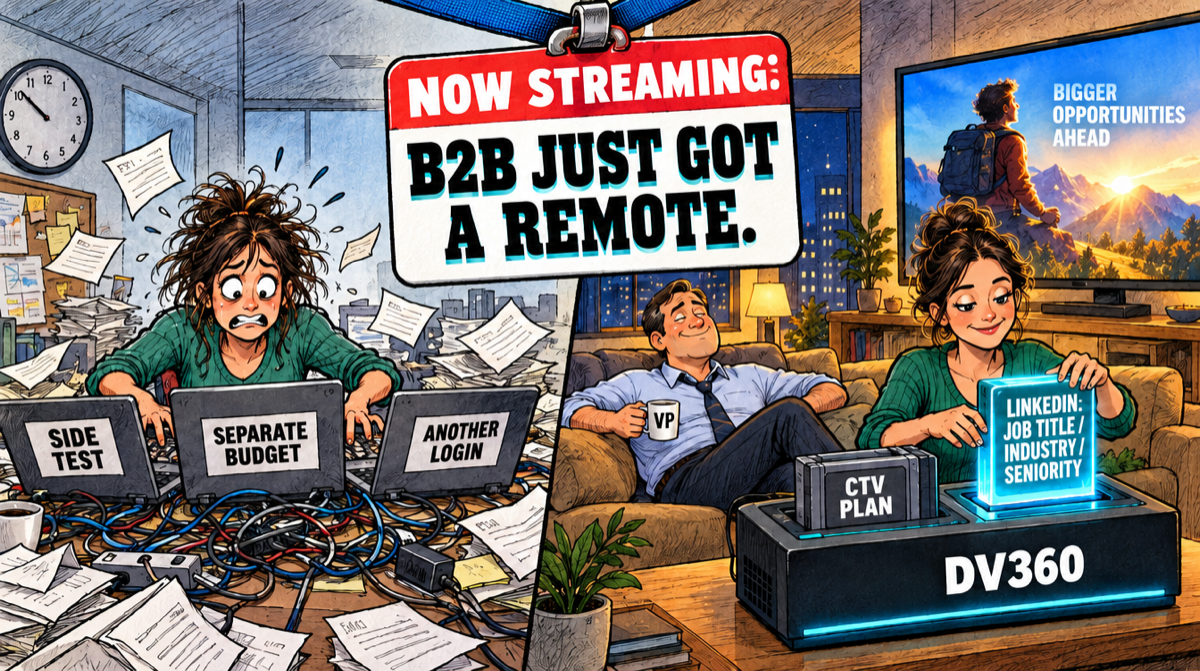
LinkedIn's CTV ads aren't new. What's new is where you can buy them. Job title, industry and seniority targeting on premium streaming TV now sits inside Google's DV360, right next to the rest of your CTV plan. B2B TV just stopped being a side experiment.
For years, B2B marketers have asked us the same question.
"Can TV actually reach the people who sign the contract?"
Not the whole household. Not everyone who watches the game. The VP of operations. The owner of the growing small business. The CFO who has to say yes.
Last week, that question got a much better answer.
On October 22, LinkedIn announced that its CTV Ads are now buyable through Google's Display & Video 360. That means LinkedIn's professional targeting, by job title, industry and seniority, running across premium streaming inventory, inside a Google DSP that a lot of agencies already use to buy CTV.
It sounds like a plumbing update.
It isn't.
The News Isn't That LinkedIn Has CTV
Let's get the facts straight first, because the headlines will blur them.
LinkedIn CTV Ads already existed. You could buy them through LinkedIn's own Campaign Manager. And earlier, LinkedIn opened them up through Amazon DSP, so Amazon buyers could "target LinkedIn professional audiences without fragmenting their media buy."
So no, B2B targeting on the TV screen is not brand new.
Here's the part that is.
DV360 is where a lot of agencies already plan, buy, cap and report CTV. Now LinkedIn's professional audiences sit in that same building. The inventory comes through Microsoft Monetize premium streaming supply. And DV360 buyers can use Google's Gemini-powered tools for planning, optimization, reporting and measurement on those campaigns.
LinkedIn's Dave Roter, Head of Global Agencies and Video Solutions, put it plainly in the announcement:
"CTV is becoming an increasingly important part of the B2B marketing mix, and advertisers want buying experiences that fit seamlessly into their existing workflows."
That last word is the whole story. Workflows.
Why "Same Console" Changes Everything
Ask any media buyer what kills a test.
It's rarely the idea. It's the friction.
A new platform means a new login, a new contract, a new pixel, a new reporting format and a new budget line that someone in finance wants to know about. It means the B2B TV test lives off to the side, in its own spreadsheet, with its own numbers that never quite line up with the rest of the plan.
And side experiments have a way of dying quietly.
When the targeting lives inside the DSP you already run, that friction goes away.
Same plan. LinkedIn's professional audiences become another line item, next to the rest of your streaming buy.
Same budget. No separate pot of "innovation money" that gets cut first when the quarter gets tight.
Same frequency caps. And that one matters more than people think. When your B2B audience is bought in one place and your general CTV is bought in another, nobody can see the total number of times the same decision-maker saw your ad. Put them in one DSP and you can manage frequency like a grown-up, across the whole buy.
Same reporting. One set of numbers, one source of truth, one conversation with the CFO.
That's the difference between "we tried LinkedIn on TV once" and "B2B CTV is part of how we buy media."
What the Targeting Actually Buys You
Here's the thing B2B brands have always known about TV.
It works. It builds the kind of trust and recognition that a banner ad never will. The problem was never the screen. The problem was waste. You were paying to reach a lot of people who would never buy enterprise software, commercial equipment or a business service.
Professional targeting fixes the waste problem.
We've written before about why qualified households beat cheap CPMs. A cheap impression in front of the wrong person is the most expensive impression you'll ever buy. For B2B, a "qualified household" means one with a decision-maker in it. Job title, industry and seniority are about as close to that as targeting gets.
VistaPrint's Erica Haydock, Global Head of Programmatic & Streaming Media, said it in the same release: "Reaching SMB decision-makers effectively requires both scale and precision."
Scale and precision. That's the promise of CTV for B2B in four words.
The Numbers, and Who Paid for Them
LinkedIn has published some strong figures on how its CTV Ads perform. They're worth knowing. They're also worth reading with your eyes open.
In LinkedIn's own study with Kantar, which LinkedIn commissioned and which looked at 97 campaigns, LinkedIn CTV Ads were 2.6x more effective at growing awareness among B2B audiences than other CTV providers (+10.2 vs. +3.9). Paired with other LinkedIn formats, they were 2x more effective than CTV alone (+18.4 vs. +7.7). And they performed especially well among senior decision-makers: CXOs, owners and VPs.
The same research found something every CTV planner should tape to their monitor.
The biggest drivers of results were frequency (35.0%) and campaign duration (16.8%). Placement and creative came last (5.6%). The optimal frequency was 12 views. The average campaign ran 10.7 weeks. And running two different creatives instead of one moved awareness lift from 6.9% to 15.0%.
Read that again. Frequency and time on air beat everything else.
That isn't just a LinkedIn finding. That's a TV finding. It's what we've seen for years: the brands that win on CTV are the ones that stay on long enough, at the right frequency, with enough creative variety to avoid wearing people out. It's why we plan ad spacing backward from the sales day instead of forward from the launch date.
And it's why B2B needs TV more than ever. LinkedIn's B2B Institute says 86% of B2B buyers have their shortlist set on day one, and 92% choose a vendor from that list. If your brand isn't already in their head before they start shopping, you're not losing the deal. You were never in it.
The Honest Asterisk
Now the fine print, because you deserve it.
It's US-only for now. The DV360 availability is for US targeting. Global B2B brands will have to wait or buy other markets another way.
You can't just flip it on. Sign-up runs through a LinkedIn or Google account rep. Expect a conversation, not a toggle.
The headline stats are LinkedIn's. The 2.6x number comes from research LinkedIn commissioned from Kantar. The Amazon DSP announcement also cites early results, measured by iSpot, showing LinkedIn CTV reaching B2B audiences 2.2x more effectively than other CTV platforms and 4.3x more effectively than linear TV. Those are LinkedIn's claims about LinkedIn's product. Kantar and iSpot are serious firms, and that doesn't make the numbers wrong. It does mean they're a starting hypothesis for your brand, not a guarantee.
And awareness isn't revenue. Every number above measures awareness or reach. That's real and it matters, especially when the shortlist is set on day one. But no CFO approves next year's budget on brand lift alone.
Which brings us to how we'd actually test it.
How We'd Test It at CS & Co.
If a B2B brand came to us tomorrow wanting to try this, here's the plan.
One DSP, two audiences. Run LinkedIn professional targeting (job title, industry, seniority) as one line item. Run standard CTV audience targeting as another. Same creative, same flight, same frequency strategy, so the only thing that changes is who you reached.
Judge it by pipeline, not awareness. The scoreboard is qualified leads, opportunities, demos booked and closed revenue, pulled from the brand's own CRM. Not a dashboard full of view-through rates.
Use geography and holdouts. Split markets so some areas get the LinkedIn line, some get the standard line and a small set get neither. Then compare pipeline in each area against its own baseline. That's how you separate what the ad caused from what would have happened anyway. It's the same logic we use to measure the alpha CTV actually creates, and it's why we always triangulate instead of trusting one instrument.
Give it time. If the research says frequency and duration drive results, a short test tells you very little. Plan for a real flight.
Rotate creative. At least two spots. The research says it, and so does common sense.
If the LinkedIn line drives more pipeline per dollar than the standard line, you scale it. If it doesn't, you've learned that for cheap, inside the plan you were already running. Either way, you have an answer you can take to the CFO.
The Final Take
B2B marketers have spent years treating TV as something other people's brands get to do.
Too broad. Too wasteful. Too hard to prove.
LinkedIn's move into DV360 knocks down two of those three walls. The targeting reaches the people who actually sign. And it now lives in the same console, the same budget and the same frequency caps as the rest of a CTV plan.
The third wall, proof, is still on you. That's not a flaw in the product. It's the job.
CTV has always been the best screen in the house for building a brand people remember. Now B2B brands can put that screen in front of the VP, the owner and the CFO, and buy it like a normal line item.
Measure it by pipeline, and you'll know whether it belongs in your plan for good.
That's how we build and measure every campaign at CS & Co. It's all in the CS Method™. Wondering whether B2B CTV makes sense for your brand? Find out if CTV is a fit.
Cory Poccia
CEO, CS & Co. Marketing Studio™