
General Marketing
Going Direct to the Seller Is Good. Going Direct to the Right Home Is Better.
Direct deals with streaming sellers buy premium shows and big reach, and they have a real role. But the number that pays the bills isn't CPM. It's what each extra sale costs you. That's why going directly to a more qualified household usually beats going directly to the seller for the lowest price.
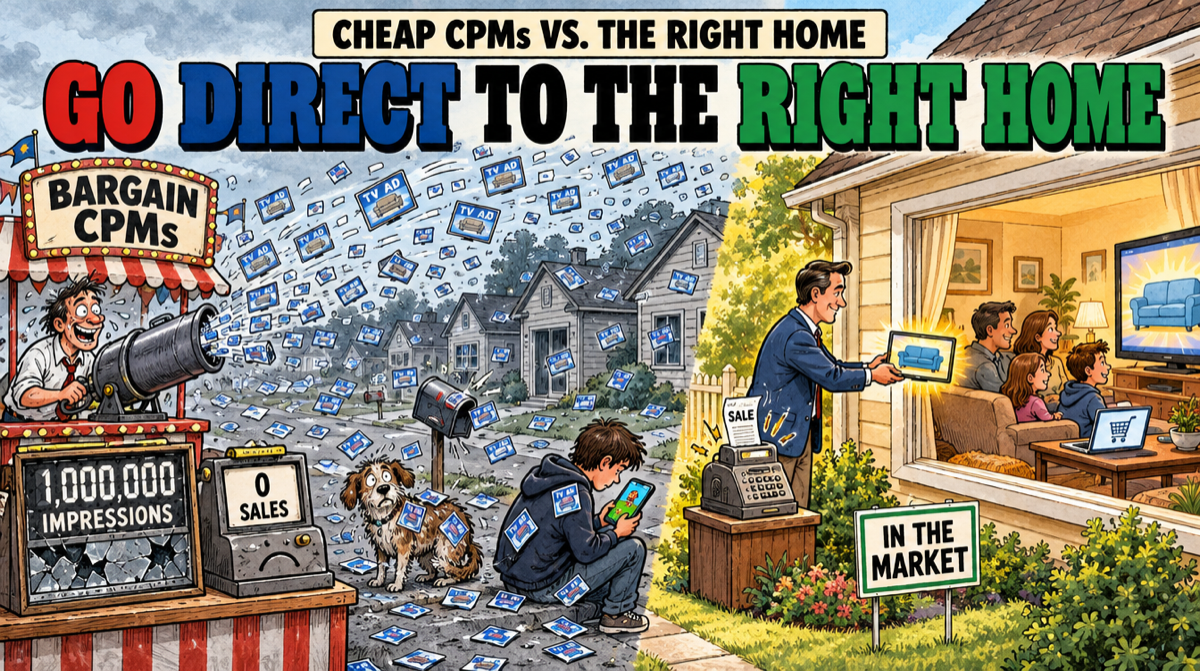
Every streaming TV plan eventually gets the same question from the CFO.
"Why are we paying more per thousand than the other guys?"
It's a fair question. And it has a fair answer.
Buying streaming TV directly from the seller gets you premium shows, clean placements and big reach, and it has a real place in a plan. But the lowest price per thousand impressions (CPM) isn't the number that pays your bills. The number that matters is cost per extra sale: what you spend to cause one sale that wouldn't have happened otherwise. On that number, going directly to a more qualified household usually wins.
Let me explain why, and then let me be honest about where direct deals still belong.
What Does a Direct Deal Actually Buy You?
A direct deal buys you the seller's best stuff: known shows, known apps and a guaranteed place in the line.
That's real value. You know where your ad runs. You get premium content next to your brand. You can reach a lot of homes fast.
The industry is clearly leaning that way. In the ANA's Q4 2025 Programmatic Transparency Benchmark, private marketplaces, the invitation-only deals between buyers and sellers, made up 100% of the CTV transactions it tracked. The ANA also found advertisers "accepting some measurement gaps in exchange for premium content and trusted environments."
So no, direct deals aren't the villain here.
Here's the part that matters.
A direct deal tells you *where* your ad runs. It doesn't tell you *who* is on the couch. And it definitely doesn't tell you whether they were ever going to buy what you sell.
Why Is the Cheapest CPM Often the Most Expensive Sale?
The cheapest CPM is often the most expensive sale because you're paying a low price for a lot of homes that were never going to buy.
Think about it like a car dealer buying a list of names.
List A is 10,000 random households for a bargain. List B is 3,000 households that have been shopping for a car in the last 30 days, and it costs more per name.
Nobody who's ever sold a car buys List A because it was cheaper per name.
Streaming TV works the same way. A thousand impressions in homes that have no interest in your product is cheap. It's also mostly waste. A thousand impressions in homes that are actively in the market for what you sell costs more. It's also where the sales are.
Here's the simple math. If one home is three times as likely to buy as another, you can pay up to three times as much to reach it and still break even. Pay less than that and you're ahead. The CPM went up. The cost per sale went down.
That's not just a theory. The ANA's benchmark found that advertisers who optimized toward quality, "rather than CPM alone, delivered nearly 40% reductions in cost per conversion, even when nominal CPMs increased."
Read that last part again. *Even when CPMs went up.*
The ANA has been warning about this for years. Its 2023 open-web transparency study, which looked at banner and video ads on websites and apps rather than TV, put it bluntly: buyers "chase cheap CPMs." It estimated as much as $20 billion of the $88 billion open-web programmatic market was waste.
Cheap reach is easy to buy. It's hard to cash.
What Is a "Qualified Household"?
A qualified household is a home that shows real signs it's in the market for what you sell, right now.
Not "adults 25–54." Not "people who like cooking shows." A home with intent: it has been shopping the category, researching the problem your product solves or buying from brands like yours.
That's the difference between demographics and intent. Demographics tell you who someone is. Intent tells you what they're about to do.
When we say "going directly to a more qualified household is better than going directly to the seller," this is what we mean. The seller controls the shows. The household controls the wallet.
The best plans use both. Premium shows and apps, served to the homes most likely to buy.
Is Every "CTV" Impression Actually on a TV?
No. And this is the part most media plans never mention.
Some trading desks fill impressions on phones, or inside mobile game apps where an ad plays between levels. On a report, it can all roll up under "video" or "cross-screen." It may even be cheap. But it isn't the big screen in the living room, and it isn't what most brands think they paid for.
There's a second problem, too: impressions that claim to be a TV and aren't a person at all.
One of the big ad-verification firms reported in May that it detected 140% more CTV fraud schemes and variants in Q1 2026 than a year earlier. It also found bots in direct deals, with 34% of impressions going to bots in one consumer healthcare campaign. Its conclusion: "There's a perception that direct deals in CTV are fraud-free, but that's not the case."
Now the good news, and it's important. In the same report, campaigns running with verification controls saw fraud rates under 1%, compared with nearly 9% in unprotected campaigns. And the ANA's benchmark found CTV fraud "remained minimal" in Q4.
So the lesson isn't "watch out for CTV." Real CTV is some of the cleanest, most valuable inventory in advertising. The lesson is that a direct deal doesn't verify itself. You still have to check that your ad ran on a real TV, in a real home, in front of a real person.
That's our no-waste rule at CS & Co. We deliver to the TV screen in a real household. Not a phone. Not a game app. The biggest screen in the house.
How Should You Judge a Streaming TV Buy?
Judge a streaming TV buy by cost per extra sale, read in your own data, not by CPM on a platform report.
Here's how to keep score:
Pick the number before you buy. Decide whether this campaign is building awareness or driving sales this quarter, and write down the one or two numbers that prove it. Our CTV metrics ladder walks through the options. For a lot of brands, cost per session is the most honest early read.
Ask for a device report. What share of your impressions ran on a TV, versus phones, tablets and computers? Which apps? If nobody can tell you, that's your answer.
Verify every buy, direct or not. Independent verification is cheap insurance. A premium deal with no checks is still a guess.
Measure what the ads caused. Compare sales where the ads run against each area's own baseline, and keep a few holdout areas where you don't advertise. That's how you find the alpha, not the beta. And since one measurement source always lies a little, triangulate.
Then compare cost per extra sale. Put the direct deal and the qualified-household buy side by side on that one number. Let the winner earn the next dollar.
The Honest Asterisk
Let's be straight about what this isn't.
It isn't "never buy direct." If you're launching a brand, you may want the biggest shows and the broadest reach you can afford, and a direct deal is a great way to get it. Live sports and tentpole events live there for a reason.
It isn't "pay any price for targeting," either. Some audience data is stale or thin, and a fancy segment name doesn't make a home more likely to buy. The household has to actually be qualified, and you prove that in your sales, not in the pitch.
And it isn't a promise of a specific result. Pricing and performance vary by category, audience and creative. The only honest way to know is to test it in your own numbers.
The Final Take
Going direct to the seller gets you great shows and a lot of homes. That's worth something.
Going direct to the right home gets you the people who are about to buy. That's worth more.
CPM tells you what an impression cost. Cost per extra sale tells you what it was worth.
So when the CFO asks why you're paying more per thousand, you'll have the answer. You're not buying impressions. You're buying the homes most likely to buy, on the biggest screen in the house, and you can prove what each sale cost.
That's how we build every campaign at CS & Co. Qualified homes, real TV screens and proof in your own sales. It's built into the CS Method™. Want to see whether CTV is right for your brand? Find out if it's a fit.
Cory Poccia
CEO, CS & Co. Marketing Studio™