
General Marketing
The Sequenced Metrics Ladder Every CTV Operator Should Know
Learn how to measure CTV campaigns with the right metrics at the right time.
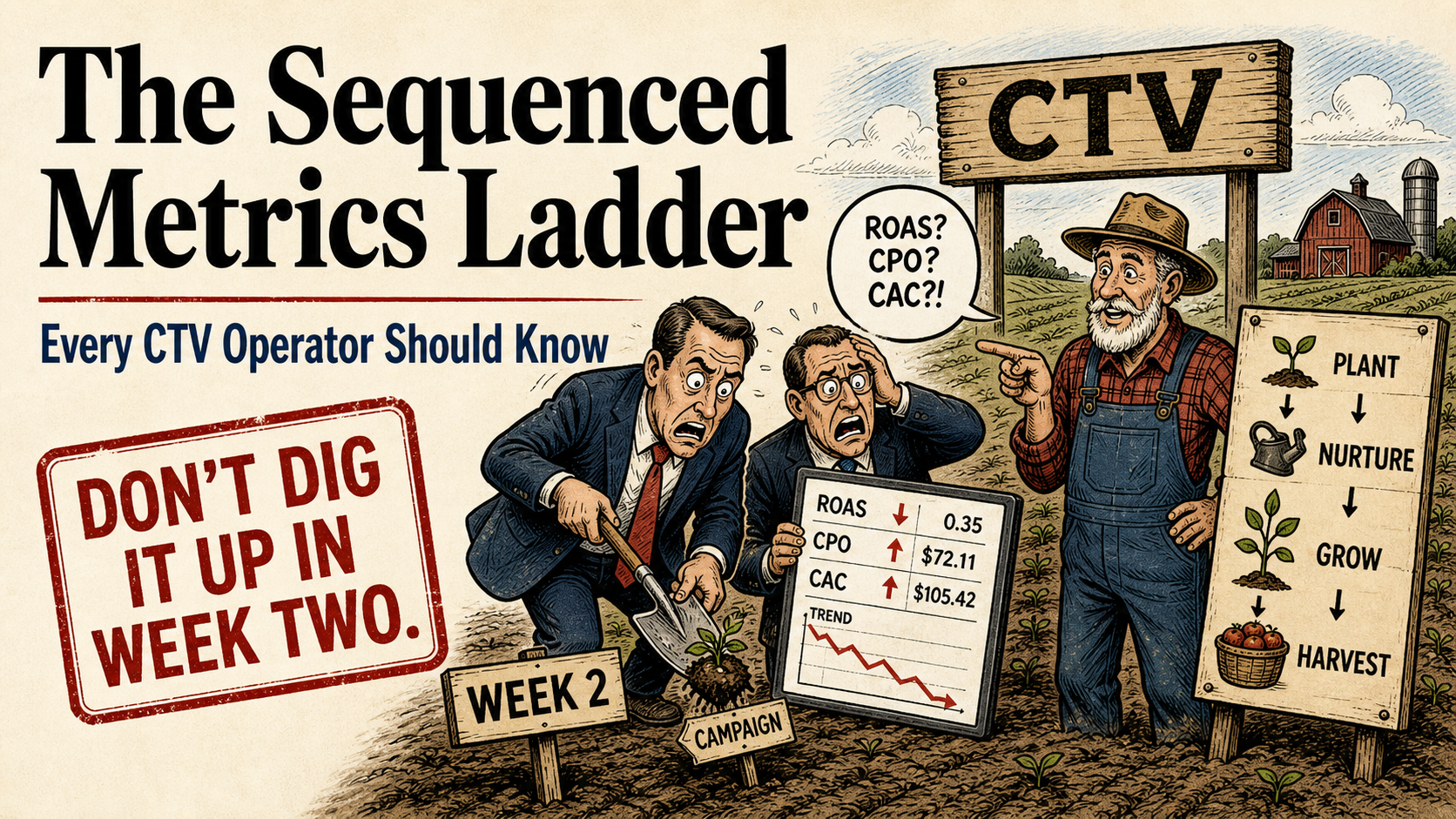
Most brands kill their CTV campaigns in week two.
Not because the campaigns are bad.
Because the brand is reading the wrong metric at the wrong time.
They look at cost per order on day six and panic.
They look at customer acquisition cost on day ten and pull the plug.
They look at ROAS on day fourteen and conclude the channel doesn't work.
What they have actually done is something farmers stopped doing about ten thousand years ago.
They planted a seed and dug it up in the second week to see if it had grown into fruit yet.
It hadn't. They threw it out. They concluded farming doesn't work.
This is what most CTV measurement looks like in 2026.
Let's fix it.
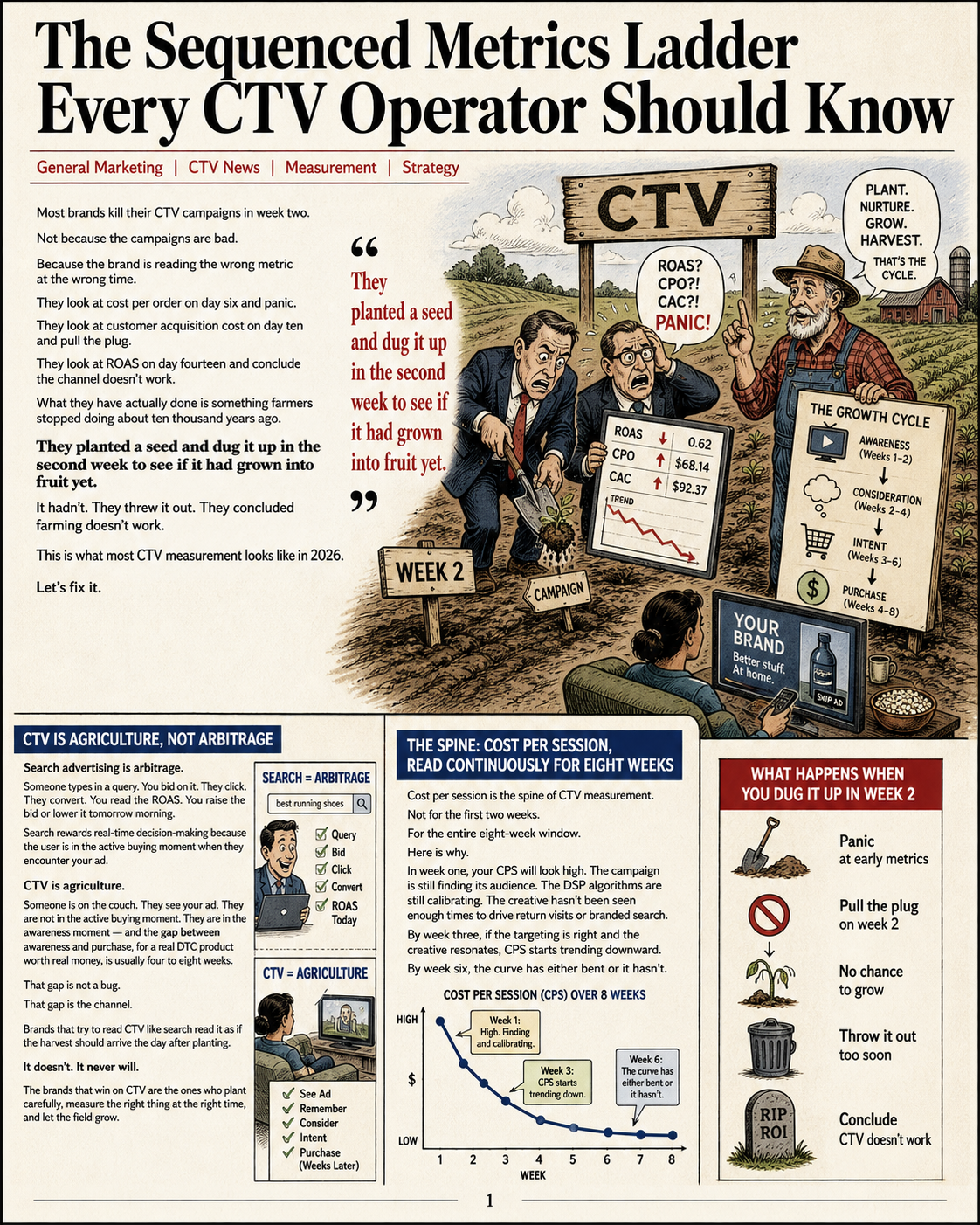
CTV Is Agriculture, Not Arbitrage
Search advertising is arbitrage.
Someone types in a query. You bid on it. They click. They convert. You read the ROAS. You raise the bid or lower it tomorrow morning.
Search rewards real-time decision-making because the user is in the active buying moment when they encounter your ad.
CTV is agriculture.
Someone is on the couch. They see your ad. They are not in the active buying moment. They are in the awareness moment — and the gap between awareness and purchase, for a real DTC product worth real money, is usually four to eight weeks.
That gap is not a bug.
That gap is the channel.
Brands that try to read CTV like search read it as if the harvest should arrive the day after planting.
It doesn't. It never will.
The brands that win on CTV are the ones who plant carefully, measure the right thing at the right time, and let the field grow.
The Spine: Cost Per Session, Read Continuously For Eight Weeks
Cost per session is the spine of CTV measurement.
Not for the first two weeks.
For the entire eight-week window.
Here is why.
In week one, your CPS will look high. The campaign is still finding its audience. The DSP algorithms are still calibrating. The creative hasn't been seen enough times to drive return visits or branded search.
By week three, if the targeting is right and the creative resonates, CPS starts trending downward.
By week six, the curve has either bent or it hasn't.
If it has bent — if your week six CPS is meaningfully below your week one CPS — your creative is working. People who saw the ad on the big screen are coming back to your site of their own accord. Branded search is filling in. Direct traffic is filling in. The campaign is compounding.
If the curve hasn't bent by week six, the creative is the problem. Not the channel. Not the targeting. The creative didn't earn return visits.
That is the only diagnostic that matters for whether your CTV creative is working.
Not view-through rate. Not completion rate. Not impression volume.
The CPS curve, watched continuously over eight weeks.
A Quick Word On View-Through Rate
While we are here.
Most CTV reports lead with view-through rate or video completion rate. 95%, 96%, 97%.
Most agencies frame those numbers as evidence the creative is working.
That framing is wrong.
Here is the test. Ask yourself why CTV view-through rates are so much higher than YouTube view-through rates. The answer is not that CTV creative is better. The answer is that CTV ads cannot be skipped.
The user is held captive by the content they came to watch. Hulu, Peacock, Tubi, Roku — they don't let the user skip. So the user sits there. Or they get up to use the bathroom. Or they check their phone for ninety seconds. The ad plays anyway. The completion rate gets logged.
A 97% completion rate on CTV does not measure attention. It does not measure creative quality. It does not measure intent. It measures the fact that the platform did not allow the user to skip.
If your CTV completion rate is below 97%, the issue is almost certainly technical — buffering, slow ad load, frame drops, malformed ad pods. The 3% who didn't complete didn't bail because your creative was boring. They bailed because the supply chain coughed.
VTR on CTV is a diagnostic for the supply chain. It is not a measurement of creative effectiveness.
The metric that measures creative resonance on CTV is CPS trending downward over weeks four through six.
If the curve bends, the creative works. If it doesn't, the creative doesn't.
Stop reporting completion rate as a creative KPI. It isn't one.
Layering In The Other Metrics
CPS is the spine. The other metrics layer in as they earn statistical significance.
Weeks 2–4: Cost Per Lead joins the read.
CPL means cost per add-to-cart, cost per checkout-page-view, cost per email signup, cost per any meaningful intent signal short of purchase.
Once CPL has accumulated enough volume — usually around week three — you watch it alongside CPS.
The diagnostic that matters most is the CPS-to-CPL ratio.
If your CPS is $3 and your CPL is $6, you have a 2:1 ratio. Roughly 50% of qualified sessions are converting into leads. That is healthy. The website is doing its job.
If your CPS is $3 and your CPL is $30, you have a 10:1 ratio. Sessions are arriving but they're not converting into intent. That is not a CTV problem. That is a website problem.
This is the most important point in this entire post.
Once the user gets to your website, OTT's responsibility ends.
The bounce, the abandoned cart, the friction in checkout — those are conversion-rate-optimization problems. They are not CTV problems. The CTV ad already did its job: it brought the qualified visit at an efficient cost. Everything that happens downstream is a function of the experience your site delivers.
Most operators don't understand this. They blame CTV for landing-page failures. The agencies that let them blame CTV are the ones that lose the account in week eight.
Weeks 4–6: Cost Per Order joins the read.
CPO matures slowly because real DTC purchase decisions take time. People see your ad on the big screen. They search the brand on their phone three days later. They compare it to two competitors. They read reviews. They wait for a paycheck. They get a reminder from your retargeting. They finally convert in week five.
If you killed the campaign in week two because CPO looked bad, you killed it before any of that journey could complete.
A healthy CPO is category-specific. The right benchmark is your blended target CAC, scaled to your channel-mix expectation for CTV — usually somewhere between 1.0x and 1.5x of your blended target depending on whether you treat CTV as upper-funnel or full-funnel.
For a supplement brand with a $60 target CAC, a healthy CTV CPO at week six is $50–$90. By week eight, you should be inside the target.
Weeks 6–8: New Customer Acquisition Cost is the harvest.
This is the number that tells you whether CTV is acquiring net-new customers at a sustainable cost — not retargeting existing buyers, not inflating apparent performance with repeat purchasers, but actually building the brand.
By week eight, you should have enough data to read nCAC with statistical confidence.
If nCAC clears your LTV-to-CAC threshold (3:1 minimum, 4:1 healthy), the campaign is working and should scale.
If nCAC is above threshold but trending toward it, give it another two weeks before deciding.
If nCAC is significantly above threshold and not moving, then — and only then — you have permission to question the channel.
Not in week two. Not in week four. Week eight.
The Diagnostic Metric Most Operators Forget
Frequency.
Frequency is not what you optimize toward. It is what you check on the way past.
Healthy CTV frequency for DTC: 3 to 6 exposures per household per week.
Below 3, your audience is too broad and your reach is too thin to drive memory.
Above 6, you are paying for impressions on households who have already decided.
If your frequency is running at 8, 10, or 12 per household per week — and we have audited campaigns running at 12+ — your audience is too narrow, your frequency cap is misconfigured, or your creative pool is too small to support the spend level. You are not buying incremental reach anymore. You are buying repetition.
The fix is not always more spend. Sometimes the fix is broader audience targeting, tighter frequency caps, or a fresher creative rotation. Diagnose first, prescribe second.
The Full Ladder, On One Page
WindowMetricRoleHealthy ReadWeeks 1–8 (continuous)Cost Per SessionSpine — measures whether creative drives return visitsCurve bends downward by week 4–6Weeks 2–4 onwardCost Per LeadDiagnoses whether the website converts the visitCPS-to-CPL ratio of 2:1 or betterWeeks 4–6 onwardCost Per OrderFirst meaningful purchase signal1.0–1.5x of blended target CACWeek 6+New Customer Acquisition CostThe harvest — channel sustainabilityInside LTV:CAC threshold of 3:1AlwaysFrequencyAre you over-paying for the same impression?3–6 exposures per household per weekNeverView-Through RateSupply chain diagnostic, not creative KPIBelow 97% means a delivery problem
That is the ladder. Read each metric in its window. Stop reading the metrics that haven't matured yet.
Why Most Operators Get This Wrong
Three reasons.
One. The dashboards report everything at once. Northbeam, Triple Whale, and Vibe.co all show CPO and ROAS on day one. The data is there. The data is just statistically meaningless until week six. The dashboard doesn't tell you that. It just shows the number.
Two. CFOs and skeptical executives demand single-number reporting. "What's our CTV ROAS?" is the question. Answering "ask me in six weeks" is professionally uncomfortable. So agencies and operators answer with whatever number they have, even when the number isn't ready to be read yet.
Three. The discipline of reading metrics in sequence requires patience that most performance-marketing teams have been actively trained out of. The whole field of digital performance was built on real-time optimization. CTV doesn't reward real-time optimization. It rewards measured patience and correct sequencing.
The agencies that are good at CTV are the ones that resist all three pressures.
What This Means For Your Monday Morning
Three rules.
Rule one. Build a metrics calendar, not a metrics dashboard.
Decide in advance which metrics you read in week one, week three, week five, and week eight. Hold the line. When the CFO asks for a CPO read in week two, you tell them — politely, with data — that the CPO read at week two will be wrong, and you can show them why.
Rule two. Separate CTV's accountability from CRO's accountability.
CTV is responsible for cost per qualified visit. CRO is responsible for what happens after the visit. If your CPS is healthy and your CPO is bad, the problem is downstream of CTV. Fix the landing page. Fix the offer. Fix the checkout. Don't blame the channel for a website problem.
Rule three. Give every CTV campaign at least six weeks before judging it.
Eight weeks if the brand is new to the channel. Six if the brand has run CTV before and the team is calibrated.
If you cannot commit to six weeks, you should not start the campaign. The math will not work in the window you are giving it.
Final Take
Most measurement debates in adtech are not about measurement.
They are about timing.
Reading the right metric at the wrong time produces the wrong conclusion every single time.
Cost per session is the spine, watched for eight weeks straight.
Cost per lead joins the read once you have enough volume to trust it.
Cost per order is the first real purchase signal, and it doesn't show up until week five.
New customer acquisition cost is the harvest, and it doesn't show up until week eight.
Frequency is the metric you check on the way past, every single week.
View-through rate is not a metric you optimize toward. It is a supply-chain diagnostic. Treat it accordingly.
You do not eat the fruit the day you plant the seed.
You water it. You weed around it. You watch the weather. You wait.
Eight weeks later, you harvest.
The brands that learn to wait are the ones that build sustainable CTV programs.
The ones that dig up the seed in week two — those brands keep concluding the channel doesn't work.
The channel works.
The timing is the discipline.
Sincerely,
Cory Poccia
CEO, CS & Co. Marketing Studio
CS & Co. Marketing Studio is a CTV-only performance agency. We build sequenced measurement frameworks for DTC brands scaling CTV from six figures to seven, calibrated to the consideration window the channel actually requires. If your team is reading CTV metrics on the search-channel timeline and getting search-channel answers, get in touch.
CTV News | Measurement | Strategy | The Metrics Ladder