
General Marketing
They Cut the Clutter. They Kept the Shows.
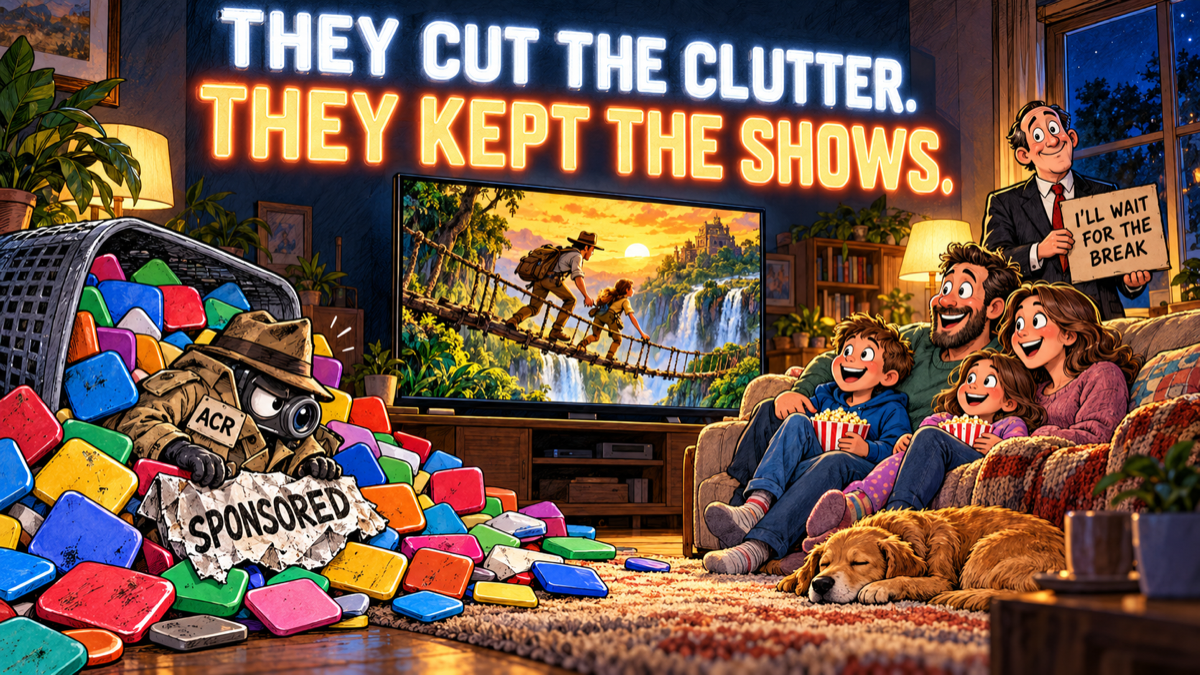
Two open-source projects, dumbtv and cleanyourtv, now let AI walk people through stripping sponsored tiles, preloaded apps and viewing tracking off their smart TVs. It's a techy crowd for now. But look at what they kept: their apps and their shows. That's where your CTV plan should live.
On Saturday afternoon, a developer named Gathin T. got fed up with his parents' TV.
"It was showing a sponsored ad before you could even get to Netflix," he posted on X. So he gave Claude Code the model number. The AI found the TV on the home Wi-Fi, removed 25 Xiaomi packages and wrote a brand-new home screen. "Looks like an Apple TV now lol."
He put his method on GitHub. By his own account, a few thousand people did the same to their own TVs over the next two days.
That project is called cleanyourtv. Another, called dumbtv, does the same kind of job on Fire TV and Google TV sets from Sony, TCL, Philips, Hisense and Xiaomi. Gadget Review covered both this week, building on TechCrunch's reporting, which summed up the trend perfectly: people are using AI to make their smart TVs dumb again.
If you buy streaming TV ads, your first reaction might be panic.
Read the fine print first. Because what these viewers are deleting tells you exactly where your ads should be.
What They're Actually Removing
dumbtv's GitHub page states its mission in one line: "Your TV should do what you paid for: your apps, your HDMI inputs, and nothing else. No ads from the TV itself, no watch tracking, no update you did not ask for."
Notice four words. "From the TV itself."
The main target is the layer the TV maker bolts on top:
- Sponsored tiles and promo rows on the home screen.
- Preloaded apps nobody asked for.
- ACR, or automatic content recognition. It identifies what's on your screen using screenshots, audio clips or other digital fingerprints, per TechCrunch. Research cited by Gadget Review found it can identify what's playing from built-in apps, broadcasts and even devices plugged in by HDMI.
cleanyourtv is just as plain. It switches off the manufacturer's "telemetry, ad services, content rows and preloaded junk," then installs a clean home screen with the viewer's four favorite apps in a dock.
Their favorite apps. Still there. Front and center.
That's the whole story. People aren't throwing out streaming. They're throwing out what stands between them and it.
Clutter and Creepiness Are the Problem. Not Ads.
This is where a lot of people will draw the wrong conclusion.
These folks aren't saying "no ads, ever." They're saying no to two specific things.
Clutter. An ad you have to get past before you can even reach the show you came for. That's not an ad break. That's a toll booth.
Creepiness. A TV quietly fingerprinting everything on the screen, including the game console. Most people don't remember agreeing to that, even when they technically did. (Gadget Review notes ACR on some platforms, including certain Samsung models, is described as optional and consent-based.)
Now compare that to a relevant commercial inside a show someone picked, in an app they chose to keep, at a sane frequency. That's the deal TV has offered for generations. Great content, paid for by ads. Viewers get it.
To be fair, the line isn't perfect. dumbtv's Fire TV pass also removes preloaded ad-funded streaming apps a household doesn't say it watches, and it offers an opt-in way to swap out one app's ad-supported player. When the ad experience inside an app is bad, people push on that too.
Which is why respect matters inside the show as well. More on that below.
The Asterisk: It's a Niche Crowd. For Now.
Let's keep this honest.
This takes developer mode on the TV, a computer on the same Wi-Fi and an AI coding assistant. That's not most households on a Tuesday night. Both projects are works in progress, and TechCrunch notes one person said they bricked their Android TV along the way.
And many of the biggest TV platforms are out of reach. dumbtv's own README says there's no path in on Samsung, LG, Roku or Vizio sets.
So no, the home screen isn't going anywhere next quarter.
But cleanyourtv went from a Saturday tweet to more than 5,000 GitHub stars by Monday night. Its README lists 66 TVs tested across 25 brands. And TechCrunch spelled out the stakes: if these hacks catch on with everyday consumers, they could disrupt a smart TV ad industry that "profits from selling viewing data to advertisers or using it to display personalized ads on their own interfaces."
That's not a crisis. It's a signal. Smart buyers act on signals before they turn into crises.
What This Means for Your CTV Plan
Here's how I'd read it if I were spending real money on streaming TV.
Buy where viewers chose to be. The strongest place in CTV is premium in-stream: your ad inside the show, inside the app the household picked. These projects keep the apps people actually use. Nobody's writing a script to delete the show they sit down to watch.
Treat the home screen as a bonus, not the foundation. Last week I wrote about AI agents buying the hero spot on LG home screens. On most TVs, that's still valuable real estate. But it's the TV maker's real estate, not the viewer's choice. Use it. Don't build the whole plan on it.
Don't bet the plan on one TV maker's ACR data. If your targeting or your proof depends on a single manufacturer's viewing data, you're renting it. We said the same about Apple's private block list: if someone else's switch can turn off your proof, you don't own your proof. ACR can already be turned off in settings. Now it can be turned off by script.
Respect the viewer inside the show. The fastest way to make people hate ads is to show them the same one six times in an hour. Too much frequency hurts, so cap it. Then space your ads so each one lands when it counts.
Measure by sales, not surveillance. You don't need to fingerprint someone's living room to know if TV worked. Read your own orders by area against each area's baseline. Keep a few holdouts. If demand moves where the ads run, it shows up in your sales.
The Final Take
People just showed us, with an AI assistant and a free afternoon, what they want from their TV.
Their apps. Their shows. Nothing in the way. Nobody watching them watch.
That's not a threat to CTV. It's CTV's best argument. The show is the thing people protect. So that's where your ad belongs: inside the content they chose, at a frequency that respects them, measured by what it sold.
Advertisers who squat on the home screen and lean on tracking will feel this first. Advertisers who earn their place inside the show may never feel it at all.
That's how we build every plan at CS & Co. It's the CS Method™: premium placements, sane frequency and proof in your own sales. Want to know if your plan is built on solid ground? Find out if CTV is a fit.
Cory Poccia
CEO, CS & Co. Marketing Studio™