
General Marketing
Cable Refuses to Die. The Smart Money Runs CTV Right Alongside It.
Every year someone writes cable's obituary, and every year it gets back up. Epsilon's 2026 Media Consumption Survey finds 4 in 10 households still use cable or satellite, and a third use cable and streaming together. The lesson isn't to pick a side. It's to run CTV right alongside linear and reach the homes linear can't.
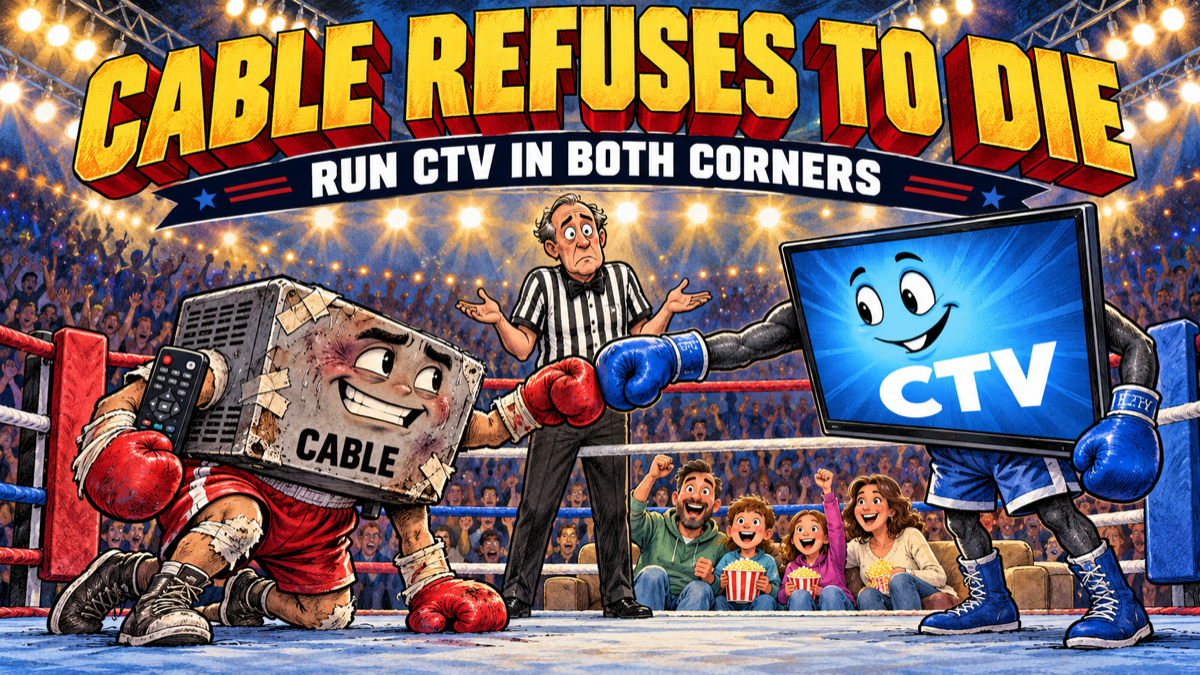
Every year, somebody writes cable's obituary. And every year, cable gets back up.
That's how MediaPost opened its look at Epsilon's 2026 Media Consumption Survey. It described cable as "a retired prizefighter taking punches in slow motion" that "somehow gets up off the canvas, asks where the remote is, and sticks around for another round," per MediaPost's Research Intelligencer.
The survey's finding: streaming remains dominant, but cable still holds "a surprisingly durable place in American households."
I love this story. Not because I'm rooting for cable. Because it kills the dumbest question in TV advertising: "Should we be on cable or streaming?"
The answer is yes.
What the Survey Actually Found
Epsilon surveyed 1,627 U.S. adults, ages 18 to 77, in March. Here's what jumped out, straight from the full report.
Streaming is nearly universal. 89% of households use at least one streaming service. Among Gen Z it's 98%.
Cable is still in 4 in 10 homes. 40% use cable or satellite TV. Among Boomers it's 56%.
A third of America uses both. 31% use cable and streaming together. Only 9% are cable-only. 58% are streaming-only.
Cable is still the single service used most. When people ranked what they watch most often, 28% put cable or satellite first. That's down from 35% in 2023, so the trend is real. But no single streaming service beat it.
And Epsilon found about 3 in 10 Millennials who dropped cable in the past year are considering getting it back in the next 12 months.
So yes. Cable refuses to die.
Each Screen Has a Job
This is the part I'd circle.
Among people who use both cable and streaming, Epsilon asked which one they prefer for each kind of viewing.
- News: 78% prefer cable or satellite.
- Sports: 62% prefer cable or satellite.
- Movies: 70% prefer streaming.
Households aren't choosing a side. They're splitting the jobs. Live news and a lot of live sports still pull them to linear. Movies and shows pull them to the apps.
Your customers already run a two-screen plan in their own living room. Your media plan should too.
Streaming Is Half of TV. Linear Is Still a Big Slice.
Nielsen's numbers tell the same story from the viewing side.
In July 2026, streaming hit 49.0% of all TV time, according to Nielsen's July report of The Gauge. Broadcast had 19.5% and cable had 18.7%.
Streaming is the biggest category, and it's still growing. That's why CTV is the hero of almost every plan we build.
But add broadcast and cable together and linear was still 38.2% of TV time in July. And when the World Cup Final came around, FOX owned 25 of the month's top 26 telecasts, per Nielsen.
That's not a dead channel. That's a different audience at different moments.
Why the Win Is Running Both
Here's the number that should end the debate.
Earlier this month, Comcast Advertising released its Multiscreen Performance Report. On campaigns that ran on traditional TV and streaming, traditional TV delivered 71% of the unique reach, streaming delivered 21%, and only 8% of households were reached by both.
Think about what that means. More than one in five households those campaigns reached were found only on streaming. And because the overlap was just 8%, streaming wasn't hitting the same homes again. It was finding new ones.
Comcast also says campaigns that paired TV with streaming delivered a 2X incremental return on ad spend and 2.4X more website visits than campaigns using only one tactic. We broke that report down in TV + Streaming Doubles Your Return.
So if you already buy linear, CTV is how you reach the homes you've been missing. The cord-cutters. The cord-nevers. The 58% of households Epsilon found are streaming-only.
And if you only buy CTV, the 31% of homes that use both are still turning to cable for news and live games.
Three Things CTV Adds to a Linear Plan
Incremental reach. This is the big one. Linear reaches who's on linear. CTV adds the households linear can't, on the same big screen in the same living room.
Frequency control. CTV lets you cap how often a household sees your ad and spread the impressions out. Here's how we think about frequency caps.
Measurement in your own sales. Streaming is bought by household and by geography. That means you can read results in your own data: orders by ZIP and DMA, branded search, direct site traffic, against a baseline. And if the screens are working together, your own numbers will show it.
The Honest Asterisk
A few things worth saying out loud.
Epsilon's survey is self-reported. It's 1,627 people telling a researcher what they use and prefer, not a meter on their TV. Some of the subgroup samples, like lapsed cable users, are small, and Epsilon flags them as such.
Comcast sells both TV and streaming ads. It picked the data and the partners, and "2X" is a ratio, not a dollar figure.
And Nielsen notes The Gauge measures all TV viewing, ad-supported or not. It isn't the currency ratings ads are bought on.
None of that changes the direction. Three different sources, three different methods, one conclusion: people watch both, and the reach is in running both. But the proof for your brand is in your own sales, so triangulate.
What This Means for Your Plan
If you're a linear buyer, add CTV as the reach engine. Don't cut what's working. Layer streaming on top to find the homes your linear plan doesn't touch.
Give each screen its job. Live news and live sports can still anchor a linear buy. CTV extends the plan into the homes and moments linear misses, including live sports on streaming.
Coordinate the frequency. Two screens can mean too many ads in the same home. Plan them together, not stacked.
Buy households, not just impressions. The cheapest CPM isn't the win. Reaching the right new homes is. More on that in qualified households beat cheap CPMs.
Keep score by geography. Read your orders by market against each market's own baseline. If the combined plan works, it'll show up there first.
The Final Take
Cable isn't dead. Streaming is winning. Both are true.
Streaming now has nearly half of all TV time and nearly every household. Cable still has 4 in 10 homes, the news and a lot of the big games. And the families in the middle, the third of America using both, don't think of it as a fight at all. They just pick up the remote.
So stop asking which screen. Ask how they work together.
That's the work we do at CS & Co. We work with linear and cable buyers and the brands behind them to get the most out of CTV alongside linear: more new households, controlled frequency and results you can see in your own sales. It's built into the CS Method™. Running linear and wondering what CTV would add? Find out if CTV is a fit.
Cory Poccia
CEO, CS & Co. Marketing Studio™