
General Marketing
Everyone Wants the Big Game. The Hard Part Is Proving It Sold.
A new survey of 302 ad decision-makers says 73% plan to put money into live sports on streaming TV. Reaching fans isn't the problem. Cost and proof are. Here's how to buy the game without overpaying, and how to prove it sold something.
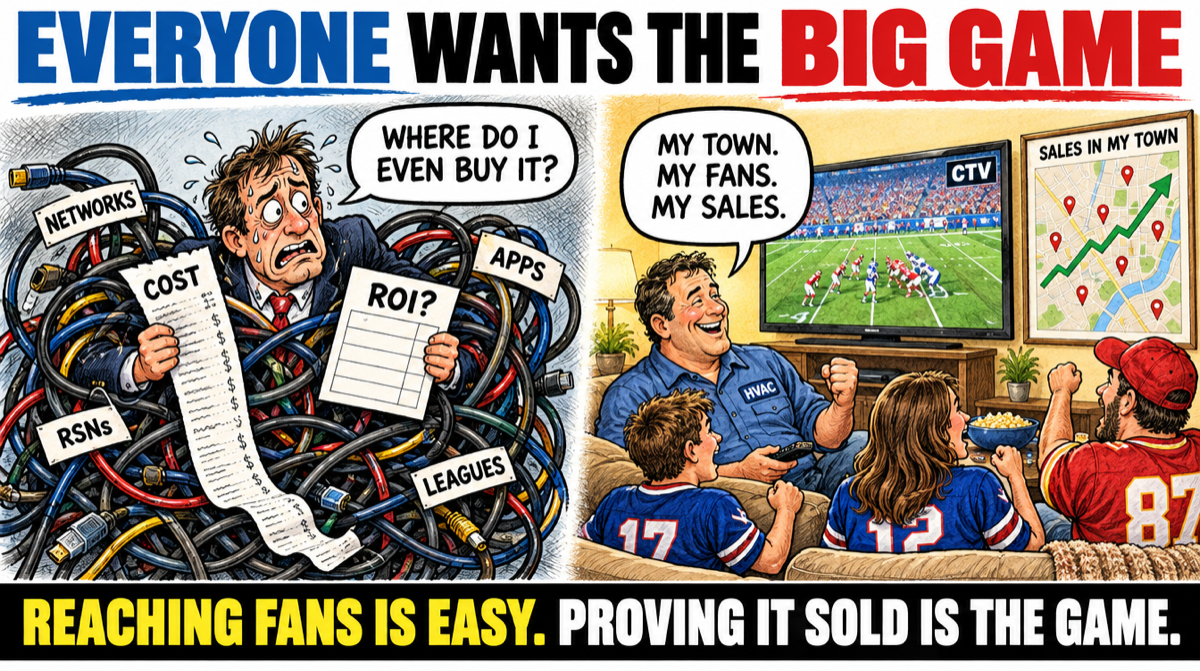
October is the best month of the year to be a sports fan.
Playoff baseball. Football every weekend. And more of it is moving to streaming, on the TV in the living room, where the whole family is watching.
Advertisers have noticed.
A new survey from Premion and Advertiser Perceptions asked 302 U.S. advertising decision-makers about live sports on streaming TV. 73% said they plan to put budget into it over the next six to 12 months. Among agencies, it's 79%. Among brands buying for themselves, 65%.
So the appetite isn't in question.
Here's the part that matters more: the same survey shows what's actually stopping people from spending more. And it isn't the fans.
Reaching Fans Is the Easy Part
Ask advertisers why they want live sports, and the answers are exactly what you'd expect.
61% say it's reaching highly engaged fans during live events. That's the number one reason.
52% want the big live moments that pull big audiences.
41% want their brand next to premium live content.
40% want to extend the reach of what they're already running on regular TV.
37% want to find the cord-cutters and streaming-first fans who don't watch cable anymore.
None of that surprises me. Nobody half-watches a Game 5. Live sports is the one place left where millions of people sit still, at the same time, and pay full attention to something they can't pause.
And here's the tell. When the survey asked about obstacles, the lowest-ranked one, at just 23%, was "difficulty reaching sports audiences at sufficient scale."
Read that again. Only about one in four buyers thinks reaching the fans is the hard part.
The fans are there. They always were.
So What's Actually in the Way?
Two things. Money and proof.
44% of advertisers say cost is the biggest barrier to spending more on live sports streaming.
41% say it's difficulty measuring performance and return on investment.
Then come the headaches of a messy market. 35% cite a lack of transparency into delivery and reporting. 34% cite the complexity of buying across multiple publishers and platforms. Another 34% cite limited access to premium live sports inventory.
That's the cartoon at the top of this post. It's not that the game isn't worth it. It's that the game is spread across networks, apps, regional sports networks, team apps and league deals, and every one of them sends a bill and a different report.
In TVREV's write-up of the findings, Blake Hebert of Premion put the complexity plainly: rights are spread across "broadcast and cable networks, streaming platforms, regional sports networks, team-owned apps and other publishers," and the available inventory "can vary by league, team, platform and market."
So the question every brand should be asking isn't "should we be in live sports?"
It's "how do we get in without overpaying, and how will we know it worked?"
The Most Interesting Number in the Survey
When advertisers ranked the measurement they care about most, the winner wasn't attribution. It wasn't clicks.
It was local.
57% ranked audience delivery and geographic reporting down to the local market as one of their most important measurement capabilities. That was higher than anything else tested.
Attribution came next at 52%. Then transparent reporting across publishers and incremental reach beyond regular TV, both at 49%.
I love this answer, because it's the right instinct.
Before you argue about which click gets the credit, you have to know the basics. Did my ad run in the markets I paid for? Did it reach real people there? And did anything change in those markets afterward?
That's how we've always believed CTV should be judged. Not by a pixel. By what happens to your sales, in the places your ads ran, compared to the places they didn't.
The Local Door Is Open
The other thing worth noticing in the TVREV piece is who's buying.
Automotive is still a big category. But Hebert says they're now seeing local credit unions, personal injury attorneys, HVAC companies and other home-services businesses get into live sports on streaming.
His reasoning: streaming "is helping democratize access." Premium sports used to be a big-budget linear buy that smaller businesses couldn't touch. Streaming is creating more ways in.
And the audience doesn't have to be the Super Bowl. He points to college athletics, women's sports, high school sports and soccer, events with passionate fan bases where "what constitutes a premium sports audience can look very different from market to market."
That's the real opportunity. You don't need the biggest game in America. You need the fans who matter in your market, watching the game they care about, on the biggest screen in the house.
Here's the Honest Asterisk
Let me be fair about the source.
This survey was commissioned by Premion, a company that sells streaming TV advertising, including live sports. The respondents all had at least $1 million in planned ad spend, so this isn't a read on the smallest local businesses. And "plan to invest" is intent, not money out the door.
None of that makes the findings wrong. The two obstacles it found, cost and proof, are exactly the two questions any brand should ask before buying anything. Just read it as a strong signal, not gospel.
How to Buy the Game Without Getting Tangled
If you're one of the 73%, here's what I'd do.
Buy the audience, not the logo. The biggest national game is also the most expensive. The local fans who care about the local team, the college rivalry or the high school final are often just as locked in. Judge every buy by what each sale actually costs you, not by how impressive the matchup sounds.
Ask for the market-level report before you sign. If the seller can't tell you where your ads ran, down to the market, you can't measure what they did. That's the 57% answer, and it's non-negotiable.
Read your own sales by market, every day. Compare the markets where your sports ads run against each market's own normal. Then check it from a few angles, because one instrument always lies: your orders, branded search by area, direct traffic and a simple "how did you hear about us?" at checkout.
Keep a holdout. Leave a few comparable markets dark. It's the cleanest way to see what the ads actually caused, and it's how you measure the alpha CTV really creates instead of taking credit for sales you'd have gotten anyway.
Don't throw out a good buy because one report is thin. Hebert makes a fair point: inventory without game-level or team-level reporting still has value if the campaign is moving showroom traffic or website actions in the right markets. Your sales are the scoreboard. Use them.
The Final Take
Live sports on streaming TV is having its moment. Three out of four advertisers want in, and they're right to.
The fans are there. The attention is there. The living room is there. CTV gives you all of it, with the ability to show up only in the markets you care about.
What separates the winners from the people tangled in cables isn't access to the game. It's discipline. Buy the audience that matters to your business. Demand to know where your ads ran. And keep score with your own sales, market by market.
Because reaching the fans is easy now.
Proving it sold something is the whole game.
That's how we build and measure every campaign at CS & Co. It's built into the CS Method™. Wondering if live sports on CTV makes sense for your brand? Find out if CTV is a fit.
Cory Poccia
CEO, CS & Co. Marketing Studio™