
General Marketing
The Robots Are Buying TV Now. Who’s Checking If It Sold?
LG and Magnite just let AI agents buy the hero spot on LG smart TV home screens. That's good news for CTV: faster setup, premium placements, fewer spreadsheets. But speed isn't proof. The agent can buy the ad. You still have to know if it sold.
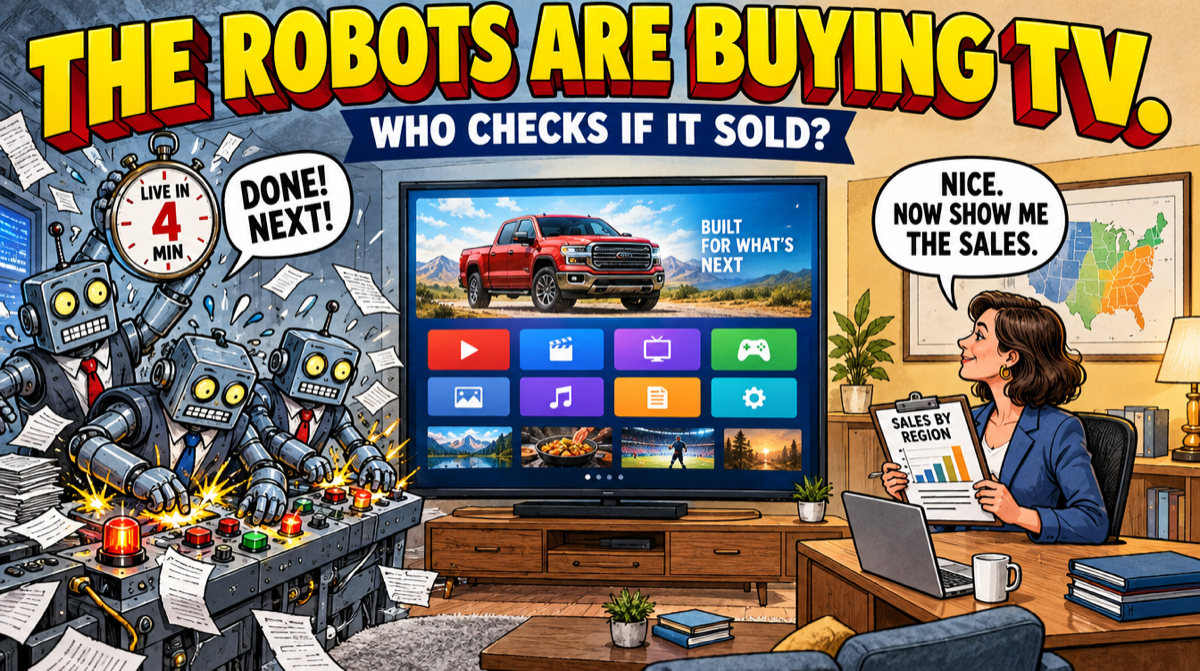
This morning, the AI agents got the keys to the living room.
Magnite and LG Ad Solutions announced that the hero ad spot on LG smart TV home screens can now be bought through agentic AI, according to AdExchanger. That's the big tile you see the second the TV turns on, before you've picked a show.
The first campaign through the new pipes is a Northern California Toyota Dealers Association ad featuring 49ers quarterback Brock Purdy next to a red Tacoma, bought by the independent agency H/L. Video plays on the left side of the takeover, a static image on the right, and the sound kicks in when a viewer hovers over it with the remote.
Here's how it got bought. H/L's buyer agent talked to Magnite's seller agent inside Magnite's ClearLine platform using Model Context Protocol, the open "plumbing" standard that lets AI tools work with other software. The agents built and activated the campaign from the brief: NFL viewers who are also in the market for a new car.
Then humans at LG and H/L looked it over and approved it before it went live.
This is good news for CTV. Let me explain why, and then let me explain the part nobody's agent is going to do for you.
Why This Is a Win for CTV
The home screen is some of the best real estate in streaming.
H/L's Jeremy Cobb called home screen ads "table stakes" in its buying strategy. His reasoning: plenty of viewers are on their phones while they stream, and plenty stream ad-free, so the home screen catches them in the few seconds before they disappear into a show.
That's attention, on the biggest screen in the house, at the exact moment someone sits down to watch.
Buyers have been asking for easier ways to buy streaming formats beyond the classic 15- and 30-second spot, AdExchanger notes, and Magnite already sold home screen inventory programmatically. Agentic buying makes that transaction "faster and cleaner," as Cobb put it.
This isn't a one-off, either. Back in September, Magnite announced it was extending agent-driven buying to interactive home screen placements from Samsung Ads, local linear TV and addressable TV through partners including DIRECTV Advertising.
On the buy side, it's already real. AdExchanger reported last week that the self-serve CTV platform Vibe says more than 1,000 brands have adopted its MCP integration, and that one independent agency now runs the majority of its biddable campaigns through an agentic workflow.
So the direction is clear. More premium CTV inventory, easier to reach, for more advertisers, including smaller ones that never had a team to wrangle it.
That's more brands on the biggest screen in the house. We're all for it.
Here's the Part That Matters
Look closely at what the agents actually did in that LG campaign.
They set up the plan. They activated the buy. Fast.
They did not decide what success means. And they didn't prove anything sold.
Even the people running the campaign say so. "Agentic media buying is not something that's going to fundamentally change what we're doing," Cobb told AdExchanger. It makes planning "better, faster and stronger." It doesn't change the job.
For this campaign, that's fine. H/L told AdExchanger it's an upper-funnel branding play, judged mainly on cost per reach, plus reach and awareness. They know exactly what they're buying and why.
But here's what worries me about the next 1,000 brands.
When a campaign can go live in minutes, the temptation is to let the same tools that bought it also grade it. Check the agent's report, see the dashboard is green, move on.
That's how you end up with a beautifully efficient machine optimizing toward the wrong number.
We've seen this movie with self-serve platforms. Making the button easier to push never made the button smarter. An agent will chase whatever metric you hand it, and chase it hard. Hand it cheap reach, it finds cheap reach. Hand it clicks on a TV, and good luck.
An agent is a very fast employee. It's not a strategy.
Speed Is Not Proof
There's a line from AdExchanger's agentic piece I keep coming back to. One agency exec said the job is changing from being an expert in pushing platform buttons to being "an expert in being judicious about what changes to make."
Exactly right.
And you can only be judicious if you know what's working. Not what the platform says is working. What your sales say.
That's the job agents just made more important, not less.
Notice who's on that first campaign, too. A regional dealer group, buying TV for Northern California. That's local CTV, and local is where you can read the truth most clearly. Did showroom traffic, leads and sales move in the areas where the ad ran, compared with each area's own normal? Your own data can answer that. No agent required.
How to Keep Score When the Robots Do the Buying
Let the agents do the buying. Keep the scorekeeping for yourself.
Decide the job before the agent gets the brief. Is this campaign building awareness or driving sales this month? Write down the one or two numbers that prove it, using the CTV metrics ladder. The agent optimizes toward the goal; you pick the goal.
Read results in your own sales data. Your order system, your CRM, your store or dealer data. It's first-party, it's yours, and no platform grades its own homework there.
Read by geography. Compare sales where the ads run against each area's own baseline, every day. One measurement source always lies a little, so triangulate.
Keep holdouts. A small, rotating set of areas where you don't advertise is still the cleanest way to see what the ads actually caused. That's how you measure the alpha, not the beta.
Keep a human in the cockpit. The LG campaign did this right: people approved the agent's plan before launch. Do the same with the agent's optimizations. One InterMedia exec put it perfectly: "You can trust AI to fly a plane, but I still want a pilot in the cockpit to watch it."
None of this slows the agents down. It just makes sure they're running in the right direction.
The Final Take
AI agents can now buy one of the best spots in streaming, the moment the TV turns on.
That's a genuine step forward for CTV. Premium placements, faster buys, and room for more brands on the biggest screen in the house. We've been saying for a while that AI was going to change how TV gets bought. Now it's here.
But here's the asterisk. The robots can buy the ad. They can't tell you if anyone bought the truck.
That part is still on you. Your sales data, your geography, your holdouts, your judgment.
Because the brands that win this next chapter won't be the ones with the fastest agents. They'll be the ones who know which agent's work actually made the register ring.
That's how we run every campaign at CS & Co. Speed where it helps, proof where it counts. It's built into the CS Method™. Want to see if CTV is right for your brand? Find out if it's a fit.
Cory Poccia
CEO, CS & Co. Marketing Studio™