
General Marketing
Stop Asking How Many Times. Start Asking When.
Every CTV plan asks how many times a household should see the ad. Almost none ask when. A memory experiment from 1885 found that spaced repetitions beat crammed ones by a wide margin. Here's how to plan your Q4 streaming flight backward from your sales day.
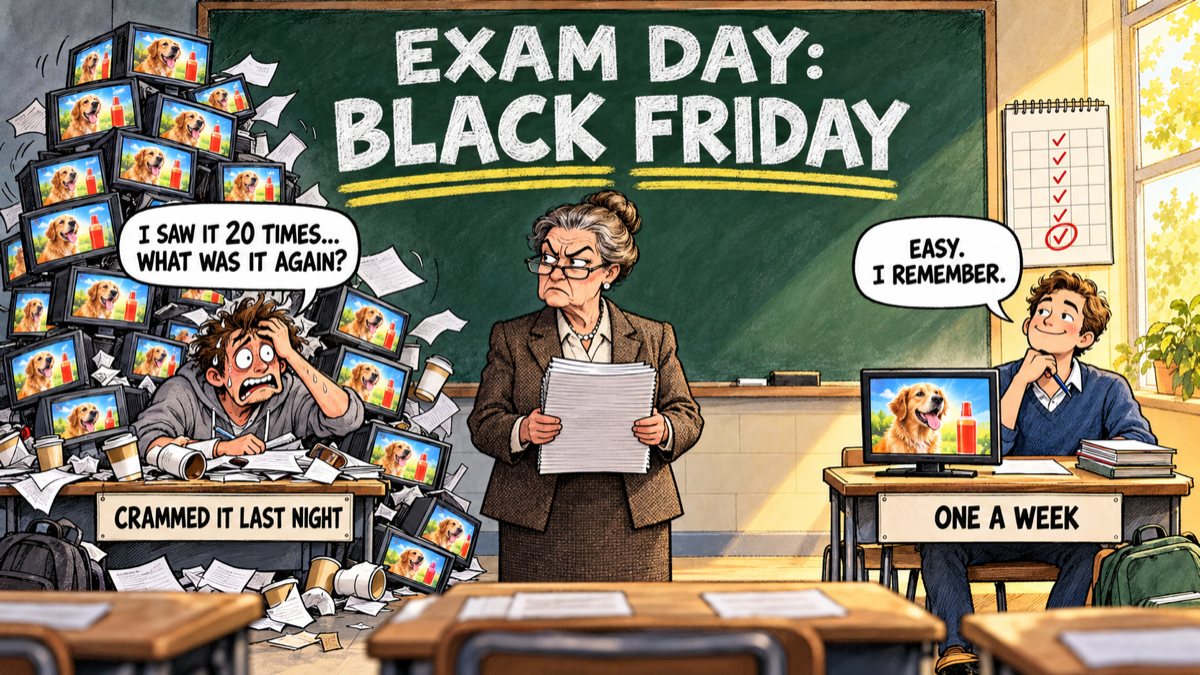
Every streaming TV plan I've ever seen answers the same question first.
How many times should a household see the ad?
It's a fair question. It's just not the most important one.
The better question is *when*.
When does the first exposure land? When does the second one come? And how close are those reminders to the day you actually need someone to buy?
That question has an answer. It's about 140 years old, and it came out of a very patient German psychologist and a stack of nonsense syllables.
The Man Who Measured Forgetting
In the 1880s, Hermann Ebbinghaus did something nobody had done before. He measured forgetting.
He memorised lists of made-up syllables until he could recite them perfectly. Then he waited (twenty minutes, an hour, a day, a week, a month) and timed how long it took to learn the same list again. The less work it took the second time, the more he had remembered.
What he found is now called the forgetting curve. In his own words, forgetting is "very rapid at the beginning of the process and very slow at the end."
The numbers are brutal.
One hour after learning a list, he had to redo about half the original work to get it back.
After eight hours, about two thirds.
After a day, only about a third of the effort was still paying off. After six days, about a quarter. After a month, about a fifth.
So memory drops off a cliff fast, then levels out into a long, slow slope.
Here's the part that should change how you plan a campaign.
38 Beats 68
Ebbinghaus then asked a second question. If you're going to repeat something, does it matter *how* you spread the repetitions out?
It matters a lot.
In one test, he crammed: 68 repetitions of a list in one sitting, then checked himself the next day. In another, he spaced it out, relearning the lists once a day across three days.
The spaced version needed only about 38 repetitions to reach the same result the next day as the 68 crammed ones. His conclusion: spreading repetitions over time is "decidedly more advantageous than the massing of them at a single time."
Read that again with your media plan in mind.
Roughly the same memory. A little over half the reps.
He even pointed out that every schoolkid already knows it. You don't learn your vocabulary all at once the night before. You go over it again in the morning.
Your customers' brains work the same way. A reminder that arrives as a memory is starting to fade does more work than one piled on top of an exposure they saw ten minutes ago.
Frequency Still Matters. It's Just Half the Story.
Let me be clear: this isn't an argument against frequency.
Whether you're a DTC brand chasing sales or a brand building awareness, people need to see your ad more than once. One exposure rarely gets the job done.
But too many hurts. We wrote about that back in May: the impression that makes a customer like you less is real, and it costs exactly the same as the one that helps you.
So think of it this way.
The frequency cap protects you from too many.
Spacing makes the ones you buy count.
Two campaigns can deliver the same number of exposures to the same household and get very different results. One crams them into a few nights. The other spreads them out so each reminder lands just as the last one starts to fade.
Same budget. Same frequency number in the report. Very different memory on the day it counts.
The Q4 Playbook: Plan Backward From Your Sales Day
Here's how we'd use this right now, with the biggest shopping stretch of the year coming up.
1. Pick your sales day. Black Friday, a product launch, the day your sale starts. Whatever day you need the household to remember you and act. That's the exam.
2. Work backward. Start from that date and count back. How many weeks do you have? That's your study period. Most brands do the opposite: they start when the budget clears and spend until it runs out.
3. Spread the exposures out. Don't let the platform pile three ads on one household in a single Tuesday night. Space them across the weeks, so each one is a reminder, not a repeat.
4. Build toward the day. Memory fades fastest right after an exposure. So the closer you get to the sales day, the more the timing of the final reminders matters. You want your brand fresh in their mind when they open the laptop or walk into the store, not three weeks stale.
5. Start early enough to space at all. You can't space six weeks of reminders into six days. If you're waiting until the week before Black Friday to go live, you've already chosen to cram. We made the case for getting on air early in Black Friday Is 7 Weeks Away. That clock is still running.
CTV is built for this. You control the dates, the households and how often each one sees you, on the biggest screen in the house, with full attention. Few channels let you plan a memory schedule this precisely.
The Honest Asterisk
Ebbinghaus wasn't studying ads.
He was one man, testing himself, on nonsense syllables, in the 1880s. He said himself that his numbers came from a small number of observations under specific conditions.
So no, I won't promise your campaign gets the same result with 38 exposures that it would with 68. That's not what the experiment shows, and anyone who sells you that number is making it up.
What it does show is the shape: fast forgetting, a long slow tail, and repetitions that work better spread out than piled up. That shape has held up for well over a century. It's a smart place to start your plan.
And the only way to know what spacing does for *your* brand is to measure it.
The Final Take
Memory is the means. Sales are the score.
We don't plan streaming TV so that people remember an ad. We plan it so they remember your brand on the day they're ready to buy, and then go buy it.
That's why we don't stop at the media plan. We measure lift where the sales actually happen: traffic to your site, people searching your brand, and sales on Amazon, compared against the areas and weeks where the ads didn't run. One instrument always lies, so we triangulate, and we look for the sales the ad actually caused, not the ones that would have happened anyway.
So before you ask how many times, ask when.
Pick the day. Count backward. Space it out. Then watch your own numbers to see what it did.
That's how we plan every flight at CS & Co. It's built into the CS Method™. Want to know if your Q4 plan is cramming or studying? Find out if CTV is a fit.
Cory Poccia
CEO, CS & Co. Marketing Studio™