
General Marketing
Black Friday Is 7 Weeks Away. The Smart TV Money Is Already on Air.
A survey of 41 direct-to-consumer brands says most are raising their Black Friday TV budgets, and more than half will be on air before mid-November. Here's what they're getting right, what they're leaving on the table, and how to read your own holiday results.
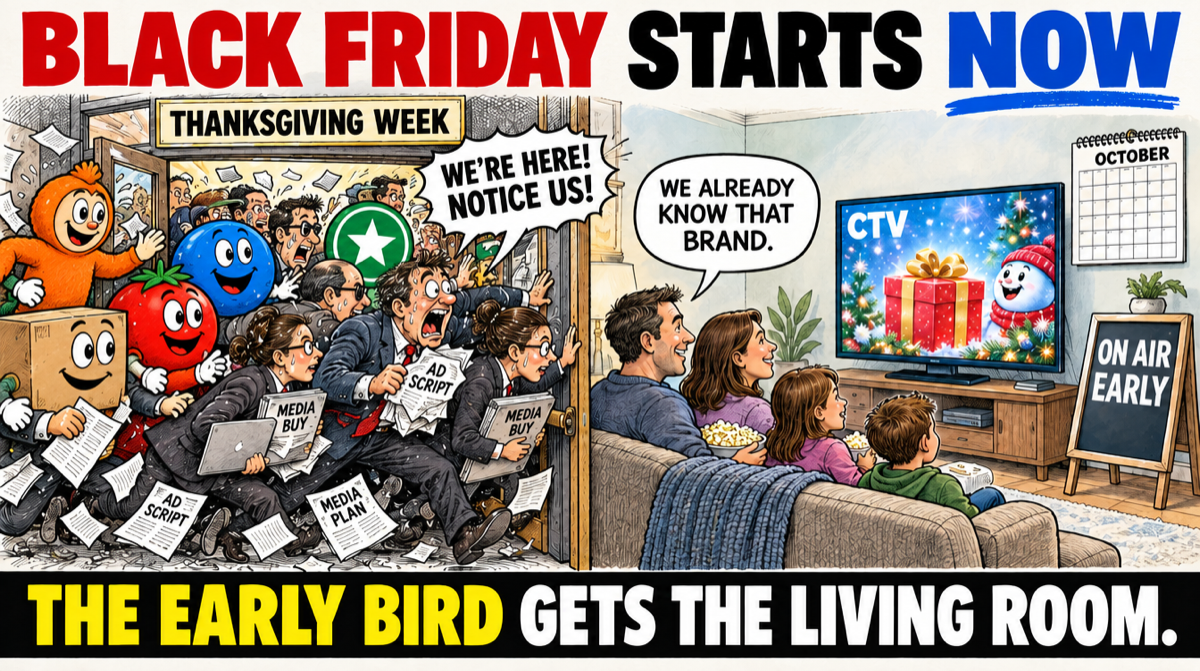
Black Friday is November 27.
That's seven weeks from today. Thanksgiving is the day before. Cyber Monday is November 30.
And if you're still "finalizing the holiday plan," some of your competitors are already on TV.
On October 8, the VAB, the trade group for TV and streaming sellers, sent out a one-page graphic called "Advertisers' Holiday Wish List." It sums up a survey of 41 digital-native and direct-to-consumer brand marketers about how they plan to advertise on TV around Black Friday and Cyber Monday, as PPC Land reported.
It's a small survey. I'll get to that.
But the direction is worth your attention, because these are exactly the kind of brands that treat TV as a sales channel, not a billboard.
What the Brands Said
Here are the headlines, straight from the survey.
59% are increasing their Black Friday and Cyber Monday TV budgets this year. 22% plan a significant increase.
54% will be on air before the middle of November. 17% start in October.
Streaming and CTV sit right next to linear TV as a priority for holiday buys: 73% for streaming, 76% for linear.
83% say maximizing performance matters more than spending the whole budget.
58% are sending shoppers to their own website.
Read that list again and you'll notice something.
These brands aren't buying TV to feel good. They're buying it to sell things, on their own site, during the most crowded shopping week of the year.
That's performance TV. That's the game we play every day.
Here's the Part Most Brands Get Wrong: Timing
The fuller version of this survey, a 15-page deck VAB shared with press in September, breaks the start dates down: 17.1% in October, 36.6% in early November, 22.0% in mid-November and 24.4% in Thanksgiving week.
So roughly one in four brands plans to show up the same week as the turkey.
I get the logic. That's when people buy. Why pay for TV in October?
Because the buying decision doesn't start on Black Friday. It ends there.
The family that orders your product on Cyber Monday decided you were worth considering weeks earlier, on the couch, watching a show. If the first time they meet your brand is Thanksgiving week, you're introducing yourself in the middle of the loudest room of the year.
And it gets loud. Integral Ad Science measured a 219% rise in impressions between November 2 and December 5 last year. Everybody piles in at once.
We've talked before about red oceans and blue oceans in Q4. Thanksgiving week is about as red as the water gets.
The brands on air in October and early November get to build familiarity while it's still quiet. By the time the stampede hits, they're not strangers. They're the brand the household already knows.
Performance Over Pacing. Good.
My favorite number in the whole survey is the 83%.
In the deck, it's 82.9% choosing maximized performance over clearing close to 100% of the budget. In plain words, most of these brands would rather leave money unspent than run ads that don't sell.
That's exactly right.
The worst holiday TV plan is the one built to spend a number. The best one is built to hit a cost per order, and it moves money toward whatever is working, daily.
The Creative Gap Is Your Opening
Here's a number that surprised me.
Only about 20% of these brands are making a spot built specifically for Black Friday and Cyber Monday. 37% are rerunning existing non-holiday creative, according to the survey, and in July another 29.3% hadn't decided yet.
Even VAB pointed out the obvious: reruns create an advantage for anyone who shows up with a fresh holiday spot.
You don't need a Hollywood budget for this. A clear offer, a reason to buy now and a simple "go to our site" will beat a beautiful summer ad that never mentions the holiday.
Now the Measurement Problem
This is the one that worries me.
To judge their holiday TV, 70% of these brands use pixel-based attribution. 52.5% run incrementality tests. 45% use media mix modeling. 20% use brand lift studies. And 12.5% have no formal approach at all.
A pixel is a little piece of code on your website that tries to connect a visit or an order back to a household that saw your TV ad.
It's useful. It's also fragile. It usually leans on IP addresses to make the match, and it lives in the shopper's browser. We just wrote about what Apple's new Safari block list can do to that kind of tracking.
Now picture Black Friday week. Your TV ad runs. Shoppers flood in through search, email, social and direct. The pixel hands most of the credit to whatever got the last click.
And your TV report says the channel was "fine." Meanwhile, the ad did the heavy lifting.
That's how brands end up undercounting what TV actually sold, then cutting it in January.
The good news is that more than half of this group also runs incrementality tests. That's the method built to answer the real question: what would have happened if we hadn't run the ad?
How We'd Plan Holiday CTV Right Now
If you're a brand that sells on its own site, here's the playbook I'd use, starting this month.
Get on air before the stampede. Start in October or the first days of November. Build familiarity with real households while it's still quiet.
Ramp, don't flip a switch. Lighter early, heavier into Thanksgiving week, Black Friday and Cyber Monday. The early weeks make the late weeks work.
Make one holiday spot. A clear offer, a deadline and your URL. That's it.
Buy for orders, not for delivery. Set the cost per order you can live with and let budget follow the results, daily.
Keep a holdout. Leave a few markets dark. Compare sales where the ads ran against those markets and against each area's own baseline. That's how you see the alpha CTV actually creates.
Read your own sales, not just the pixel. Your order system knows what sold and where it shipped. Triangulate it against branded search lift and direct traffic by area. One instrument always lies.
The Honest Asterisk
Let me be straight about this survey, because the headlines won't be.
It's 41 brands. All of them were clients of the TV ad-buying company that ran it. The answers were collected July 13 to 24, so they're plans, not spending. And on a sample this small, one brand moves a result by about 2.4 points.
So don't read it as "the whole market." Read it as a window into how performance-minded brands are thinking.
The bigger picture points the same way. In September the IAB raised its 2026 forecast for CTV ad spend growth to 15.6%, up from 13.8% in January. The same update says customer acquisition jumped to 63% as the top goal for media spend.
Brands want new customers. The audience is streaming. The money is following.
The Final Take
Black Friday doesn't start on Black Friday.
It starts weeks earlier, on the biggest screen in the house, when a family meets your brand for the first time and files it away.
The brands in this survey get most of it right: more budget, earlier starts and performance over pacing. The gaps are fresh creative and honest measurement.
So start now. Make a spot that actually says "holiday." And keep score with your own sales, not someone else's pixel.
CTV will do its job this season. Make sure your plan lets you see it.
That's how we build every holiday plan at CS & Co. It's part of the CS Method™. Want to know if CTV fits your holiday? Find out if CTV is a fit.
Cory Poccia
CEO, CS & Co. Marketing Studio™