
General Marketing
Apple Has a List. Your Measurement Might Be On It.
Apple quietly blocked The Trade Desk, LiveRamp, ID5 and others on Safari with iOS 27. Now it has a private list of hundreds more it can switch on at will. The TV screen isn't a Safari tab. But your measurement might be.
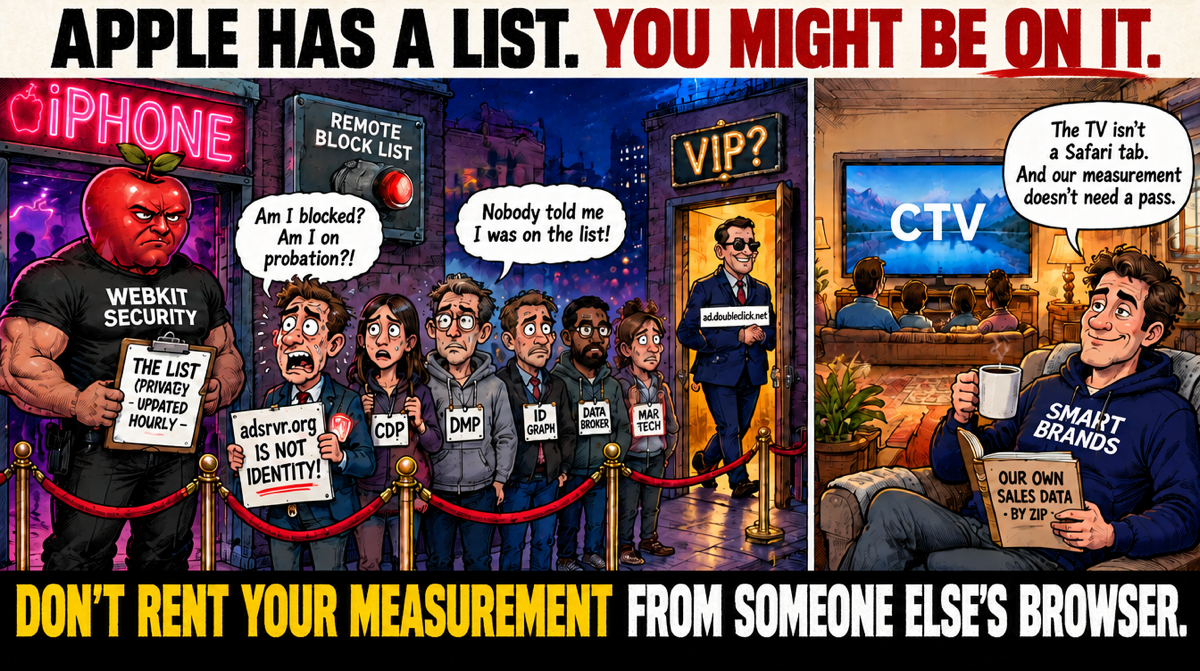
Two weeks ago, Apple shipped iOS 27.
Nobody threw a parade. There was no keynote slide about it. But somewhere inside that update, Apple quietly decided that some of the biggest names in programmatic advertising were no longer welcome on its phones.
The Trade Desk. LiveRamp. ID5. Permutive. Audigent. The Trade Desk-backed Unified ID 2.0. All blocked from collecting data or serving ads in Safari, according to AdExchanger. And because every browser on an iPhone has to run on Apple's WebKit engine, "use Chrome instead" doesn't get you out of it.
That would have been news on its own. This week it got bigger.
The List Just Got Longer. And Private.
According to two sources who spoke to AdExchanger, that original handful of blocked companies has been replaced by something far more ambitious: a library of hundreds of CDPs, ad tech and mar tech companies, data sellers and ID graph operators.
Here's the part that should keep every marketer up tonight.
The list lives in a private repository. Nobody outside can see it. Apple's devices now check a remote list on a regular schedule, which means Apple no longer needs a new iOS release to block someone. It can flip a vendor on or off whenever it wants.
And the vendors may not even know they're on it. There's a "potentially blocked" tier and an "actively blocked" tier, and only Apple seems to know what moves you from one to the other.
Think about what that means. A company can be working fine on Monday and dark on every iPhone by Tuesday, with no warning, no notice and no appeal process anyone can point to.
That's not a privacy policy. That's a velvet rope with a bouncer, and the bouncer doesn't have to tell you why you're not getting in.
This Isn't Even About Identity Anymore
The Trade Desk's situation is the one to study.
The other companies Apple blocked are, in plain terms, identity businesses. They match people across sites. Apple has been coming for that for years, and nobody should be surprised.
But Apple also blocked adsrvr.org, The Trade Desk's core ad request and delivery domain. In The Trade Desk's own words on Apple's WebKit bug tracker: "Adsrvr.org is The Trade Desk's core ad request and delivery domain, not identity."
In other words, the largest independent DSP in the world was effectively shut out of Safari on the newest iOS. Maybe by accident. Maybe not. As of this writing, Apple's response amounts to: we'll let you know.
Meanwhile, in that same bug report, Google's bids went through cleanly. AdExchanger is still trying to find out whether ad.doubleclick.net is anywhere on Apple's list at all.
If you've been in this business long enough, you've seen this movie before. Apple's App Tracking Transparency hit Meta so hard that in early 2022 Meta told investors it would cost them roughly $10 billion that year. Safari's tracking rules knocked Criteo on its back before that. Every time Apple moves, somebody's business model breaks overnight.
The only difference now is that Apple doesn't have to wait for a software update to do it.
The TV Screen Isn't a Safari Tab
Let me be clear about what this does and doesn't touch, because the panic headlines won't be.
Nothing in this reporting says Connected TV advertising on the big screen is being blocked. Your ad on a streaming service in someone's living room runs inside a TV app, on a TV, on the couch. It is not a webpage loading in Safari on an iPhone.
The audience is still there. The attention is still there. The household still sees the ad, and the household still goes and buys the thing.
So the delivery side of CTV is not the problem.
The measurement side might be.
Where Apple Can Actually Hurt You
Walk through the customer journey we talk about all the time.
Tuesday night, a family sees your ad on their TV. Friday, one of them picks up an iPhone, opens Safari, searches your brand and buys.
Now ask the uncomfortable question. How does your reporting connect that purchase back to the TV ad?
For a lot of brands, the honest answer is a tracking pixel feeding a last-click report. A little piece of third-party code on your website, firing in the shopper's browser, sending the sale back to some vendor's server so a dashboard can light up.
That pixel lives in the browser. The browser belongs to Apple. And Apple now has a private list of hundreds of ad tech and data companies it can cut off whenever it likes.
If your measurement vendor lands on that list, the ad keeps working. The customers keep buying. And your dashboard quietly tells you the channel stopped performing.
That's the worst kind of failure, because it doesn't look like a failure. It looks like a result. And brands pull good campaigns over results like that every single day.
We already know what happens when a CFO sees a CTV line that reads zero. Apple just made it easier for that zero to show up even when the channel is working.
Own Your Measurement, or Someone Else Does
Here is the lesson, and it's bigger than Apple.
If your proof of performance depends on someone else's code running in someone else's browser on someone else's phone, you don't own your measurement. You're renting it. And the landlord just told everyone the lease can be cancelled at any time, without notice.
So build measurement that doesn't need Apple's permission.
Start with your own sales data. Your order system already knows what sold, when and where it shipped. That's first-party data, it lives on your servers, and no browser update can touch it.
Read results by geography, not just by click. One instrument always lies, so triangulate. Compare sales in the areas where your ads run against each area's own baseline, every day. If demand moves where the TV ad runs, you'll see it in your own orders, with or without a pixel.
Keep a few holdouts. A small, rotating set of areas where you don't advertise is the cleanest way to prove what the ad actually caused. It's the gold standard for a reason, and it's how you measure the alpha CTV actually creates.
Move tracking server-side. Whatever pixel tracking you keep, send it from your servers to your partners, not from the shopper's browser. It's sturdier, and it's yours.
Watch the backstops. Branded search lift by area, direct traffic and a simple "where did you hear about us?" question at checkout. None of them need anyone's blessing.
None of this is exotic. It's just discipline. It's the difference between a measurement plan that survives the next iOS update and one that finds out about it from a flat dashboard.
The Final Take
Apple has a list. It's private, it's growing, and it can change tonight.
Maybe your vendors are on it. Maybe they're not. Maybe they don't know yet. The point is you shouldn't have to care.
CTV still does what it has always done: puts your brand in front of a real household, on the biggest screen in the house, and creates the demand that shows up later in your sales. Apple didn't change that.
What Apple changed is how risky it is to let someone else keep score.
So keep your own. Read your own sales. Run your own holdouts. Build the kind of proof no bouncer can turn away at the door.
Because the brands that win the next few years won't be the ones with the best pixels. They'll be the ones who never needed them.
That's how we measure every campaign at CS & Co. It's built into the CS Method™. Want to know if your measurement would survive Apple's list? Find out if CTV is a fit.
Cory Poccia
CEO, CS & Co. Marketing Studio™