
General Marketing
YouTube on Your Phone and YouTube on Your TV Are Not the Same Ad
Everyone quotes YouTube's cheap average price. Almost nobody notices that the YouTube playing on the living room TV is priced, built and watched completely differently. Here's why the average is low, what changes when YouTube moves to the big screen, and how to buy it.
YouTube just had another record month on television.
In July, it pulled in 14.2% of all TV viewing in America, according to Nielsen's July Gauge. Not phone viewing. TV viewing. More than any other media company.
So brands keep asking me the same question.
"YouTube is so cheap. Why would I pay more for anything else?"
Here's the part almost nobody understands.
The cheap YouTube price you keep hearing is an average. And the YouTube playing on the living room TV isn't the YouTube in that average. It's priced differently, built differently and, most importantly, watched by a completely different version of the same person.
Let's dig into both halves of that.
Why the Average Is So Low
When people say "YouTube runs about seven bucks," they're quoting a blended number across every device and every format. Depending on whose benchmark you read, that all-device price lands somewhere in the single digits, roughly $4 to $10.
Now look at what's inside that blend.
Shorts. Ads between vertical videos, which Google itself describes as "a mobile-optimized experience." One industry roundup citing Strike Social's analysis of $14.3 billion in spend puts Shorts ads around a $4 CPM.
Bumpers. Six-second ads. The same roundup puts them at roughly $3.24 to $4.37.
Skippable ads. This is the big one. Per Google's own ad format guide, viewers can skip after 5 seconds. And if you buy on a cost-per-view basis, you only pay when someone watches 30 seconds (or the whole ad, if it's shorter) or clicks.
Read that one more time.
Every person who hits "Skip" costs the advertiser nothing. Millions of skipped ads are quietly pulling the average price down.
So the low average isn't a bargain on television. It's mostly a picture of phones, Shorts, six-second clips and ads people tapped away from.
What YouTube on the TV Actually Is
Now walk into the living room.
When YouTube runs on a television, it's Connected TV. Same couch, same household, same big screen as any other streaming service. And Google sells it that way.
Google recently made its VRC Non-Skips product generally available, including a 30-second, CTV-only non-skippable format. In Google's words, it's "optimized for CTV delivery" and ensures "your message is delivered in its entirety."
That's a TV ad. Full screen. Thirty seconds. No skip button. Your whole story, offer and all.
And it's priced like one. In the quotes we see, YouTube on the TV screen usually lands somewhere in the teens to the high $20s. Some planners quote a rough $25 to $30 band for TV-screen placements.
That's not YouTube being overpriced. That's YouTube charging TV prices for a TV product. Which is exactly what it should do.
Two Different People in the Same Body
This is the half I really want brand owners to sit with, because it matters more than the price.
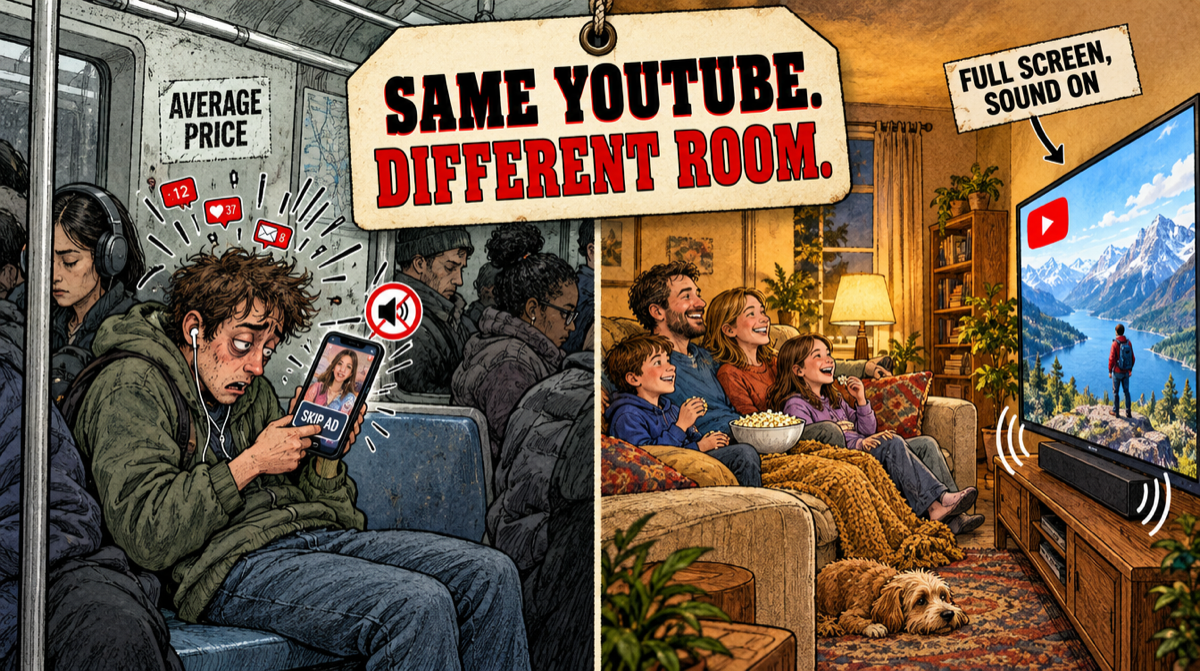
The same person watches YouTube on their phone and on their TV. But they are not in the same state of mind.
On the phone, they're leaning forward.
One hand. Thumb ready. They're scrolling, hunting for the next thing. The screen is small. The sound is often off, because they're in a waiting room, on a train or in bed next to someone who's asleep.
And they're usually alone. Nobody's watching over their shoulder.
And the whole experience is built around moving on. Vertical Shorts flick by in seconds. The skip button shows up at five. Your ad isn't the show. It's an obstacle between them and the next video.
That's not a bad mindset. It's just a fast one. Phone viewers decide in a heartbeat, and a lot of what they see is gone before it lands.
On the TV, they're leaning back.
They picked something to watch. A cooking channel, a long interview, a creator they've followed for years. They sat down on purpose.
The video fills a wall. The sound is on and comes through the room. The remote is on the coffee table, not in their hand.
And very often, they're not alone.
Google's own panels show multiple people watching YouTube together on TV screens, which it calls "a consumer behavior characteristic of linear television." It now counts every co-viewer in its CTV numbers so YouTube can be compared fairly with the rest of a TV buy.
In Google and Ipsos research in Europe, 86% of viewers said they pay more attention to what they're watching when they co-view YouTube on a TV. Three quarters said they feel a deeper connection with the people they watch with.
Think about what that means for your ad.
On the phone, you're interrupting one person who's trying to get somewhere. On the TV, you're showing up in the middle of a shared evening. A spouse turns and says, "We should get that." A kid points at the screen.
That's not a scroll. That's a household moment. And household moments are where buying decisions actually get made.
A 2023 study from LG Ad Solutions and TVision, which used camera sensors in real homes, found CTV content earned a 13% higher attention index than linear and a 74% higher incidence of co-viewing.
Same YouTube. Same person. Completely different moment.
The Honest Asterisks
I promised to be straight with you, so here are two.
Asterisk one: the benchmarks don't agree. The same roundup that puts Shorts around $4 also lists YouTube CTV CPMs at roughly $9 to $10, close to the average. Other planners quote $25 to $30. That gap isn't a typo. YouTube's TV-screen price depends heavily on how you buy it: auction or reserved, how tight the targeting is, and whether you're buying 30-second non-skips or a mix of formats. Treat every number here as a planning range, not a rate card.
Asterisk two: co-viewing isn't a free pass. A study from the ARF and the Journal of Advertising Research, built on nearly 25 billion seconds of TV viewing, found that watching with others actually decreases attention to ads while increasing attention to the show. Longer ads hurt attention, too.
So the room is fuller, but the room is also chatting. Co-viewing multiplies your reach. It doesn't guarantee anyone is staring at your logo.
That changes how you build the ad, which brings us to the practical part.
How to Buy YouTube for the Living Room
Compare TV screen to TV screen. Never put YouTube's all-device average next to a streaming service's TV price. Ask for YouTube's TV-only price, then compare it with other CTV on the same screen. Better yet, compare the cost of reaching qualified households, not just impressions.
Buy for the living-room mindset. Restrict the buy to TV screens. Use the 30-second CTV-only non-skip when you have a story to tell. Write for sound on, a big screen and more than one person on the couch.
Win the first 15 seconds. LG and TVision found attention is inversely related to ad length, so the opening is critical. Put your brand and your reason to care up front. Don't save the logo for the last frame.
Manage frequency. The same research found attention is highest at first exposure and declines as frequency rises. Cap it, and space your flights around when people actually buy.
Judge it by sales, not CPM. A cheap impression nobody saw is the most expensive thing you'll ever buy. Read results by geography, keep a few holdout areas and triangulate until you can see the incremental lift the ad actually created.
The Final Take
YouTube's average price is low because most of that average is phones, Shorts, six-second clips and skips nobody pays for.
YouTube on the TV costs more because it's a different product. Full screen. Sound on. Thirty seconds, no skip. And a viewer who's leaning back, chose what they're watching and is often sharing the couch with someone who helps decide what the household buys.
That's not a knock on YouTube. YouTube on the TV is CTV, and it's some of the most-watched television in America.
Just stop pricing the living room like the checkout line. Compare TV to TV. Build the ad for the couch. And let your sales tell you what it's worth.
That's how we plan and prove every campaign at CS & Co. It's built into the CS Method™. Want to see what YouTube and the rest of CTV could do on the big screen for your brand? Find out if CTV is a fit.
Cory Poccia
CEO, CS & Co. Marketing Studio™