
General Marketing
Your CTV is Bigger Than You Think
CTV attribution isn’t broken—it’s being undercounted. This article explores how outdated measurement models fail to capture the true impact of CTV, why brands are missing 2–5× more conversions than reported, and how modern approaches like incrementality, device graphing, and brand search lift reveal the real performance of connected TV.
For years, the advertising industry has framed CTV attribution as a technical challenge.
A fragmented ecosystem.
A cross-device problem.
A lack of standardized measurement.
That narrative has been repeated often enough to feel definitive.
But the data suggests something more important.
CTV is not difficult to measure.
It is being systematically undercounted.
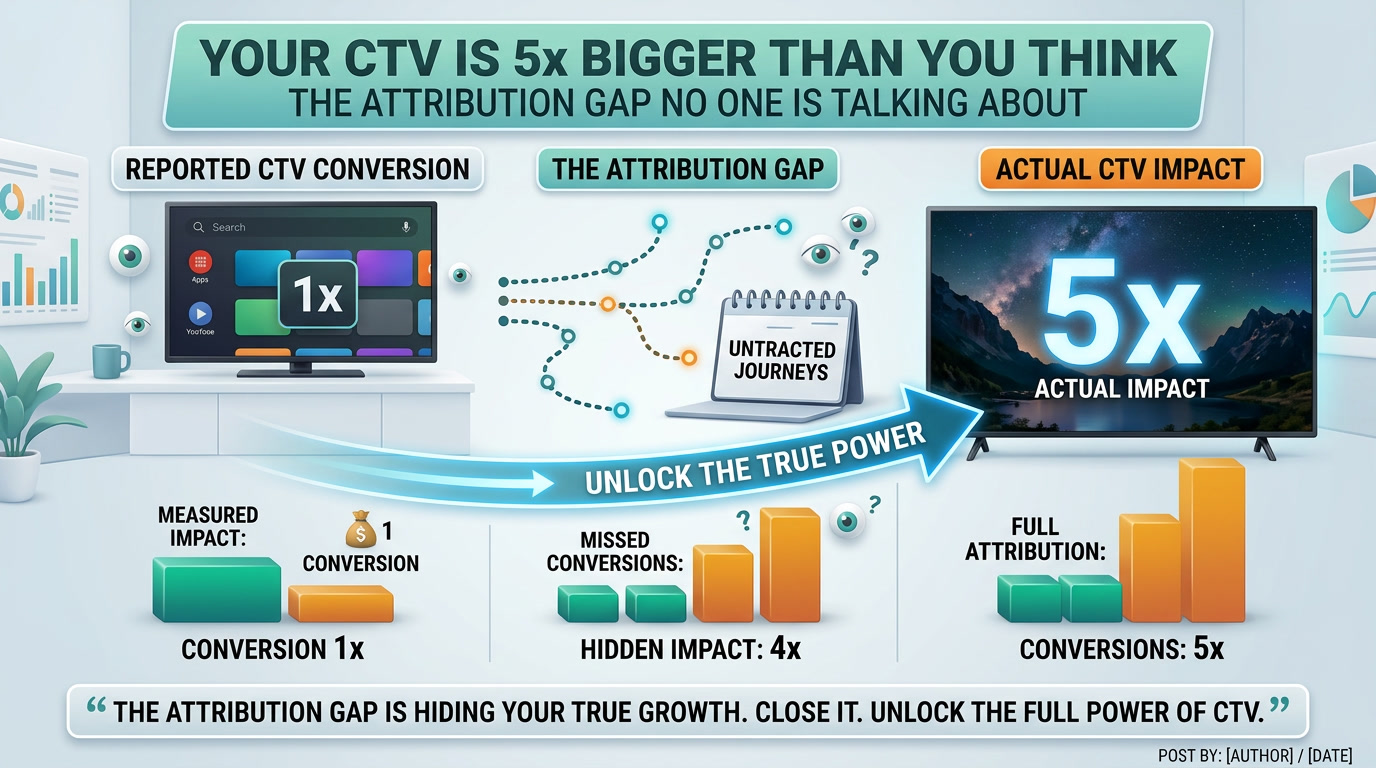
The 2×–5× Attribution Gap
Across attribution platforms, incrementality studies, and campaign data, a consistent pattern is emerging:
CTV drives significantly more conversions than it gets credit for.
Multi-touch attribution platforms routinely report three to five times more conversions than last-click models. Incrementality frameworks often show even higher total impact.
Delayed response models indicate that conversion lift continues well beyond initial exposure.
This is not a marginal discrepancy.
It is a structural gap in how performance is being measured.
Why This Gap Exists
The issue is not a lack of measurement tools.
It is the continued reliance on outdated measurement frameworks.
Most digital attribution models are built on three assumptions:
There is a click.
There is an immediate response.
There is a single-device journey.
CTV violates all three.
There is no click.
There is rarely an immediate conversion.
And the user journey spans multiple devices and sessions.
Instead, CTV initiates a sequence of behaviors:
A viewer sees an ad on television.
They pick up a phone.
They search the brand.
They visit multiple sources.
They convert later, often through a different channel.
Only a fraction of that journey is directly trackable.
The rest is absorbed into other channels.
The Post-Impression Economy
CTV does not operate in a click-based environment.
It operates in a post-impression economy.
After exposure, users do not convert immediately. They:
Search
Compare
Validate
Return later
In many campaigns, the majority of conversions occur:
Hours or days after exposure
On a different device
Through a different channel
This is why last-click attribution consistently fails in CTV environments.
It is measuring the wrong moment in the journey.
The Measurement Stack That Reveals the Truth
Closing the attribution gap requires a layered approach. No single method is sufficient on its own.
IP Matching and Household Resolution
CTV platforms can connect television exposure to devices within the same household using IP-based matching.
This creates a directional link between impression and action, allowing marketers to associate ad exposure with downstream behavior.
While not perfect, it provides a critical foundation for understanding CTV impact.
Device Graphing and Cross-Device Tracking
Consumers do not convert on televisions.
They convert on phones, tablets, and laptops.
Device graphs unify these interactions into a single user journey, connecting exposure on one device to conversion on another.
Without this layer, a significant portion of CTV-driven activity remains invisible.
Incremental Lift Studies
Incrementality testing is widely considered the most reliable method for measuring true impact.
This includes approaches such as:
Difference-in-differences analysis
Geo-based holdout testing at the DMA level
These methods isolate the effect of CTV by comparing exposed and non-exposed audiences.
They answer a fundamental question:
What changed because of this campaign?
This removes attribution bias and provides a clear view of true performance.
Amazon and Off-Site Conversion Tracking
A meaningful share of CTV-driven conversions does not occur on owned channels.
Instead, users move to:
Amazon
Retail marketplaces
Offline channels
Without tools like Amazon Attribution, this demand is not captured.
As a result, reported performance significantly understates actual impact.
Brand Search Lift
One of the clearest indicators of CTV effectiveness is brand search behavior.
During active campaigns:
Branded search volume increases
Direct traffic rises
Conversion rates improve across channels
This is not incidental.
It is a direct result of demand created by CTV exposure.
The Cost of Misattribution
The attribution gap is not just a reporting issue.
It has direct business consequences.
When CTV is undercounted:
High-performing campaigns are paused
Budgets shift toward last-click channels
Overall growth slows
At the same time, channels like search and social receive credit for demand they did not generate.
This leads to inefficient allocation of marketing spend.
The Industry Is Measuring the Wrong Thing
Most reporting frameworks are built around a single question:
How many conversions came directly from this channel?
That approach works for click-based media.
It does not work for CTV.
A more accurate question is:
How much demand did this channel create?
This shift in perspective is essential for understanding CTV performance.
The Shift Toward Incrementality
Leading advertisers are moving beyond channel-level attribution.
They are adopting measurement frameworks that focus on:
Incrementality
Blended customer acquisition cost
Cross-channel impact
These approaches reflect how consumers actually behave across devices and time.
They prioritize outcomes over isolated interactions.
Final Take
CTV attribution is not a technology problem.
It is a measurement problem rooted in outdated assumptions.
The tools already exist:
IP matching
Device graphs
Incrementality testing
Cross-channel analysis
But most organizations have not fully adapted their frameworks to use them effectively.
The Opportunity
If CTV is undercounted by two to five times, it represents one of the most mispriced channels in modern advertising.
This creates a clear opportunity.
Brands that measure correctly will:
Invest earlier
Scale more efficiently
Capture a disproportionate share of demand
While others continue optimizing for what is easiest to measure rather than what actually drives growth.