
General Marketing
Political Ads Bumped Your Holiday TV. Don’t Go Dark. Get Ready for Nov. 4.
Political money is pushing local and regional brands out of Q4 TV: higher CPMs, bumped spots, pricier 'safe' streamers. Going dark is the wrong answer. Here's the managed CTV plan for the next six days, and for Nov. 4.
Election Day is next Tuesday, six days from now.
If you're a local or regional brand, you probably don't need me to tell you that. You can feel it in your TV plan.
The spot you booked got bumped. The show you wanted is sold out. The rate card went up. And the "safe" streaming apps you fled to are getting more expensive too.
Digiday laid it out this week in a piece called "Midterm political spending throws spanner into regional advertiser holiday plans." The quotes come from agencies in Dallas, New York and Minnesota, with clients from Texas to Wisconsin. The story is the same everywhere.
Political money is buying the room. Your holiday ads are standing in the hallway.
Here's what I'd do about it. Hint: it isn't going dark.
We Saw This Wave Coming. It's Bigger Than Forecast.
Back in April, we wrote about the political CTV tsunami headed for 2026 media plans. It showed up, and then some.
AdImpact's June update raised its projection for the cycle from $10.8 billion to $11.6 billion, the most expensive cycle it has on record. CTV alone was projected at $2.7 billion, 23% of the total, and AdImpact called it the fastest-growing media type in political advertising.
Now, per Digiday, AdImpact expects about $12 billion in total, with some $8.2 billion going to TV or CTV.
And a lot of that lands on local TV. S&P Global projects $4.02 billion in local-TV political advertising for 2026, per TVREV, which works out to 16.3% of total net broadcast revenue.
That's a lot of new money chasing the same breaks you buy every year.
What the Squeeze Looks Like on the Ground
Here's what the agencies told Digiday.
Prices are up. In Texas, where Digiday points to the close race between Democrat James Talarico and Republican Ken Paxton, David Hassard of Electric Symphony Media said linear CPMs are typically up 10% to 15%, with some programming up as much as 30% to 50% in recent weeks.
Shows are sold out. Jacqueline Hoyos, chief media officer at Moroch Partners, said one Texas grocery client got pushed out of live college football coverage in September. The remaining slots were already gone to political buyers.
Spots are getting bumped. Local stations often write "pre-emption" clauses into contracts, which let them bump a brand when a political buyer pays more. "In Wisconsin, there has been a lot of preemptions for our clients," Nola Ladd of Collective Measures told Digiday. Brands usually get make-goods, but those can land on sub-optimal inventory.
Even the escape hatches are crowded. Brands are fleeing to Netflix, Prime Video and Disney+, which don't take political ads. That extra demand is pushing up prices there too.
It's not just TV. One agency exec told Digiday, anonymously, that average YouTube CPMs rose 20% in recent weeks. Data firm AdsMom said political clients spent $149 million on YouTube and Meta in the week of Oct. 11, up from $34 million in the last week of July.
And here's the part that stings for regional brands. As Digiday puts it, a national advertiser can ignore an inflated market until the election is over. A local advertiser doesn't have that option. "When you're a local advertiser and you're really focused on audiences and geo-targeting, it does impact scale," Hoyos said. Your stores are where they are.
Why "Just Go Dark" Is the Wrong Answer
When prices spike, the tempting move is to pull everything and wait it out.
Hassard said some clients have gone dark on linear until the election, but called it a minority position. Natalee Geldert, PMG's head of emerging services, put it plainly: going dark in Q4 is "really hard to come back from."
I agree with her.
Q4 is when your customers are making their holiday lists. Going quiet in the weeks before Black Friday hands that memory to whoever stayed on air. Rebuilding it costs more than holding it.
So stay on. Just stop fighting the fight you can't win.
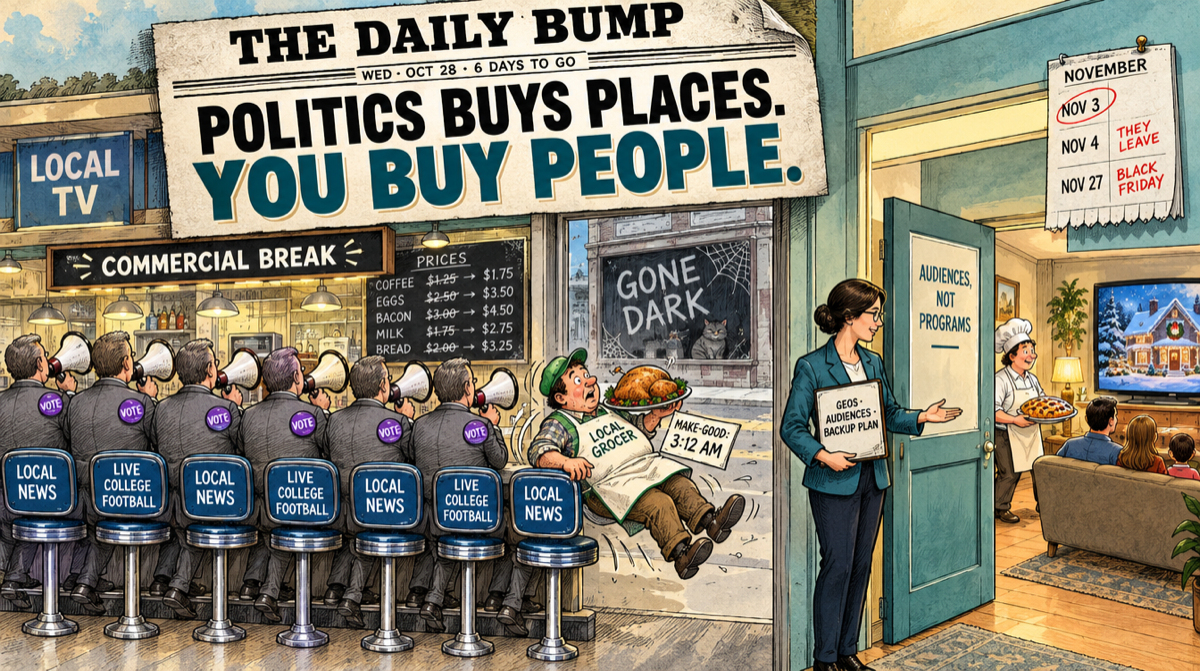
Politics Buys Places. You Buy People.
This is the whole idea, so let me slow down on it.
Political campaigns buy places. A district. A DMA. The local news. The big live game. They have to, because voters are defined by where they live, and they're paying for the spots that every voter in that place will see.
That's exactly why they crowd out regional brands on linear. You're bidding on the same programs, in the same markets, against someone with a deadline and a war chest.
But you don't actually need the 6 o'clock news. You need the people who buy from you.
That's what CTV does better than any other kind of TV. You buy the household, not the timeslot. And that changes your options.
The Managed CTV Plan for the Next Six Days
None of this happens on autopilot. It's the stuff we covered in what goes wrong when nobody manages a CTV buy. Here's what managed looks like this week.
1. Shift geos where you can. PMG told Digiday it's advising clients to lean out of the most contested DMAs and states. If your footprint spans several markets, move weight to the ones that aren't battlegrounds for the next six days, then move it back.
2. If you can't move, change what you're buying, not just when. A Texas-only brand can't leave Texas. And on linear, switching dayparts won't save you; on the impact of political money, Hassard told Digiday "it really doesn't matter what day part you're buying." So stop chasing local news and live sports, where political buyers are crowding in, and find the same households in the rest of their TV time: on-demand streaming, quality FAST channels and the shows politics isn't fighting over. CTV lets you move across dayparts and apps in the same market without giving up the market.
3. Keep the audience, drop the program list. Target the households you want, by audience and ZIP, and let the plan find them wherever they're watching. When a program gets expensive, the audience is still reachable somewhere else.
4. Plan for pre-emption instead of being surprised by it. Know which of your buys can be bumped. Have backup inventory ready. Read every make-good before you accept it, and keep frequency in check so the catch-up spots don't hit the same homes five times in a night.
5. Keep holiday creative clearly holiday. Digiday reports clients are asking agencies for extra creative reviews so their ads don't read as election commentary. Smart. This isn't the week for a "the people have spoken" pun.
Then Be Loaded for Nov. 4
Here's the part almost nobody is planning for.
On Nov. 3, the polls close. For most races, the campaigns' reason to buy TV ends that night.
Then the calendar flips straight into holiday season. Thanksgiving is Nov. 26. Black Friday is Nov. 27. That's about three weeks.
Every brand that went dark, or got bumped, or waited, is going to come back at once.
The brands that win that window aren't the ones who start planning on Nov. 4. They're the ones whose creative is approved, geos are set, budgets are released and inventory is lined up before the polls close. We call it planning backward from the sales day. This year, the sales day has a political deadline in front of it.
Be the first call on Nov. 4, not the twentieth.
The Honest Asterisk
CTV is not a free pass this season.
Ladd told Digiday that average premium CTV and streaming CPMs rose from $34-35 to $43, depending on the locations advertisers were targeting. The no-politics streamers are getting pricier because everyone had the same idea. And a recount or a runoff can keep a market hot past Election Day.
So no, moving your budget to "streaming" doesn't make the problem disappear.
What CTV gives you is flexibility: more ways to reach the same people when the obvious spots are taken. Flexibility only pays off if somebody is actually using it. Moving geos, shifting dayparts, checking make-goods and loading the Nov. 4 plan is work. Done well, it keeps you on air at a fair price. Not done, it's just a more expensive version of the same squeeze.
The channel isn't the edge right now. The management is.
The Final Take
Every two years, politics rents out the living room for a couple of months. Local and regional brands feel it first and feel it most.
But the answer isn't to leave the room. It's to stop competing for the seats politics wants and go find your customers in the seats it doesn't.
Politics buys places. You buy people.
Stay on air. Shift where you can. Plan for the bumps. And be loaded when the political money stops on Nov. 4, because the holiday shoppers are still there.
That's how we plan every campaign at CS & Co., with the CS Method™. Wondering how your holiday plan holds up this week? Find out if CTV is a fit.
Cory Poccia
CEO, CS & Co. Marketing Studio™