
General Marketing
Good FAST, Bad FAST: The Two-Bucket Rule, Part 2
Part 1 said CTV is two buckets: FAST for reach, Premium for attention. Part 2 is the practical stuff: how the split moves with your goal, what a bad FAST buy looks like, and the five questions that separate good FAST from cheap noise.
Last time, I told you you're buying CTV wrong.
Quick recap. Connected TV isn't one channel. It's two buckets. FAST (Tubi, Pluto, The Roku Channel and the rest) is your reach bucket. Premium (the logged-in, subscription-style ad tiers) is your attention bucket. Different jobs, different prices, different creative, different scorecards.
That framework leads to two obvious next questions.
First: "OK, so how much goes in each bucket?"
Second: "Isn't FAST where all the junk lives?"
This post answers both.
The Split Moves With Your Goal
In Part 1, I gave you a starting point of 60% FAST and 40% Premium, then said to adjust by funnel stage.
Here's what that looks like in practice, by the job you're actually hiring CTV to do.
Launching (new brand, new product, new market). Lean FAST, somewhere around 70/30 or even 80/20. Nobody knows you yet. Paying top dollar for a leaned-in viewer who has never heard your name is buying attention before you've earned it. Use FAST to get your brand into living rooms, build familiarity and set your baseline.
Scaling (it's working, now grow it). Move toward the middle, around 60/40. You've proven the channel moves sales in your markets. Now you want more households and more conversions at the same time. FAST keeps widening the circle. Premium starts turning the people who've seen you three times into people who search your name.
Direct response (you need orders this quarter). Lean Premium, around 40/60 or 30/70. You already have awareness. Now you're paying for the logged-in audience, the first-party matching and the cleaner read on what happened after the ad.
One more thing. A big chunk of premium streaming is about to sit under fewer roofs, as the Skydance merger just showed. When the Premium side gets repriced, the brands with a written split can move dollars on purpose. Everyone else just pays the new rate.
None of these numbers are religion. Your category, margins and creative all matter. The rule is that the split is written down before the buy, not discovered in the invoice.
Here's the Part Nobody Says Out Loud About FAST
FAST is great. I mean that.
But "FAST" on an insertion order can mean two very different things.
It can mean real channels in real apps, watched by real households on real TVs. Or it can mean a line called "CTV run of network" that turns out to be a long list of apps you've never heard of.
To see why, you have to know how FAST is built. The apps you know, like Pluto TV, Tubi, The Roku Channel, Samsung TV Plus, LG Channels and Vizio WatchFree+, are the aggregators. They own the app and the viewer. But a lot of the channels inside them are separate businesses that supply the feed and split the ad money, according to PPC Land's FAST explainer.
That same explainer notes something buyers should love: FAST channels typically carry four to eight minutes of ads per hour, compared with cable's twelve to sixteen. Fewer ads in the break means your ad has more room to land.
It also notes the industry's real headache. Typical FAST fill rates sit at 20 to 40 percent, against a target of 75 to 85. In plain English: there's a lot of empty ad space out there, and empty space attracts people who want to sell it to you whether or not anyone is watching.
What a Bad FAST Buy Looks Like
Here's the scary-sounding part, so let me keep it honest.
In July, HUMAN Security disrupted a CTV fraud operation it called NewsJunkie. A group of sellers passed off junk traffic as premium streaming inventory, at peak hitting nearly two billion fake bid requests a day per seller, as PPC Land reported. They faked the device, the app and the household.
In that same report, DoubleVerify's 2026 research found that in campaigns without pre-bid fraud protection, 9 percent of CTV impressions never reached a real person.
Notice what that means. The problem isn't TV. The real TV audience is huge and it works. The problem is paying for "TV" that was never on a TV.
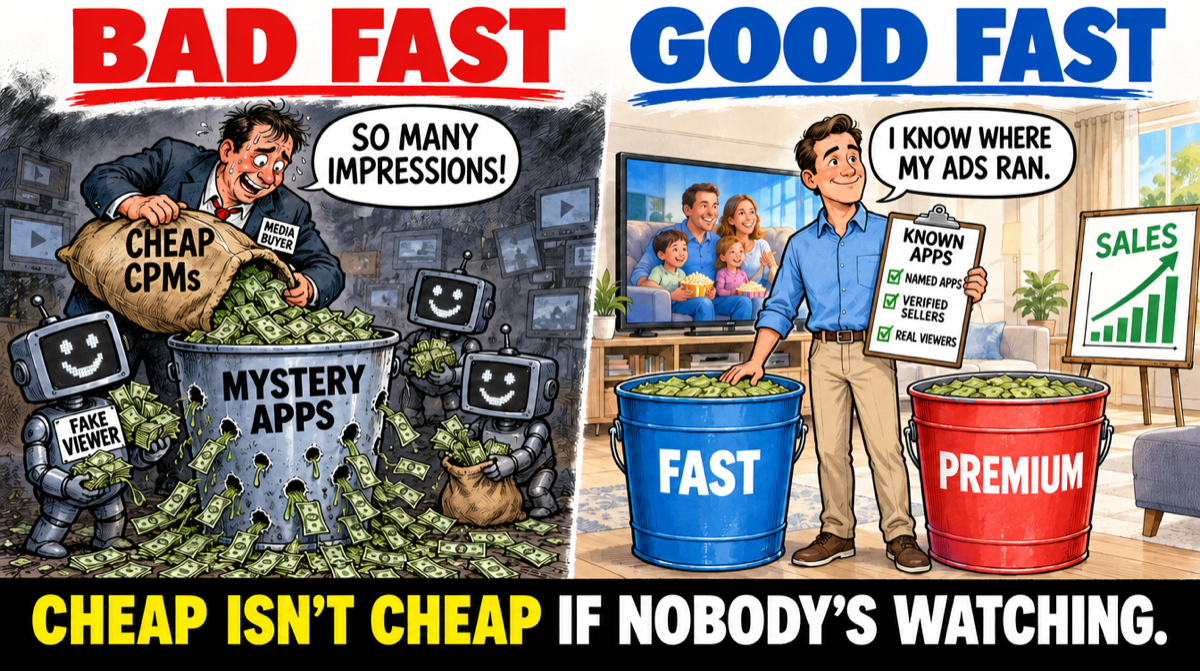
Bad FAST usually has the same fingerprints:
- You can't get an app-level list. "Premium CTV network" with no names attached.
- The CPM is too good to be true. If it's far below every name-brand FAST app you know, ask what you're actually buying.
- The seller can't prove they're allowed to sell it. No match in the app's authorized seller list.
- Frequency looks weird. Huge impression counts, tiny reach, the same "households" over and over.
- Results only show up in the vendor's dashboard. Nothing moves in your own sales, your branded search or your direct traffic.
Five Questions That Separate Good FAST From Bad
Good FAST is easy to recognize once you ask.
1. "Show me the app list." Channel by channel, app by app. A partner who won't share it isn't a partner.
2. "Are you an authorized seller?" The IAB Tech Lab created ads.txt, app-ads.txt and sellers.json so you can check who's allowed to sell each app's ads. Ask your buyer to verify it.
3. "Is pre-bid fraud protection on?" Filtering bad traffic before you pay for it beats a refund request after.
4. "Can we buy the names we trust through deals?" Curated and private marketplace deals let you buy known apps directly. In one January 2026 survey of more than 200 decision-makers, 76 percent rated curated, private marketplace or deal ID supply as important for the year, per PPC Land.
5. "What happened in my sales, by market?" Good FAST shows up where it ran. Read your own orders against each area's baseline, keep a few holdouts and triangulate. That's how you see the real lift CTV creates, not just the impressions a vendor reports.
The Honest Asterisk
Premium isn't automatically clean, either.
NewsJunkie worked by pretending to be premium. And the same DoubleVerify research found fraud running as high as 25 percent in some direct deals, which kills the idea that a direct buy is safe by default.
So this isn't "FAST bad, Premium good." It's "known good, mystery bad," in both buckets. The fix is the same: named apps, verified sellers, protection on, and proof in your own sales.
The Final Take
FAST is one of the best deals in advertising right now.
Real households. The biggest screen in the house. Lighter ad breaks than cable. Prices that let a growing brand build reach it could never afford on linear TV.
That's exactly why bad actors want to sell you something that only looks like it.
So keep the two buckets. Move the split with your goal: FAST-heavy to launch, balanced to scale, Premium-heavy when you need orders now. And buy FAST like you'd buy anything valuable. Know the name on the label.
Cheap isn't cheap if nobody's watching.
Good FAST is cheap and watched. That's the whole game.
This is how we build every CTV plan at CS & Co. It's part of the CS Method™. Want to know which bucket your next dollar belongs in? Find out if CTV is a fit.
Cory Poccia
CEO, CS & Co. Marketing Studio™