
General Marketing
You're Buying CTV Wrong. Here's the Two-Bucket Rule.
CTV is two markets in a trench coat. The two-bucket rule for budgeting FAST and Premium.

If you're a marketer running Connected TV in 2026 and you're treating it as one channel, you are leaving money on the table.
Not a little money.
A lot of money.
The CTV market is now a $33.35 billion category in the U.S. — projected to cross $42 billion by 2027. Every major streaming platform now has an ad-supported tier. Disney has 164 million ad-supported monthly active users. Netflix has 94 million. The number of FAST channels worldwide has grown to over 1,900.
And almost every brand we audit is running their CTV campaigns the same way they ran linear TV in 2018.
One line item. One CPM target. One creative. One audience strategy. Across an ecosystem that has fundamentally bifurcated into two completely different products with two completely different jobs.
This is the post that fixes that.
The Two Buckets
Here is the framework. It is not complicated.
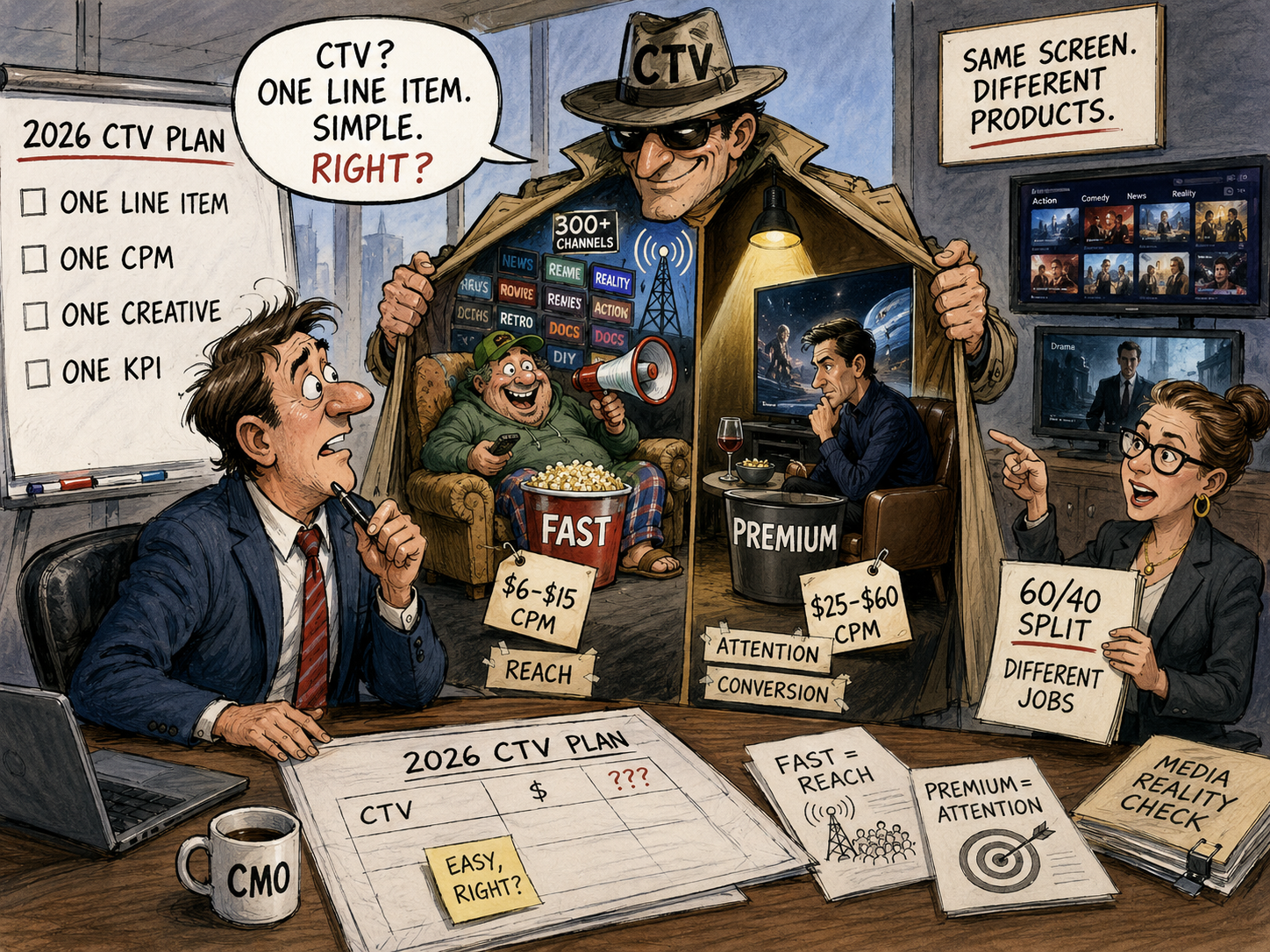
CTV in 2026 is two markets in a trench coat.
Bucket one: FAST. Free Ad-Supported Streaming TV. Tubi. Pluto. The Roku Channel. Amazon Freevee. The 1,600+ channels available in the U.S. that don't require a subscription. CPMs run $6 to $15. Audience is broad, lean-back, "watch what's on." This is the digital descendant of cable.
Bucket two: Premium. Netflix's ad tier. Disney+. Hulu. Max. Peacock. Amazon Prime Video. Logged-in, authenticated, on-demand viewing. CPMs run $25 to $60. Audience is leaning in, actively choosing what to watch, deeply engaged with the content.
Same screen. Same household. Two completely different products.
If you are buying both at the same target CPM with the same creative and the same KPI, you are doing it wrong.
The first thing every CTV plan needs in 2026 is a budget split that names which bucket each dollar is doing work in.
The Job Of Each Bucket
This is the part most marketers miss.
FAST and Premium are not competing for the same job. They are doing two different jobs in a full-funnel plan.
FAST is the reach bucket.
Its job is to put your brand in front of as many qualified households as cheaply as possible. The audience is broader. The attention is shallower. The viewer is in a passive, "what's on" mode — the same mode they were in for fifty years of cable. You are not buying deep engagement. You are buying frequency, brand familiarity, and presence in the lower half of the cost curve.
This is where you build the baseline. This is where you reach the cord-cutter who never subscribes to anything. This is where you fill geographic and demographic gaps that linear TV used to cover. The CPMs are low because the inventory is abundant and the audience is broad.
The right metric for FAST is incremental reach — how many net-new households are you putting your brand in front of, at what cost, that you weren't reaching anywhere else.
Premium is the attention bucket.
Its job is to convert that broad familiarity into intent. The audience is logged in. They actively chose to watch this show. They are leaning forward, not back. TVision data shows premium platforms hold viewer attention 18% better than YouTube, and Trade Desk research shows premium environments drive 40% higher purchase intent and 30% better downstream conversion than less premium environments.
You pay more for Premium because you get more. The viewer is more engaged. The data is deterministic — the platform knows exactly who they are. You can layer first-party CRM matching, lookalike audiences, retargeting from your FAST campaign. The closed-loop attribution is real.
The right metric for Premium is conversion lift — how much did exposure to this premium creative move your downstream behavior, measured against a holdout, in dollars.
If you have not built a media plan that explicitly assigns these two jobs to these two buckets, your CTV strategy is leaking money.
The Allocation Rule
Here is what we recommend to every DTC client.
Start with a 60/40 split — 60% FAST, 40% Premium — and adjust based on funnel stage.
If you are early stage, scaling awareness, or new to CTV: skew heavier toward FAST. 70/30 or even 80/20. Build the reach. Establish the baseline. Don't overpay for attention before you've earned the brand recognition that makes attention worth paying for.
If you are mature, retargeting, or driving direct response: skew heavier toward Premium. 40/60 or 30/70. You already have the awareness. Now you need the conversion. Pay for the deterministic data, the logged-in audience, the closed-loop attribution.
This is not a religious rule. The right split for your brand depends on your stage, your category, your margin profile, and your retargeting infrastructure. But the discipline of explicitly allocating the split is the rule. The brands that walk into a CTV buy without a defined split end up over-indexed on whichever inventory their DSP happens to be cheapest on that week. That is not a strategy. That is an accident.
What Most Marketers Get Wrong
Three specific failures we see over and over.
Failure one. They buy Premium CPMs for reach work.
The brand wants reach. The DSP shows them an Inventory Pool with Disney+ and Hulu in it. They buy it. They get reach — at a $35 CPM that should have been a $10 CPM if they had bought the same audience volume on Tubi or Pluto.
Premium inventory is for attention work. Buying it for raw reach is the most common mistake in CTV media planning, and it shows up as a CPM that is two to four times what it should be.
Failure two. They buy FAST CPMs and expect Premium attention.
The reverse mistake. The brand wants conversion lift. They buy cheap FAST inventory because the CPMs look good. The campaign generates impressions. It generates view-through reports. It does not generate conversions.
Why? Because the FAST viewer is in a different mode. They are watching ambient content while folding laundry. The 3D shoppable ad format that drives 50% spontaneous recall on Premium does not work the same way when the viewer is on a Tubi loop of The Addams Family.
You cannot buy FAST inventory and expect Premium engagement. The job of the bucket is structural, not negotiable.
Failure three. They use the same creative for both.
This is the most expensive mistake.
Premium creative should be cinematic, high-production, narrative-led. The viewer is leaning in. They will watch a 30-second story. They will engage with an interactive shoppable element. They will respond to a brand asking them to think.
FAST creative should be punchier, simpler, faster on the hook. The viewer is leaning back. The ad needs to land in the first three seconds before the viewer's attention drifts back to whatever they were doing.
Same brand. Same product. Two different creative cuts. The agencies that don't deliver both are not running the campaign correctly.
The Measurement Question
Here is where most CTV plans actually fall apart.
Different buckets need different measurement.
For FAST, measure reach efficiency. Cost per incremental household. Frequency distribution. Reach overlap with linear and Premium. Do not — repeat, do not — judge FAST campaigns on last-click ROAS. The viewer just saw your ad while making dinner. They are not converting tonight. They might convert in three weeks when they finally need what you sell. That is the channel doing its job.
For Premium, measure conversion lift. Run a quarterly geo-holdout. Compare Premium-exposed DMAs against matched controls. Look at branded search lift, direct traffic lift, and net-new customer acquisition cost. The deterministic data inside Premium environments lets you do this cleanly. The data inside FAST does not.
For both, measure the halo. The Birch & Barrel mid-market e-commerce case from late 2025 is the canonical example: 1.2 million CTV impressions across 180,000 households drove a 112% lift in branded search, materially better Meta performance from primed audiences, 35% growth in new customer acquisition, and 41% YoY revenue growth. None of those wins showed up cleanly in last-click. All of them were the channel doing its job — and only the brands measuring the halo got credit for them.
If your CTV measurement framework reads CPS, CPL, and CPO at the channel level without distinguishing FAST from Premium, you are pooling two completely different data populations. The averages will be wrong. The diagnoses will be wrong. The optimization decisions will be wrong.
What This Means For Your Monday Morning
Three rules.
Rule one. Build a budget split. Right now. Today. Pull up your CTV plan and ask: how much is going to FAST, how much is going to Premium? If you cannot answer in fifteen seconds, you don't have a strategy. You have an aggregation.
Rule two. Build two creative cuts. Different lengths. Different hooks. Different stories. Different calls to action. The Premium cut leans into attention. The FAST cut leans into recognition. Both are necessary. Either one alone is leaving conversion on the table.
Rule three. Measure each bucket on its own job. Stop reading FAST campaigns on conversion KPIs. Stop reading Premium campaigns on reach KPIs. Hold each bucket accountable to what it was bought for, on the timeline that bucket actually matures on.
These three rules will improve the efficiency of almost every CTV plan we audit. None of them require new technology, new vendors, or a bigger budget. They just require the discipline to recognize that CTV is two markets, not one.
Final Take
Connected TV is not a channel anymore. It is an ecosystem.
It is more like the difference between Vogue and the local newspaper than the difference between Hulu and Pluto. Same medium. Different products. Different audiences. Different jobs.
The brands that win on CTV in 2026 are the ones that stop pretending it is one thing and start budgeting, creating, and measuring like it is two things.
FAST is the reach bucket. Pay reach prices for it. Hold it accountable to reach work.
Premium is the attention bucket. Pay attention prices for it. Hold it accountable to conversion work.
The marketers who internalize the two-bucket rule are the ones whose CTV plans will look smart at the end of 2026.
The ones still treating it as a single line item are the ones whose CTV plans will look expensive.
The channel works.
The architecture is the discipline.
Sincerely,
Cory Poccia
CEO, CS & Co. Marketing Studio
CS & Co. Marketing Studio is a CTV-only performance agency. We architect FAST and Premium budget splits, build dual-creative production pipelines, and run sequenced measurement frameworks for DTC brands scaling CTV from six figures to seven. If your team is treating CTV as a single line item, get in touch.
CTV Strategy | Media Planning | The Two-Bucket Rule