General Marketing
It’s Nov. 4. The Campaigns Just Handed Back the Remote.
Political ads on Roku in Q3 beat the 2024 presidential quarter, and 39.9 billion hours were streamed on the platform. The campaigns' reason to buy TV ended last night. The viewers are still on the couch, and Black Friday is 23 days out.
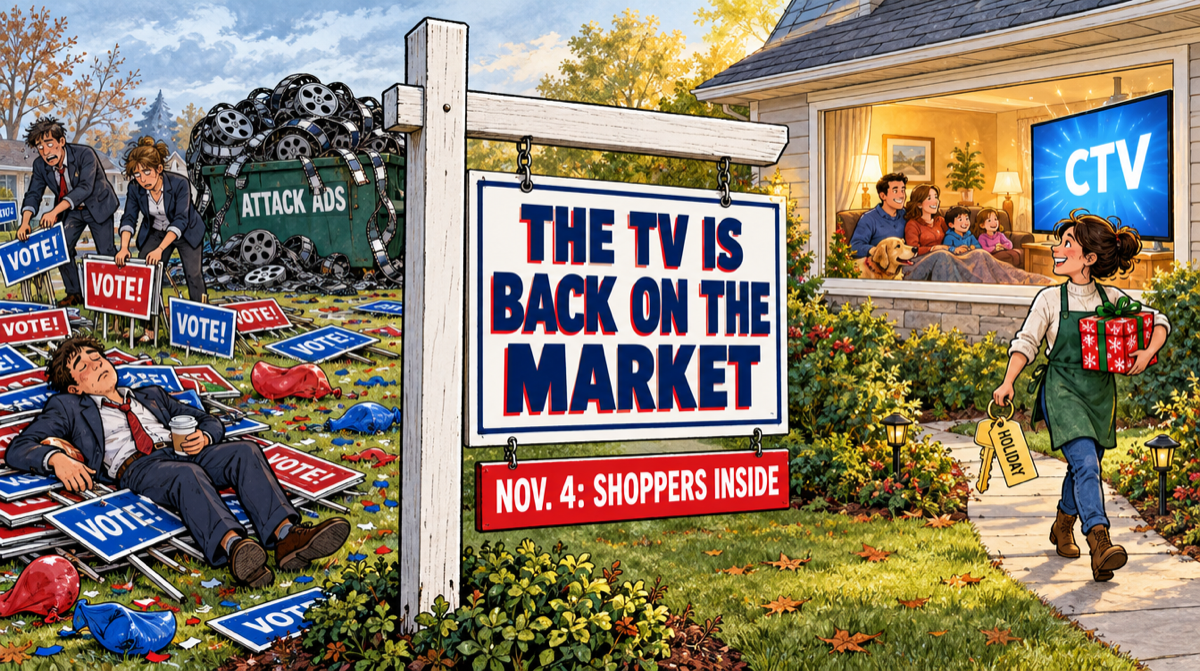
The polls closed last night.
Some races may still be counted for a while, and a few markets may stay noisy. But for most campaigns, the reason to buy TV ended when the polls closed.
A week ago, we told brands to get ready for this morning. Creative approved. Geos set. Budgets released. Be the first call on Nov. 4, not the twentieth.
Well, it's Nov. 4.
And the timing couldn't be better, because two days ago Roku published its third-quarter shareholder letter. Read it the way a brand should, and it says something very simple.
The campaigns just spent a record amount of money proving that CTV works. Now they're leaving. The viewers they were paying to reach aren't.
The Most Expensive Election on Record
Start with the size of what just ended.
AdImpact data shared with Adweek calls this cycle "the most expensive election on record." Back in June, AdImpact forecast spending would top $11.6 billion.
By late October, spending had already passed the 2022 midterm record of $8.9 billion, and was running "slightly ahead of the 2024 presidential election cycle of $11.2 billion."
Read that again. A midterm, the off-year election, outspent a presidential year.
That's a lot of money chasing the same living rooms you want for the holidays.
What Roku's Letter Actually Says
Now look at where a big piece of that money showed up.
From Roku's Q3 2026 shareholder letter, in Roku's own words:
"Our programmatic capabilities continue to drive strong results in political advertising. Similar to Q2, political advertising on the Roku platform in Q3 exceeded the comparable quarter from the 2024 U.S. presidential election cycle."
Here's the part I keep coming back to.
Political advertising on one streaming platform, in a midterm, beat the same quarter of a presidential election. Two quarters in a row.
Campaigns are the toughest TV buyers in America. They get one deadline and one result. There's no "brand lift" to hide behind on election night. And this cycle they picked CTV over cable, then showed up on Roku bigger than they did in 2024.
The rest of the letter backs it up.
The audience grew. Streaming hours on Roku hit 39.9 billion in Q3, up 9% from a year ago.
The ad business grew. Roku's advertising revenue rose 23% to $727 million, which Roku calls "our ninth consecutive quarter of double-digit growth." Its video ad growth "once again outpaced the U.S. OTT and digital markets."
The buying got easier. "In Q3, more than 80% of our in-stream video ad impressions were delivered programmatically." Roku says it has "integrations with every major DSP and SSP so that advertisers can buy Roku inventory wherever they already plan and buy."
The whole company grew. Total net revenue was $1.5 billion, up 24%. Variety's headline on the results: "Sales Soar 24%, Net Profit Booms 7-Fold," with net income of $183 million.
And one more detail worth noticing. Roku says its Media & Entertainment category had "the highest YoY revenue growth in four years," as media companies paid to promote their own shows and services on the platform.
When the people who make TV are buying more TV ads to get their own shows watched, that tells you where they think the attention is.
The Campaigns Left. The Couch Didn't.
So here's where we are this morning.
The biggest, most deadline-driven TV buyers in the country spent the fall on the big screen. They proved it reaches people at scale. They proved it can be bought programmatically, fast, across a lot of markets.
Then, last night, their reason to be there ended.
But the households didn't log off. They're still on the couch, still streaming, still watching the biggest screen in the house. Tonight they'll be watching too.
And Thanksgiving is Nov. 26. Black Friday is Nov. 27.
That's 23 days from today.
Learn From What the Campaigns Did Right, and Wrong
The campaigns get credit for proving the channel. But not every campaign bought it well, and that's the lesson for brands.
Sarah Fuller of Comcast Advertising told Adweek the best campaigns reach "the right people in the right places with the right message."
She also said some campaigns ran national buys, including during live sports, because the space was so crowded. That means a lot of political money reached general audiences instead of the targeted ones it was meant for.
And Comcast uses frequency caps so viewers aren't buried in ads. In Fuller's words: "It's extremely important that we're not ruining that experience by having it be more ads than actual content that they're choosing to view."
Every brand should tape that line to the monitor this week.
Viewers just sat through months of political ads. The brand that shows up next with the same spot over and over all night isn't going to be loved for it.
What I'd Do This Week
1. Buy households, not a whole market. Campaigns had to buy places, because voters are defined by where they live. You don't. Target the homes that look like your buyers, by audience and ZIP, in the markets you actually ship to.
2. Buy the show, not just the channel. Know which shows your ads run in, and pick them on purpose. That's what we mean by buying the show. It's how you get good attention instead of leftover inventory.
3. Cap frequency on day one. Set it before the first impression serves, not after the complaints. Comcast caps frequency for a reason: too many ads ruin the experience the viewer chose. Don't be the next ad people mute.
4. Plan backward from the sales day. Black Friday is the finish line, so build the schedule from Nov. 27 back to today. Space the spots so the memory is fresh when the wallet opens. That's planning backward from the sales day, and this year you have 23 days to do it.
5. Measure in your own sales. Read your own orders by area against each area's baseline. If demand moves where the TV ad runs, you'll see it in your own data, without needing anyone's dashboard to tell you.
None of this is new. It's what we told you to have loaded a week ago. The difference is that this morning, it's live.
The Honest Asterisk
Let me be straight about what this window is and isn't.
It's open, but it's crowded. Every brand that went dark, got bumped or waited out the election is coming back at the same time. I'm not going to promise you prices drop today, because nobody has published a number that says they will. What you get is the chance to compete for the household without a campaign war chest in the same auction.
A few markets may stay hot. Runoffs and recounts can keep some races alive past Election Day. If you're in one of those markets, expect it to stay noisy a bit longer.
Roku's political number is relative. Roku said political "exceeded the comparable quarter" from 2024. It didn't publish a dollar figure, so I'm not going to make one up.
Roku isn't forecasting Q4. Per Variety, Roku isn't holding an earnings call or giving guidance, citing Fox's pending acquisition. So this letter tells you what just happened, not what's coming next.
None of that changes the main point. The viewers are on the big screen, and the holiday window is open right now.
The Final Take
For months, politics rented out the living room.
The campaigns paid record prices to be there, and in the process they proved what we've been saying all along: CTV reaches real households, at scale, on the biggest screen in the house.
Last night, they handed back the remote.
The audience is still on the couch. Black Friday is 23 days out. The brands that move this week, with targeted households, real shows, sane frequency and a plan built backward from the sales day, get the best seats in the house for the season that matters most.
Don't wait for the twentieth call. Make the first one.
That's how we plan every holiday campaign at CS & Co., with the CS Method™. Want to know if you can still make the Black Friday window? Find out if CTV is a fit.
Cory Poccia
CEO, CS & Co. Marketing Studio™