
General Marketing
86% Weren’t Looking. Streaming TV Found Them.
Philips Sonicare found that 86% of oral care shoppers weren't even considering it. So it stopped buying streaming TV one app at a time, ran one plan across six services, and reported 24% incremental reach and a 75% lower cost per acquisition. The lesson isn't a tool. It's how the buy was built.
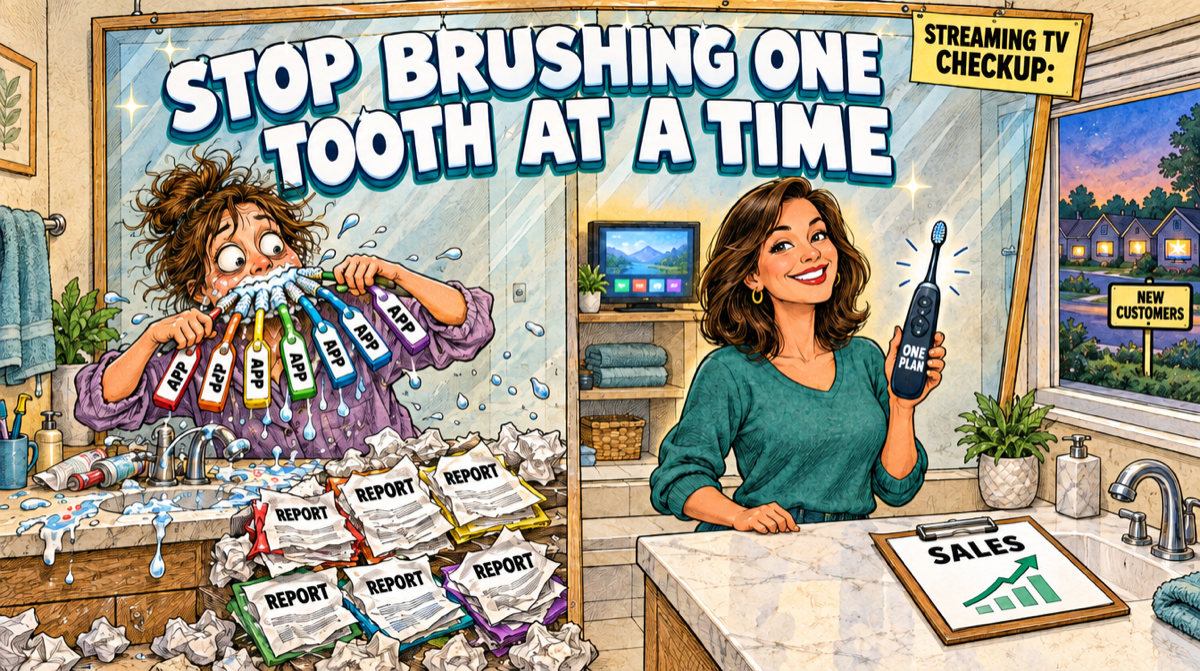
Picture the toothbrush aisle.
Somebody's standing there, comparing two electric brushes. Your brand isn't one of them. It never even crossed their mind.
Now picture most of your category looking exactly like that.
That's what Philips Sonicare found. According to AdExchanger, 86% of the oral care audience segment was not considering Philips products.
Eighty-six percent.
Philips was already running Sponsored Ads on Amazon's site. Those work. But an ad on a shopping site can only meet people who are already looking. It can't do much for the 86% who aren't.
So Philips went to streaming TV. And how it bought streaming TV is the part every brand owner should study.
What Did Philips Actually Change?
Before, Philips bought streaming one publisher at a time.
Paramount+. Roku. Tubi. Peacock. TelevisaUnivision. Warner Bros. Discovery. Each one worked with separately, per AdExchanger.
In its 2025-26 upfront, it consolidated those buys into one place, Amazon's buying platform (which Amazon itself recently merged and renamed "Amazon Ads Agent", with an Amazon executive saying the changes were all about simplicity).
Then it got specific about who it wanted. Philips paired Amazon's shopper data with its own first-party data to build audiences of people who are in market for oral care products but haven't bought from Philips before.
Not existing customers. Not people already searching for it. New people.
Here's what Philips reported, according to AdExchanger:
- 24% incremental reach among audiences likely to be interested in its products.
- A 75% reduction in customer cost per acquisition.
- After seeing the connected TV ads, more people searched online for Philips products by name, and "that intent translated into purchases."
That's a toothbrush brand using streaming TV as a sales engine. Not just an awareness line on the plan.
Priyanti Telang, director of Amazon activation, retail media and digital shelf excellence for Philips North America, put the role of streaming plainly: "a contributor to commercial performance as well as brand awareness."
Here's the Part Nobody Talks About
The channel didn't get fixed. The buying did.
Six separate buys means six separate reports. Six separate frequency counts. Six sellers, each seeing its own slice of the audience, and nobody seeing the whole.
And the audiences overlap. Amazon's Chris Conetta said it directly: buying media and pulling reports from several platforms is "highly inefficient" because of audience overlap, so marketers "lose a lot of the incrementality."
Telang's version is the sentence I'd tape to the wall:
"We can apply one audience strategy across our portfolio, and manage reach and frequency more effectively while better understanding what happens after an ad is seen."
One audience strategy. One way to manage reach and frequency. One view of what happens after the ad.
Yesterday we wrote about the same household seeing the same ad again and again when one campaign runs through several partners and nobody counts the total. That's the frequency side of this problem.
Sonicare shows the other side. Once you stop paying to hit the same couch twice, that money can go find couches that have never heard of you. Philips reported 24% incremental reach doing exactly that.
Isn't the Lesson "Use Amazon"?
No.
Amazon and Philips are the news here. They're not the point.
AdExchanger made the same call: "That logic applies beyond just Amazon's platform." Other retailers can bring purchase data to streaming TV too.
The lesson is the shape of the buy, not the logo on the dashboard:
One plan. One audience. One count across every app. Judged on sales.
You can build that a lot of ways. What matters is that somebody owns the whole picture.
And notice what this story doesn't say. It doesn't say search or retail ads stopped working. Philips was already running them. The best results came from the two working together, which we'll get to in a second.
What Should a Brand Owner Copy?
Four things. None of them need a specific vendor.
1. Aim at the people who haven't bought you yet. Pair your own customer data with whatever shopper data your partners bring, so you can skip the people who already buy you. That's exactly what Philips did. We've written about how retail data can sharpen CTV targeting. The rule is the same on any platform: new households first.
2. Run one plan across every streaming service, with one reach and frequency count. Not six reports stapled together. One total. If no one on your plan can tell you how many unique households you reached across every app, that's the first thing to fix.
3. Watch what people do after the ad runs. Philips watched branded search: people typing its name after seeing the TV ad. Add sales in the areas where the ads run, against each area's own baseline. If demand moves where the TV runs, you'll see it in your own orders.
4. Judge it on cost per new customer, not CPM. Philips' headline result wasn't a cheaper impression. It was a 75% lower cost per acquisition. That's the number that pays the bills. We've made the case before: stop shopping the CPM and start shopping the cost per sale.
The Honest Asterisk
Let's be clear-eyed about these numbers.
This is a case study reported by the brand and the platform selling the ads. It's not an independent test, and the article doesn't include a method or a control group.
The biggest number deserves the closest read. AdExchanger reports a 15x higher purchase rate among people who saw the streaming TV ads than among people who only saw a Sponsored Ads placement online.
But look at what's being compared. One group saw streaming TV ads, and many of them also saw the on-site ads. The other group saw only the on-site ads. And Amazon's own Conetta said the increase was a result of customers seeing Philips ads across both streaming and Amazon's site.
So the 15x isn't streaming alone. It's streaming plus retail, working together. That's good news for CTV. TV found the people search never would, and then the two finished the sale side by side. But it's not a number to drop into your forecast.
So before you scale, prove it in your own sales. Hold out a few areas where the streaming ads don't run, and compare. That's how you find the real lift the TV is creating, not the sales that would have happened anyway.
The Final Take
Eighty-six percent of the category wasn't looking at Philips.
Ads for people already shopping couldn't reach them. Streaming TV could.
It found new households, brought the cost of a customer down, and sent people to search the brand by name and buy. That's CTV doing performance work, on the biggest screen in the house.
But the win didn't come from a new channel. It came from a new way of buying the one they had. One plan instead of six. One audience. One count. One view of what happened after the ad.
Copy the shape, not the vendor. Aim at people who haven't bought you. Count reach once, across every app. Judge it on cost per new customer. And prove it in your own sales before you scale.
That's how we plan and measure every campaign at CS & Co. It's built into the CS Method™. Want to know how many new customers your budget could reach on streaming TV? Find out if CTV is a fit.
Cory Poccia
CEO, CS & Co. Marketing Studio™