
General Marketing
Same Couch. Same Ad. Nobody’s Counting.
Streaming has the lightest ad load on TV: four to five minutes an hour, against 14 to 15 on linear. So when a household sees your spot again and again, it isn't a CTV problem. It's a buying problem: one campaign, several sellers, and nobody counting the total.
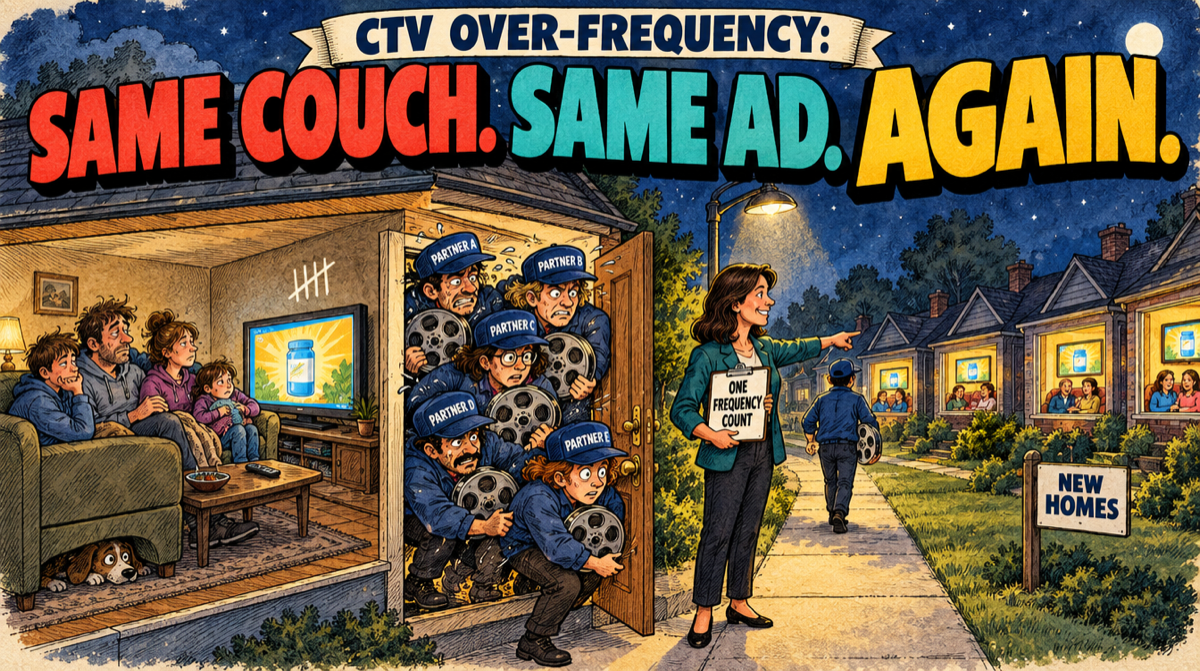
It's Tuesday night. A family is on the couch, halfway through a show.
The break comes up, and there's your ad.
They switch to another app. Your ad again.
Later, a different channel. You already know what happens.
Nobody in that room is thinking, "What a great brand." They're thinking, "This again?"
And here's the strange part. Each of those ads may have been bought by a different partner, on the same campaign, from the same budget. Every one of those partners did exactly what it was asked to do.
That's the over-frequency problem. And this week, two people who sit inside the CTV business said it out loud.
What Did the Industry Just Admit?
At Beet Retreat LA, George Blue, who runs publisher partnerships and enterprise sales for North America at Equativ, told Beet.TV that he thinks the industry is ready to admit it has an over-frequency problem.
His description of how it happens is worth reading slowly:
"Brands are contracting out with multiple publishers, OEMs, MVPDs in an upfront, and essentially with the same campaign buying the same inventory."
Beet.TV summed up the result: for many advertisers, upfront season "started to look more like a way of reaching the same viewers over and over."
The same day, in a TVREV interview with Alan Wolk, Magnite's Matt McLeggon described the plumbing version of the same thing. The trouble starts, he said, "when the same inventory is exposed to the same demand through multiple platforms."
Two executives. Two interviews. One picture: the same campaign, sold through several doors, walking back into the same living rooms.
Why Isn't This a CTV Problem?
Because CTV is the cleanest ad experience on television.
McLeggon put the number on it: "Streaming viewers typically see four to five minutes per hour of ads compared with 14 to 15 minutes on linear TV."
That's the whole reason brands come to CTV. Fewer ads in the break means your ad gets noticed. The household is watching a show they chose, on the biggest screen in the house.
So when the same family sees your spot over and over in one night, the channel didn't do that. The plan did.
The problem is how the campaign was bought, not where it ran.
Why Can't Anyone See the Total?
Here's the part nobody sees.
Every partner's report looks fine.
Partner A delivered what it promised, at a reasonable frequency. Partner B did the same. So did Partner C.
Each report is honest. Each report is about its own slice.
And nobody sees the total.
No single seller can tell you how many times one household saw your ad across all of them, because no single seller can see what the others delivered. Add up three "reasonable" frequencies on one household, and you can end up with a number nobody would ever have approved on purpose.
That's not anyone being sneaky. It's a structure where everyone counts their own piece and nobody counts the whole.
We've written before about how many times is too many, and why unmanaged volume becomes a brand tax. This is the step before that. A cap only works if someone can see every impression it's supposed to cap.
If your frequency lives in every seller's report, you don't have one frequency cap. You have one per seller.
What Should a Brand Owner Do About It?
You don't need to tear up your plan. You need one plan with one total.
1. Put frequency in one place. Pick one place where frequency is counted across every partner on the plan. Not each seller's own number, the combined one. McLeggon's point was that bringing fragmented CTV supply "through a single point of access" lets advertisers manage "frequency, performance and delivery more holistically." Whatever your setup, someone has to own the total.
2. Ask every seller what else your campaign is already buying. It's a simple question: "Where else could this same inventory be reaching us?" Blue's line on curation is the right standard: "You have to know what you're buying." If you can't see overlap, you can't fix it.
3. Spend the extra frequency on new households. Every impression that hits the same couch one too many times is an impression that could have reached a home that hasn't heard of you yet. Blue says that incremental reach lives in FAST channels and in CTV platforms and content providers that lack a direct sales team. He calls that inventory "the ultimate vehicle for increased reach." (FAST isn't one thing, by the way. Here's how we split good FAST from bad.)
4. Judge that reach on performance. Blue expects the upfront to stay focused on branding, with the long tail of CTV "better suited to performance KPIs." So treat it that way. Give the new-household money a sales job and score it on sales.
5. Measure across every buy with a partner you trust. Not each seller grading its own homework. McLeggon said buyers should be able to "use the measurement partners they trust" to get a consistent view of reach, frequency and outcomes across CTV, "rather than having those insights available only within individual platforms." That's the same reason we always triangulate: one instrument always lies.
6. Tell your sellers what you actually want. This is the lemon story.
Why Does the Lemon Matter?
Blue told Beet.TV about a video he watched on a flight. Two people wanted the same lemon, so they cut it in half.
Later they found out one wanted the zest. The other wanted the juice.
"They both could have had the same lemon and got exactly what they wanted if they had just communicated," Blue said. "And I think part of the long tail of CTV is going to be better utilized if there's trusted communication between the buyer and the seller."
That's the frequency problem in one fruit.
Brands worry that telling sellers what they value will raise the price. Sellers are wary of working from a brand's KPIs. So everybody guesses, and the guessing shows up as the same ad on the same couch.
If your real goal is new households and sales, say so. Every seller on the plan should know it.
The Honest Asterisk
Two things, so you go in with clear eyes.
First, this won't be perfect. McLeggon was direct about it: "There probably won't be a single identifier that solves this across all of CTV." He sees the realistic path as platforms working together better, not one magic ID. So the goal isn't perfect deduplication. The goal is managed frequency, with one total view, that keeps getting tighter.
Second, these are two executives' views from interviews. It's not a measured study. Nobody published an over-frequency percentage here, and I'm not going to invent one. What they described is the structure. Your own data will tell you how much of it is happening on your plan.
The Final Take
CTV gives you the cleanest break on television: four to five minutes of ads an hour, against 14 to 15 on linear.
That's a gift. Don't spend it showing the same household the same spot again and again.
The fix isn't fewer partners, and it isn't a different channel. It's one plan instead of several. One frequency count across every partner. One measurement view you trust. And every impression you save from the same couch, spent finding a couch that hasn't met you yet.
Reach and performance are both in CTV. You just have to buy it like one campaign.
Somebody has to count the total. Make sure it's you.
That's how we plan every campaign at CS & Co. It's built into the CS Method™. Want to know how many new households your budget could reach? Find out if CTV is a fit.
Cory Poccia
CEO, CS & Co. Marketing Studio™