
General Marketing
We Know What They Buy. Now Your TV Ad Can, Too.
Most TV still guesses who's watching. We don't have to. CS & Co. can put your CTV ad in front of households based on what they actually buy at Walmart and on how closely they look like your best customers. Here's how it works, and how we stack it.
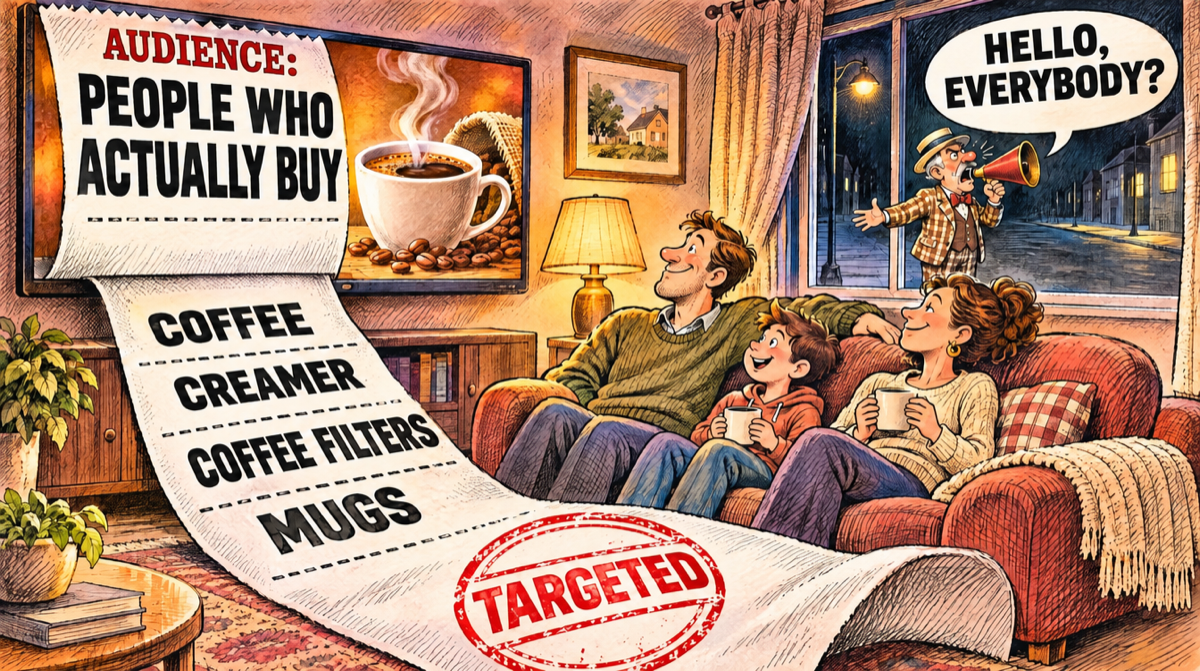
For most of TV history, buying an audience meant buying a guess.
Women 25 to 54. Adults 35 plus. A show that skews a certain way. You paid for everyone in the room and hoped the right people were on the couch.
Connected TV changed that years ago. Every ad on a streaming screen is served to a household, one at a time. The question was never whether you could choose the household. It was what you knew about it.
Now we know a lot more. At CS & Co., we can put your CTV ad in front of households based on what they actually buy at Walmart, and on how closely they look like your best customers. Here's how it works, and how we put it together.
Walmart's Shopper Data, on the Biggest Screen in the House
Walmart knows what people buy. It says its U.S. ad business, Walmart Connect, "reaches more than 150 million weekly customers" (Walmart, June 2026).
For years, that knowledge mostly lived inside Walmart's own stores, site and app. Not anymore. Walmart Connect now invites brands to "activate our first-party data beyond Walmart's stores, site and app to reach verified customers across CTV, social media, the open web, and more" (Walmart Connect).
That opens a door for every brand we work with.
We reach streaming households by what they shop for: the coffee drinker, the new parent, the pet owner, the home cook, the household that's been buying in your category and the one that's about to. Walmart Connect says its CTV solutions "sit at the intersection of premium content, retail-powered audiences and performance insights" (Walmart Connect). On CTV, that means your ad plays in the living rooms where your category already lives.
One note, because it matters.
We build with segments of households, not names. We don't ask who anyone is, and we report back in campaign results.
Lookalikes of Your Best Customers
Walmart data tells us who buys in your category. Your own data tells us who buys from you.
A lookalike audience starts with your real buyers. We seed it with your customer list or your site's purchasers, and the model finds households that look like them: similar habits, similar homes, similar buying patterns. We leave your existing customers out of it, so the lookalike goes after new households.
The craft is in the sizing. Set it too narrow and you run out of homes in a week. Set it too wide and it stops looking like your customer at all. We pick a starting size, read the results, then tighten or widen on purpose.
How We Stack It: Buyers First, Cold Last
Here's the order we target in, on every plan.
1. Your own buyers and site visitors. The people who already know you. We bring them back with TV, and we keep them out of your new-customer audiences so you don't pay to reach them twice.
2. Lookalikes of your buyers. New households that look like the ones already buying from you.
3. Retail shopper data. Households that buy in your category at Walmart, or are in the market to buy soon.
4. In-market and contextual. Households showing interest signals, and the shows and content your buyers watch. We wrote about buying the show, not just the network.
5. Broad reach, last. Only when there's a clear reason it beats the four layers above.
Why this order? Because it would make no sense to spend your budget on households we know nothing about when we can start with households whose buying habits we do know. A smaller, smarter audience beats a giant cheap one. That's why qualified households beat cheap CPMs.
The Edge Isn't the Data. It's the Setup.
Here's the honest part. Shopper segments and lookalikes are tools. Lots of people will have access to them.
What wins is how they're put together.
Segment choice. Walmart's shopper data is cut into a long list of categories. Picking the few that match your buyer, not every one that sounds close, is the difference between a sharp audience and an expensive one.
Layers you can read. If you stack everything into one campaign, you'll never know which layer worked. We run each layer side by side so the results tell us where to put the next dollar.
Frequency that respects the viewer. A household that sees your spot over and over doesn't love your brand more. We set frequency caps for every campaign, so the budget reaches more homes instead of annoying the same ones.
Market tests. We test in a set of chosen markets against comparable markets, so we can see sales move where the TV ad runs.
Measurement built around the audience. The audience comes first. Then we build the proof around it: holdouts, market-level reads and your own sales. That's how you measure the alpha CTV actually creates, not just the sales that would have happened anyway.
The Same Flip, Your Data
We just wrote about how Best Buy is flipping the funnel on CTV: start with real purchase behavior and work backward to the TV ad.
Retail data targeting is how every brand gets to run that play. Your buyers. Their lookalikes. The households already shopping your category. All of them on the biggest screen in the house.
The Final Take
TV used to be the channel where you paid for everyone to reach someone.
That's over. Today we can start with the households that buy, and the ones that look like them, and put your brand in front of them on the screen the whole family watches.
The data is the starting line. The win is in choosing the right segments, sizing them right, capping the frequency and proving it worked.
That's how we build every campaign at CS & Co. It's built into the CS Method™. Want to see which households your brand could reach? Find out if CTV is a fit.
Cory Poccia
CEO, CS & Co. Marketing Studio™