
General Marketing
Stop Shopping the CPM.
A CPM is a price tag, not a score. The ANA found that buying on quality instead of CPM alone cut cost per conversion by nearly 40%, even when CPMs went up. Here's the math on a $5 vs. $12 CTV buy, and the one-line test you can run on any two quotes.
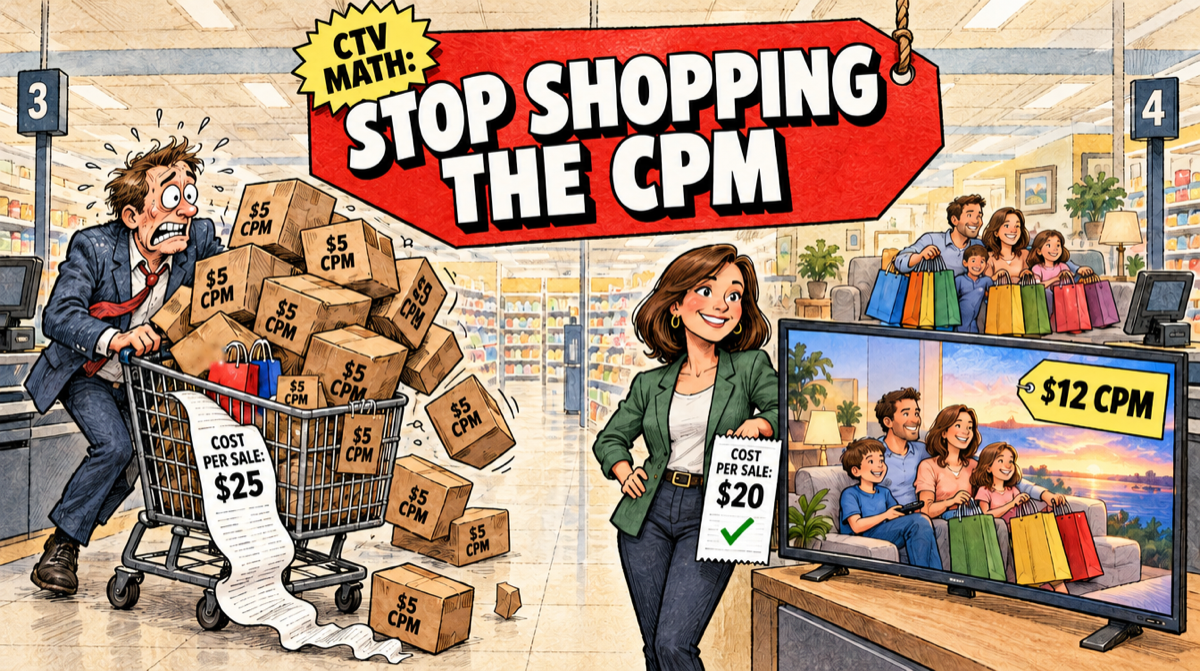
Two CTV quotes land on your desk.
One says $5 CPM. The other says $12.
Most people pick the $5 before they finish reading the email. It feels like the responsible move. It's less than half the price.
But a CPM is a price tag. It isn't the score.
And the brands that keep score the right way keep finding the same thing: the pricier impression is often the cheaper sale.
That's not just my opinion. In its Q4 2025 Programmatic Transparency Benchmark, the Association of National Advertisers reported that advertiser case studies "optimizing toward quality-adjusted metrics, rather than CPM alone, delivered nearly 40% reductions in cost per conversion, even when nominal CPMs increased."
Read the end of that sentence again. CPMs went up. Cost per conversion went down by nearly 40%.

What Does a CPM Actually Tell You?
CPM is the cost per thousand impressions. It tells you what you paid to show up.
It doesn't tell you what showing up did.
The same ANA report went looking at the stuff a CPM never shows you: ad clutter, how many ads run per piece of content, whether the ad was actually in view. Its words: those signals reveal "hidden inefficiencies that low CPMs often mask."
Here's the part nobody likes to say out loud.
A $5 CPM can be a great buy. A $12 CPM can be a bad one. The CPM alone can't tell you which.
And when a plan gets hard, price is the lever people reach for first. In a new CIMM survey of 50 programmatic CTV buyers, 46% said they lowered bids when their signal requirements weren't met. (We dug into that study in did your CTV buy listen?)
We've already covered *who* you're buying, in qualified households vs. cheap CPMs, and *where* you're buying, in YouTube vs. premium streaming vs. FAST.
This one is the math.
The $5 vs. $12 Math
These numbers are illustrative, and I've kept them simple on purpose: one impression per home.
Buy A: $5 CPM. You reach 10,000 homes. That's 10,000 impressions, so it costs $50. It drives 2 sales. $25 per sale.
Buy B: $12 CPM. You reach the same 10,000 homes. That costs $120. It drives 6 sales. $20 per sale.
Buy B charged 2.4 times as much for every impression.
It sold 3 times as much.
So it was $5 cheaper for every sale you actually got.
A $5 CPM that doesn't sell loses to a $12 CPM that does.
The One-Line Test for Any Two Quotes
You don't need a data science team for this. You need one division.
Divide the higher CPM by the lower CPM. That's how many times better the pricier buy has to convert to win.
In our example, 12 ÷ 5 = 2.4.
If Buy B converts more than 2.4 times as well as Buy A, Buy B is the cheaper way to get a sale. It converted 3 times as well. It wins.
Below 2.4x, the cheaper CPM wins. Above it, the pricier one does.
That's it. Run it on every pair of quotes you get. It turns "which one is cheaper?" into the question that matters: "which one is cheaper per sale?"
Why Can a Pricier CTV Impression Be the Cheaper Sale?
Because on the big screen, attention is part of what you're buying.
Scott Young put it plainly at LUMA's Digital Media Summit, in a session AdExchanger covered: "You're getting a higher rate of attention. Yes, you might be paying more for it, but you need exposure and attention in order to actually convert."
That's the whole case for CTV in two sentences. A household watching a show on the biggest screen in the house is a different moment than a scroll past a banner.
But CPM shopping hides it. In the same piece, Lou Paskalis said CTV is "just not seen as being as performative as programmatic." If all you compare is the price of the impression, you will never see the performance.
Timing works the same way. In that same session, Vinny Rinaldi, formerly at Hershey's, said most Halloween candy sales came in the last three or four days of October. "But I wanted 95% of my spend to be the last week of October, because it would have driven a lot more revenue for my company, not somebody else's."
He wasn't shopping impressions. He was shopping revenue.
Guardrail One: Expensive Isn't Automatically Better
Let me be clear, because this is where people overcorrect.
A high CPM is not a quality certificate. Paying $12 doesn't make a buy good any more than paying $5 makes it bad.
The point isn't "buy the expensive one." The point is to stop deciding on price alone.
So test both. Then pay for what converts.
Guardrail Two: Only Incremental Sales Count
This is the guardrail that keeps the whole test honest.
When I say Buy B drove 6 sales, I mean 6 sales that wouldn't have happened without the ad. Not every sale from a home that saw it.
Some of those homes were going to buy from you anyway. They were already loyal, already searching, already on their way. Counting them makes any buy look good, cheap or expensive.
If you run the 2.4x test on sales the ad didn't cause, you'll get a confident answer to the wrong question. That's the difference between the alpha CTV actually creates and the beta it just shows up next to.
The good news: measuring this is no longer exotic. Philip Inghelbrecht said in that session that about ten years ago people looked at him cross-eyed when he talked about incrementality. Today there are lots of independent third-party measurement companies offering it.
The market is even starting to price on it. One TV ad sales chief told the same room he'd offered a big restaurant brand a deal where it would "only pay us based on incremental visits to your store as defined and measured by your independent third-party measurement provider." The brand's answer: "Well, how do I know I can trust them?"
His own words: "We're not there yet."
What to Do Before Your Next CTV Buy
Ask every seller for cost per incremental sale. Keep the CPM in the conversation, but make it the second number, not the first.
Run a holdout or a geo test. Keep a few areas dark, or compare areas where the ad runs against their own baseline. It's the cleanest way to see what the ad caused.
Compare buys by your own sales against baseline. Your order system already knows what sold, where and when. That's your scoreboard, and nobody else's dashboard gets to overrule it.
Pay for what converts. Run the one-line test. Move money toward the buy that wins on cost per incremental sale, whatever its CPM says.
The Final Take
A CPM is what you pay to be seen. A sale is why you bought it.
On CTV, those two numbers can point in opposite directions. The impression that costs more can earn more, because a household watching on the biggest screen in the house is paying attention. And attention is what converts.
So the next time two quotes land on your desk, don't ask which one is cheaper. Divide the higher CPM by the lower one, and ask which one will beat that number.
An honest asterisk: the $5 and $12 buys are illustrative, built to show the math, not a quote from any seller. And the ANA's nearly 40% comes from advertiser case studies across programmatic, where CTV was about 40% of spend in Q4. It's real-world proof the principle works, not a CTV-only promise. Your number comes from your own test.
Stop shopping the CPM. Start shopping the sale.
That's how we judge every buy at CS & Co. It's built into the CS Method™. Want to know what your cost per incremental sale could look like? Find out if CTV is a fit.
Cory Poccia
CEO, CS & Co. Marketing Studio™