
General Marketing
You Asked for the Show. Did Your CTV Buy Listen?
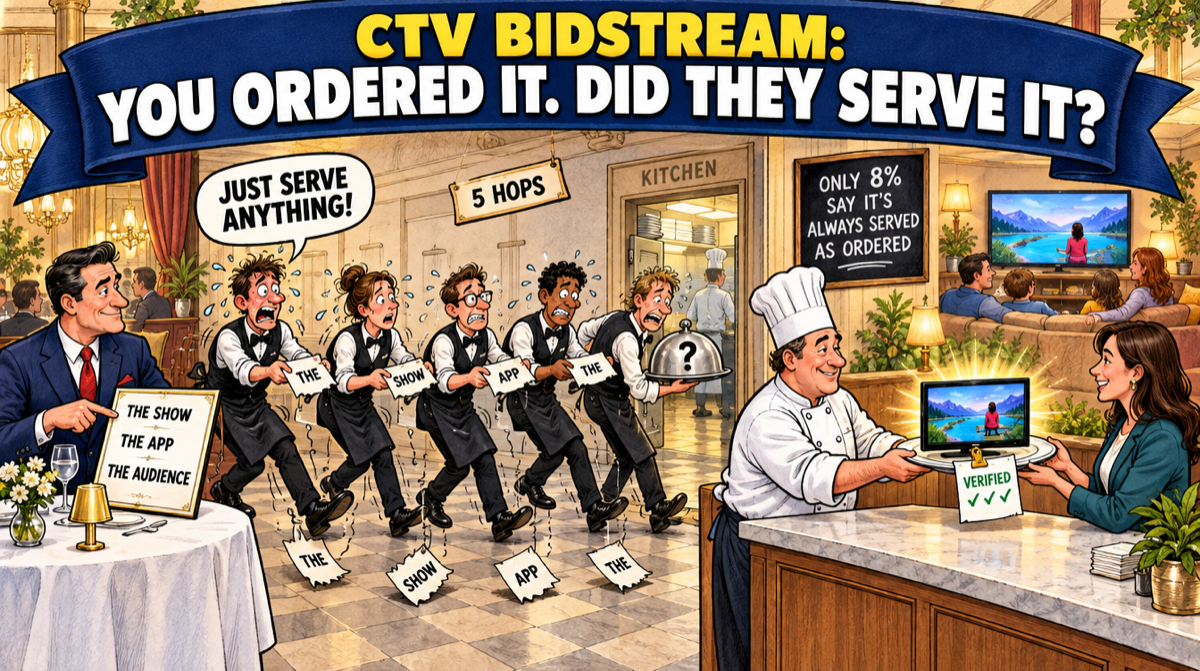
A new CIMM study of programmatic CTV buyers found only 8% are sure their required signals are always used once a campaign goes live. When the info goes missing, buyers broaden targeting or switch supply paths to keep delivery on track. Here's how a brand owner keeps the campaign that runs matched to the plan that got approved.
You approved the plan.
The right streaming apps. The right shows. The right households. Everyone nodded, the budget got signed, and the campaign went live.
Here's the question almost nobody asks next: did the buy actually follow the plan?
A new study says a lot of the people doing the buying aren't sure.

Only 8% Are Sure
This week the Coalition for Innovative Media Measurement (CIMM) released "Behind the Bidstream: The Signals that Matter," a report on what buyers and sellers need from connected TV ad auctions. Advanced Television's headline went straight for the money: when the information buyers need is missing, 62% of them shift spend to a different supply path.
First, the plumbing, in plain English.
Before a CTV ad is served, the buying platform (the DSP) reads a "bid request" for that one ad opportunity. According to CIMM, that request describes the app or service, the content, the device, the audience signals and the companies selling it. Those details are the "signals." They're how your plan ("this show, this app, this audience") turns into an actual bid.
CIMM surveyed 50 programmatic CTV buyers in May and June 2026, interviewed 28 senior executives and analyzed bid logs from FreeWheel and OpenX. FreeWheel and OpenX also co-sponsored the paper.
Here's the part that should get every brand owner's attention.
Only 8% of buyers said their required signals were always operationalized by their DSPs once campaigns went live. Another 58% said often. CIMM's own read: "a full third of buyers regularly see a gap between what they negotiated and what their DSP did."
So the people placing the bids can't always tell whether the platform used what they asked for.
What Happens When the Signal Goes Missing
This is where a plan quietly turns into something else.
When signal requirements weren't met, here's what buyers told CIMM they do:
- 66% work with the seller or platform to fix it
- 62% shift to a different supply path
- 54% broaden targeting to keep delivery on track
- 46% lower their bids
- 30% proceed as planned and monitor
Read the third line again. More than half of buyers widen the targeting so the campaign keeps spending.
That's not a scandal. It's a reasonable move when the budget has to deliver on schedule. But it means the campaign that runs can drift away from the plan that got approved, and nobody upstairs gets a memo about it.
It gets sharper under deadline. Among buyers who answered the follow-up, only 27% kept the same requirements regardless of pacing pressure. Everyone else relaxed them, reduced them, added more supply paths or pushed the signals down the priority list.
When the month is ending and the spend isn't, "broaden to deliver" is exactly where budget leaks.
CIMM's managing director Jon Watts put it this way: "When those expectations do not match, suitable inventory can miss out on demand and campaigns can become harder to deliver."
Don't Blame the Screen
Let me be clear, because someone will read this and say "see, CTV doesn't work."
That's the wrong takeaway.
The screen is real. The attention is real. The premium content is real. A household on the couch watching a show they chose is still the best seat in advertising.
And the report actually shows that clear information gets rewarded. In FreeWheel's data, the publisher name was present in 98% of deal-based bids versus 67% of open-exchange bids, and in the open exchange its presence was associated with 6-13% higher CPMs. OpenX reported a sevenfold higher average bid rate on deals targeted with content information, and an 11% higher average bid CPM when requests carried standardized genre information.
Translation: when buyers can see what they're buying, they show up and pay for it.
This is a plumbing problem. Plumbing is fixable. It's the same lesson behind the dangers of unmanaged CTV buying: the channel works, but somebody has to watch the pipes.
Shorter and Verified Beats Longer and Fancier
One finding surprised me, and I think it's the most useful one in the whole paper.
CIMM asked buyers how likely they'd be to bid on a few different setups. 66% were likely to bid on limited signals coming through a verified supply path. Only 36% said the same for detailed signals coming through an unverified path with multiple hops. Detailed signals on a verified path topped the list at 88%.
In other words, buyers would rather know less from a source they trust than know more from a chain of resellers they can't trace.
That matches what they say they care about. Supply-path transparency made the top three buying factors for 48% of buyers, ahead of scale and reach (46%), brand safety (44%) and cost efficiency (42%). If transparency improved, 54% said they would raise bids only for trusted sources or paths.
FreeWheel's Alex Strickland summed it up: "In CTV, more data doesn't always mean more clarity."
What a Brand Owner Should Actually Do
You don't need to learn ad tech to protect your budget. You need to ask five plain questions.
1. Write down your must-haves before money moves. Which apps and shows are non-negotiable? Which audience? Separate those from the nice-to-haves. CIMM's first recommendation is the same: agree signal requirements explicitly before trading, and tell essential requirements apart from "desirable enrichment." If you've ever bought the show instead of the audience guess, you already know why the list matters.
2. Ask for proof after. Where did the ads actually run, at the app and show level, matched against the plan? CIMM recommends reconciliation reports that show whether agreed signals were received, forwarded, valid and available. You don't need the technical version. You need a report that answers "did we get what we bought?"
3. Prefer the shorter, verified path. A direct, traceable route to the inventory beats a long chain of hops, even if it comes with less data attached. 66% versus 36% is not a close call.
4. Watch what happens under pacing pressure. Only 27% of buyers held the line when delivery got tight. Ask, in advance, what gets loosened if the campaign falls behind, and who approves it. Make "broaden to deliver" a decision, not a default.
5. Judge it by sales, not delivery. A campaign that spent 100% of its budget on schedule has proven it spent the money. That's all. Read results against a sales baseline, and triangulate your measurement so no single dashboard gets the final word.
The Honest Asterisk
This survey is 50 buyers' perceptions. CIMM says so plainly: the responses "do not independently measure how often or why platforms operationalize signals."
So no, this doesn't prove your CTV campaign ignored your targeting. It proves something more practical: the people running the buys often can't confirm it either way. When nobody can see whether the plan was followed, that's the gap to close.
The fixes CIMM proposes are sensible and voluntary: a minimum trading baseline covering who owns the inventory and who is authorized to sell it, comparable statements from platforms on what they support, reconciliation reports, and an industry pilot to test it all.
And the timing matters. OpenX's Erika Loberg: "Automation scales whatever it's built on, so the supply path has to be trustworthy before agents start negotiating on top of it." As AI agents start buying CTV, whatever gaps exist today get bigger at machine speed.
The Final Take
CTV isn't broken. The pipes just need a meter.
You asked for the show, the app and the audience. Write it down before the money moves. Ask for proof after. Keep the path short and verified. Decide ahead of time what gets loosened when pacing gets tight. And grade the whole thing on sales against a baseline, not on whether the budget got spent.
The brands that win in CTV won't be the ones with the longest list of signals. They'll be the ones who checked that the buy listened.
That's how we run every campaign at CS & Co. It's built into the CS Method™. Want to know if your CTV plan is actually the one running? Find out if CTV is a fit.
Cory Poccia
CEO, CS & Co. Marketing Studio™