
General Marketing
The Toughest TV Buyers in America Just Picked CTV Over Cable
Political campaigns get one deadline and one result, with no 'brand lift' to hide behind. This cycle, more than half of their new money went to connected TV, and CTV passed cable for the first time in a midterm. Here's what brands should copy.
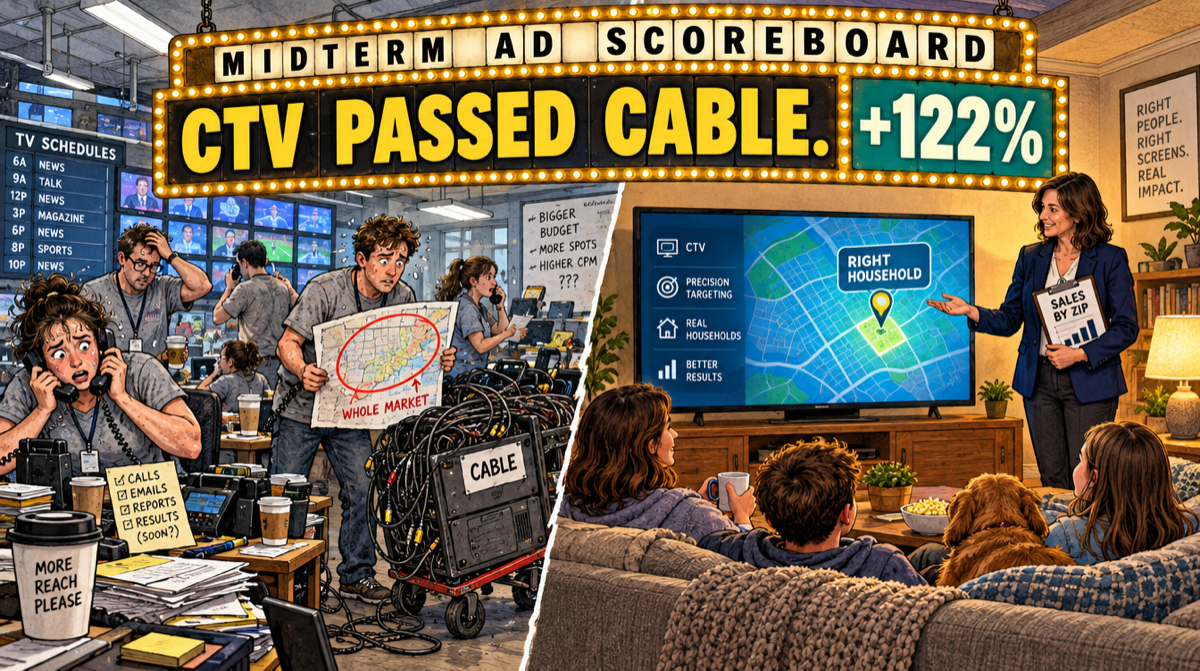
The 2026 midterms will be remembered for a lot of things.
In my business, one of them is this: for the first time in a midterm, connected TV passed cable in political ad spend.
That's the headline Adweek ran this week, based on AdImpact data shared with them. And I don't think most brands understand why it matters to them.
It matters because of who did the buying.
The Numbers
Here's what AdImpact's data shows, per Adweek.
2026 midterm political advertisers have spent $11.4 billion to date. That's up 28% from the 2022 midterms.
It's also more than any cycle AdImpact has tracked. That includes the 2024 presidential cycle, which held the previous record at $11.2 billion. A midterm just outspent a presidential year.
Now look at where the growth went.
Spending is up $2.5 billion over the 2022 midterms. More than half of that increase, 53%, went to connected TV.
CTV spend grew 122%, from roughly $1.1 billion in the 2022 midterms to $2.4 billion.
That growth is what carried CTV past cable for the first time in a midterm.
Why Political Buyers Are the Ones to Watch
Most TV advertisers get to grade their own homework.
A brand can run a quarter of TV, see a "brand lift" study, call it a win and plan next year. Nobody gets fired over a soft quarter. There's always next quarter.
Campaigns don't get next quarter.
They get one deadline. One outcome. A specific person, in a specific district, has to be persuaded or turned out by a specific day, or the money was wasted. There is no "awareness" result to point to on the morning after. You won or you didn't.
That makes political buyers the most results-obsessed TV buyers in America. In my experience, they're also some of the most ruthless about cutting what doesn't work. Every dollar has to move a real person in a real place.
So when those buyers put more than half of their new money into one channel, I pay attention. You should too.
What AdImpact Says Is Driving It
I don't have to guess at the "why" here. AdImpact said it plainly in its June 2026 projection report.
It called CTV "the fastest-growing media type in political advertising." It showed CTV's share of cycle spending going from "just 12%" in 2022 to 21% in 2024, and projected 23% for this cycle.
And it named the reason: "Its ability to reach granularly targeted audiences at scale has made it particularly valuable for House advertisers navigating redrawn districts."
Read that sentence again, because it's the whole lesson.
A House campaign doesn't need a state. It needs a district. Sometimes a district whose lines just moved. If you're buying a whole TV market to reach a slice of it, you're paying for a lot of people who can't vote for you.
CTV lets you buy the households inside the lines. Not the whole market around them.
AdImpact also said cable "has ceded ground to CTV as the preferred complement to broadcast." That's the professionals choosing their second channel, and choosing CTV.
Here's the Part Brands Keep Missing
Your stores have district lines too.
You may call them trade areas, delivery zones, dealer territories or "the ZIP codes where we actually make money." Same idea. You don't need everyone in the DMA. You need the households who can buy from you.
And you have your own Election Day. Black Friday. A grand opening. The end of a quarter. A product launch. A deadline where the money either worked or it didn't.
So here's what I'd copy from the campaigns.
1. Buy the households you need, not the market around them. Campaigns buy inside the district. Brands should buy inside the footprint. Target by audience and by ZIP, and stop paying to reach people who will never walk into your store. Just make sure the audience you're buying actually exists and is actually watching in your area before you build a plan around it.
2. Flex fast. From what I've seen, campaigns move money in days, not quarters. A race tightens, the weight shifts. CTV lets you move budget between geos, audiences and shows mid-flight. If your plan can only change at the next upfront, you're not using what you paid for.
3. Measure the outcome in your own data, not a dashboard. A campaign doesn't trust a vendor report to tell it whether it won. It counts votes. Your version of counting votes is your own sales, read by geography. Compare the areas where you ran against their own baseline and against a few holdout areas where you didn't. Triangulate instead of trusting one instrument. That's how you see the lift the ad actually caused, and it's the kind of proof a skeptical CFO will actually accept.
4. Plan backward from your deadline. Campaigns know exactly when the clock runs out, and everything is built backward from it. Know your sales day, and have creative, geos and budget set before the window opens.
None of that is a political trick. It's just what disciplined TV buying looks like when the result is non-negotiable.
The Honest Asterisk
Let me be fair to the other channels, because the data is.
Broadcast is still the biggest piece of political TV, and it isn't close. AdImpact projected broadcast at $5.6 billion, 48% of total cycle spending, and called it "the dominant force in political advertising."
Cable isn't collapsing, either. AdImpact's June projection had cable at $1.4 billion, and its share of total spending actually grew to 12%.
So this isn't a story about CTV replacing TV. It's a story about CTV becoming the channel campaigns add next, the "preferred complement to broadcast," in AdImpact's words. And CTV is the fastest-growing piece of the mix.
A few more caveats. The Adweek numbers are spend to date, not a final tally. And most of the "why" in this post beyond AdImpact's own words is my read, from years of buying TV, not something the data proves.
Also, a projection is a projection. For what it's worth, AdImpact's projection for the last cycle, $10.7 billion, came within 5% of the actual $11.2 billion. That's a decent track record.
And spending more on CTV doesn't guarantee anything on its own. My read is that campaigns get results from CTV because they target tightly, move fast and count the outcome. Pour money in without that discipline and you get an expensive version of the same old TV plan.
The channel gives you the tools. The management is what makes them pay.
The Final Take
Every two years, the people with the least patience for wasted TV dollars show us where they think the results are.
This cycle, they spent more than any cycle AdImpact has tracked. And more than half of the new money went to CTV, past cable for the first time in a midterm.
Brands don't have to guess what that means. Copy what the campaigns are copying.
Buy the households you need. Flex fast. Count the outcome in your own sales.
The election has a deadline. So does your business.
That's how we plan and measure every campaign at CS & Co., with the CS Method™. Want to see if your footprint is a fit for this kind of buy? Find out if CTV is a fit. And if your holiday plan got squeezed by political ads this fall, start with our plan for that.
Cory Poccia
CEO, CS & Co. Marketing Studio™