
General Marketing
Every Medium Hits Its Inflection Point. TV Just Hit Its Own.
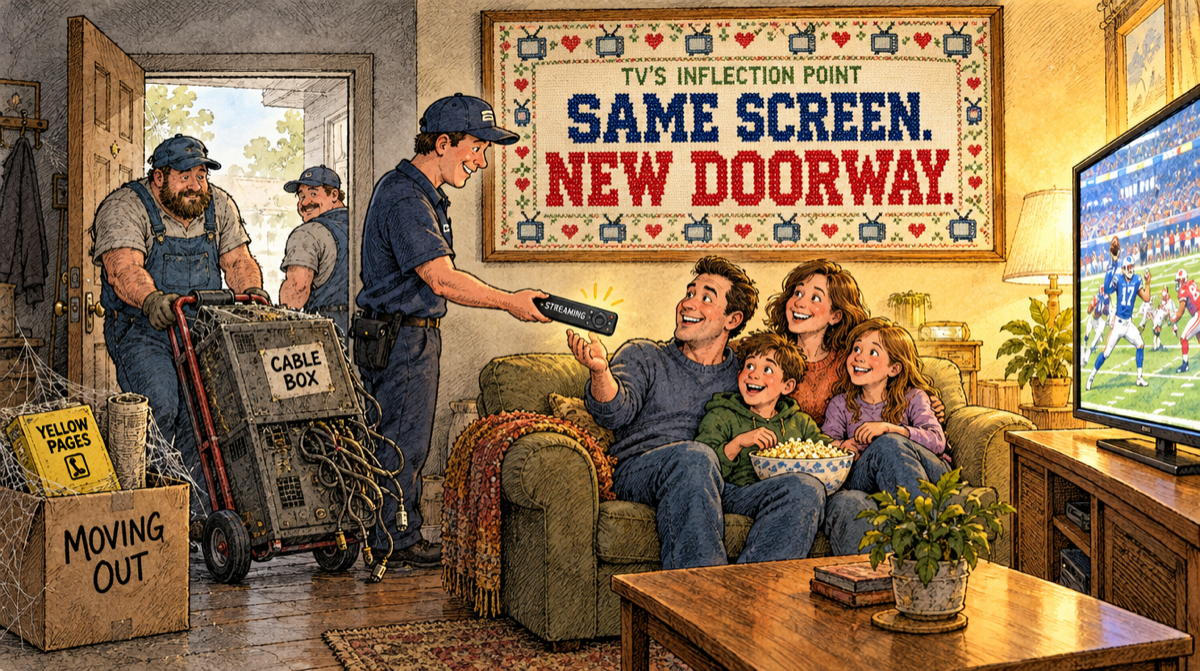
Every medium hits a moment where the audience changes how it shows up. Newspapers hit theirs. Yellow Pages hit theirs. TV just hit its own, and unlike the others, the audience didn't leave the screen. It moved to streaming, and TV moved with it.
Someone sent me a chart this week called "Evolve or Decline."
Yellow Pages. Newspapers. Traditional TV. Then streaming. Each one with a turning point, and an arrow pointing down.
I get why people share it. It's clean, it's scary, and it fits the story everyone likes to tell about media: the old thing dies, the new thing wins.
But I've been in this business since 2010, and I own a radio station. Radio was supposed to die when TV showed up. It's still on in my car every morning.
So I read that chart differently. Every medium hits an inflection point. The question is never "is it over?" The question is "where did the audience go, and did the medium go with them?"
TV just hit its own. And TV went with them.
What an Inflection Point Actually Is
An inflection point isn't a funeral. It's the moment the audience changes how it shows up.
Newspapers hit theirs when readers moved to screens. Newspaper ad revenue in the U.S. peaked in 2005, at roughly $49.4 billion, according to Pew Research Center. The readers didn't stop reading. They read somewhere else, and a lot of the ad money followed them there instead of staying on the page.
Yellow Pages hit theirs when people stopped looking things up in a book and started typing into a phone. The need didn't go away. Nobody stopped wanting a plumber. The search just moved.
Here's the pattern. In every case, the audience kept the habit and changed the doorway.
That's where TV's story is different from the other two. And it's why the arrow on that chart points the wrong way.
TV's Moment Came in May 2025
In May 2025, streaming passed broadcast and cable combined for the first time.
Streaming took 44.8% of all TV viewing in the U.S. Broadcast had 20.1% and cable had 24.1%, which adds up to 44.2%. That's from Nielsen's The Gauge, the monthly report the whole industry watches.
Read that number carefully, because the word that matters is "TV."
That 44.8% isn't time spent on a phone. It's time spent watching television. The family is still on the couch. The screen is still the biggest one in the house. The show is still a show.
What changed is the pipe. Instead of an antenna or a cable box, more and more of what plays on that screen comes through an app.
The newspaper lost its page. The Yellow Pages lost its book. TV kept its screen.
That's not decline. That's a medium following its audience, in real time, without losing the room.
Here's the Part Most People Miss
Every inflection point creates winners. Usually they're the people who notice the doorway moved before everyone else does.
When search took over from the phone book, the local business that showed up in search won customers from the one still buying a bigger ad in the book.
TV's shift has its own version of that. And I think it's the most important part of the whole story.
For most of TV's history, buying it meant buying a market. One big geography, a big minimum, a schedule built around national brands. If you were a regional company, a local service business or a brand that sells in 40 ZIP codes and not 4,000, TV was something you watched. It wasn't something you bought.
Streaming changes that math.
When TV comes through an app, it can be bought more like digital media. You can aim at the households you actually serve, by ZIP code and audience, instead of paying for a whole market to reach the slice that matters. We wrote about why the right households matter more than the cheapest CPM, and this is where that starts.
Same big screen. Same sight, sound and motion. Same family on the couch. A much smaller door to walk through.
The Money Is Following the Audience
Advertisers noticed.
U.S. Connected TV ad spend grew 16% in 2024, from $20.3 billion to $23.6 billion, according to the IAB.
And it's still climbing. In its 2026 Digital Video Ad Spend & Strategy Report, the IAB puts CTV's growth this year at 11%, and it points to self-serve platforms "lowering the entry barrier" for smaller buyers.
That's the inflection point in one line. The audience moved, the money is moving with it, and the door is getting wider.
The Honest Asterisk
Two things I'd want you to hear from me before you hear them somewhere else.
First, 44.2% is not zero. Broadcast and cable together still hold a huge share of what people watch, and live sports and local news still pull real audiences. The smartest plans I see don't pick a side. They run streaming alongside linear, because the viewer doesn't care which pipe the show came through. We made the case for that in Cable Refuses to Die, and the research on TV plus streaming together backs it up.
Second, a lower barrier is not a free pass. Easier to buy doesn't mean easier to buy well. A cheap impression in the wrong house is still a wasted impression. And if you can't connect the spend to what sold, you'll end up judging TV by a dashboard that can't see the store, the call center or the search that happened three days later. That's why we triangulate every campaign against real sales instead of trusting one number.
Neither of those is a reason to wait. They're the reasons to do it right.
The Final Take
Every medium hits its inflection point. Newspapers did. The Yellow Pages did. Radio did, more than once, and it's still playing in my car.
TV just hit its own. The audience moved to streaming.
But look at what didn't move. The screen. The couch. The attention. The thing that has made TV the most powerful ad medium in the house for generations is still sitting right there in the living room.
The chart says "evolve or decline." TV already chose. It evolved.
The only question left is whether your brand evolves with it. For a lot of businesses that spent years on the outside looking in, this is the first time the answer can be yes.
That's what we build at CS & Co. Every campaign runs on the CS Method™: the right households, the right creative and measurement tied to real sales. If you've ever been told TV was too big or too expensive for your business, find out if CTV is a fit.
Cory Poccia
CEO, CS & Co. Marketing Studio™