How CS & Co. was born — and why it stands for Caffeinated Strategies.
By Cory Poccia, Founder & CEO
Everybody asks what the CS stands for.
The honest answer is Caffeinated Strategies. And the reason isn't a branding exercise. It's a coffee shop on Broadway in Lynbrook, New York, and about a thousand nights that ran too late.
The Broadway Beanery
I was in college, working the counter at Blockbuster Video. That's not a detail I'd normally put in a company story, but it's how the rest of it happened — I was there long enough, and loud enough about wanting to shoot, that eventually corporate let me make some videos for them.
So during the day I was shooting. My own films when I could, Blockbuster's when I couldn't. If a camera was rolling somewhere, I wanted to be behind it.
But you can't shoot every night.
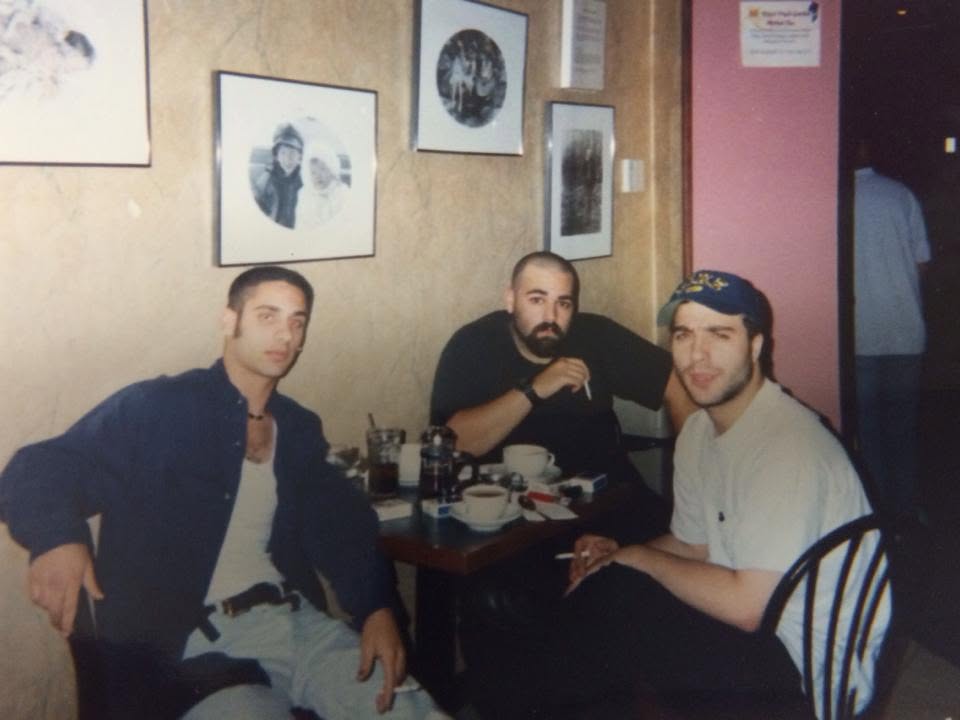
So on the nights I wasn't shooting, I was at the Broadway Beanery with Ari Sobel, talking about scripts. About structure. About why one story lands and the near-identical one next to it doesn't.
The Broadway Beanery was a real coffee shop — good coffee, the kind you went to on purpose. When it closed we'd move the chat to the Lynbrook Diner, where the coffee was considerably worse and nobody cared, because by then the conversation had its own momentum.
Some nights it was the two of us. Most nights a few more — Craig Parten, whoever else had nothing better to do at that hour.
We weren't networking. There was nobody there to impress. We were kids trying to figure out how the thing actually worked.
That's where the habit started. Both of them — the coffee and the creativity.
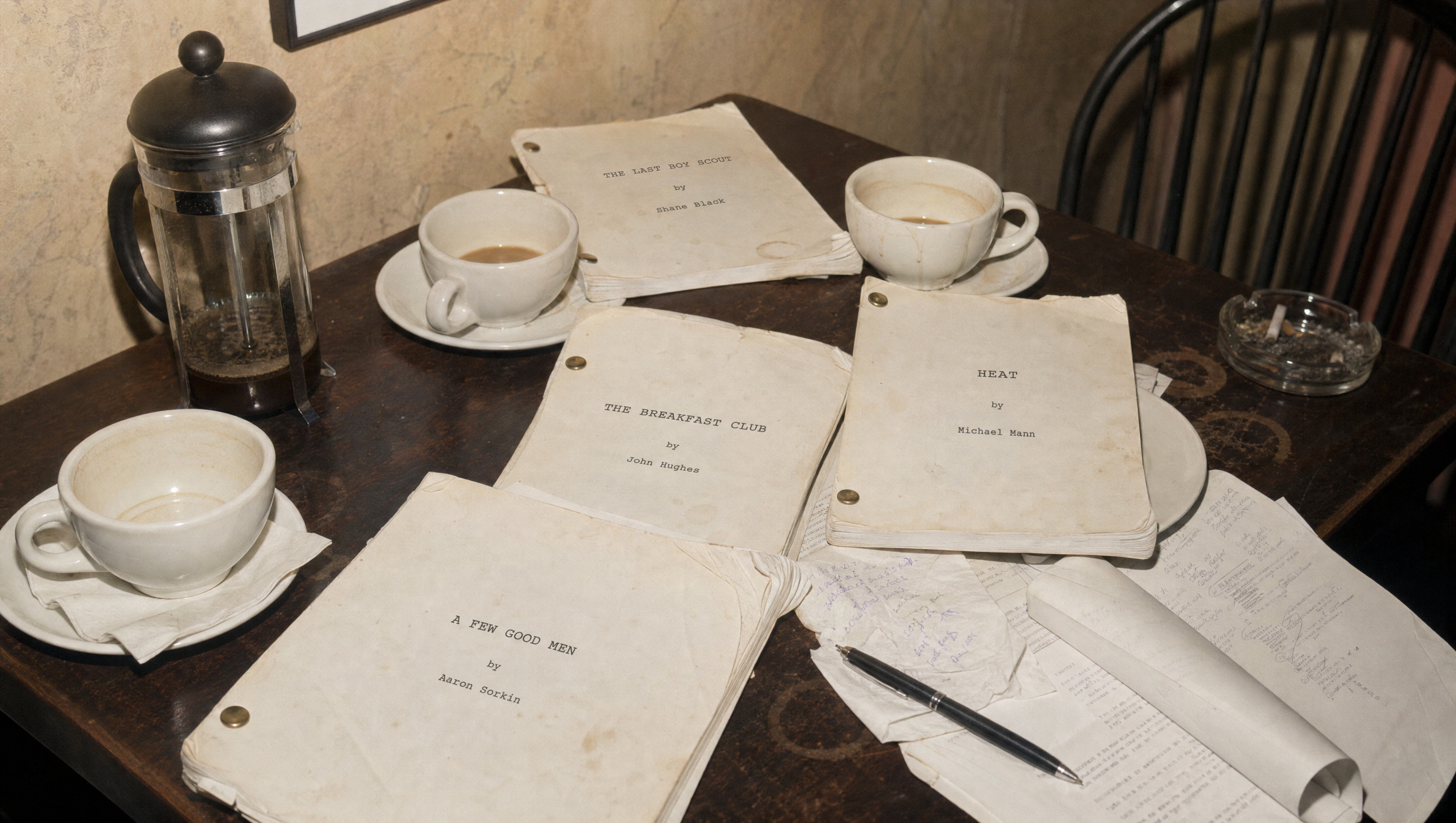
The table, more or less. Four scripts, one press, three cups. Most nights looked about like this.
What Caffeinated Actually Means
The coffee never went away. Twenty-five years later it still doesn't.
But the name isn't about the drink. It's about what happens to your thinking at that hour, when you've had too much but the creative thinking is still there.
Caffeinated strategy is awake. It has a pulse. It's the version you land on at 2 a.m. after you've thrown out the safe one — not the version that survived four rounds of committee because nobody objected to it.
Today, most media plans are DECAF. They're fine. They're defensible. They also don't do anything.
We didn't want to build an agency that made fine.
Then I Went and Got a Real Job
A few, actually.
I produced at WWE. That's where I learned to work fast — real production at real speed, on a schedule that doesn't move for anybody.
Then I ran video marketing at Cision, a PR firm. That's where I learned the other half of the job: what happens to a piece of content once it's inside a business, with a budget attached and somebody who has to defend it upstairs.
Production at WWE. Marketing at Cision. I've been putting those two things together ever since.
Then I went out on my own. Small businesses first. Then bigger ones. Then the kind of names you'd recognize.
And somewhere in there I started noticing something I couldn't stop noticing.
The Thing I Kept Watching Happen
I watched clients, colleagues, and companies I worked alongside hand agencies enormous monthly retainers. I watched them pay commissions on media that had been quietly inflated before it ever reached them.
And I watched a lot of them get very little back.
Here's the uncomfortable part. It usually wasn't fraud. It was structure.
Very few shops have the talent to actually produce a result. But every shop has the ability to send an invoice. And in the standard agency model, those two things aren't connected. The invoice goes out on the first of the month whether the campaign moved the business or not. Spend more, they make more. That's not a conspiracy. It's just the math of how the business was set up in 1870, and nobody ever went back and fixed it.
I didn't want to argue about it. I wanted to not be in it.
The Glass Screen Never Left
For about a decade the industry told itself that social was the new television.
It wasn't.
The glass screen is still in the living room. It's still the biggest one in the house. It's still the one that's on when the family is together. What changed isn't the screen — it's the pipe feeding it.
And that changed everything, because the moment television started arriving over the internet, it became measurable. For seventy years TV was the most powerful advertising medium ever built and the least accountable. You bought ratings, ran your spot, and hoped. Now the same screen can be targeted at a household and tied to what that household actually does next.
I've said this to a few people and gotten a look, but here it is anyway: CTV is Brock Lesnar walking into the WWE in 2002.
Physically different from everyone else in the room. Obviously not built the same way. And the entire business had to reorganize itself around him whether it was ready to or not.
That's the moment we're in. It isn't coming. It's here, and most media plans haven't caught up.
So We Changed How We Get Paid
We charge one flat fee to build the strategy. That's it — a real plan, senior-built, yours whether you ever hire us to run it or not.
After that, media runs at cost. No commission. No markup. No monthly retainer.
We earn the rest on performance, against a number we agree on in writing before a dollar moves. If it moves, we get paid. If it doesn't, we don't.
People sometimes hear that and assume it's a discount. It isn't. It's the opposite — it's the version where we carry the risk instead of you. We only built it this way because I spent fifteen years watching the other way work out for exactly one party in the room.
We Still Shoot
I want to be clear about something, because "we pivoted to CTV" makes it sound like we walked away from the craft.
We didn't. We still produce. We still shoot. Our studio in Plainview has a stage, a post suite, and people who've worked on more than two hundred film and television projects. We're also deep in AI production now — not as a gimmick, as a way to make more versions of a thing and find out which one actually works.
Plainview, New York. Stage, post suite, and media operations under one roof.
Production isn't a side business we kept out of nostalgia. It's the reason the media works. You can buy the best inventory in the country and put a bad thirty seconds on it and nothing happens. The buying and the making were never separate problems. Most of the industry just organized itself as though they were.
Ari's Still Here
Here's my favorite part.
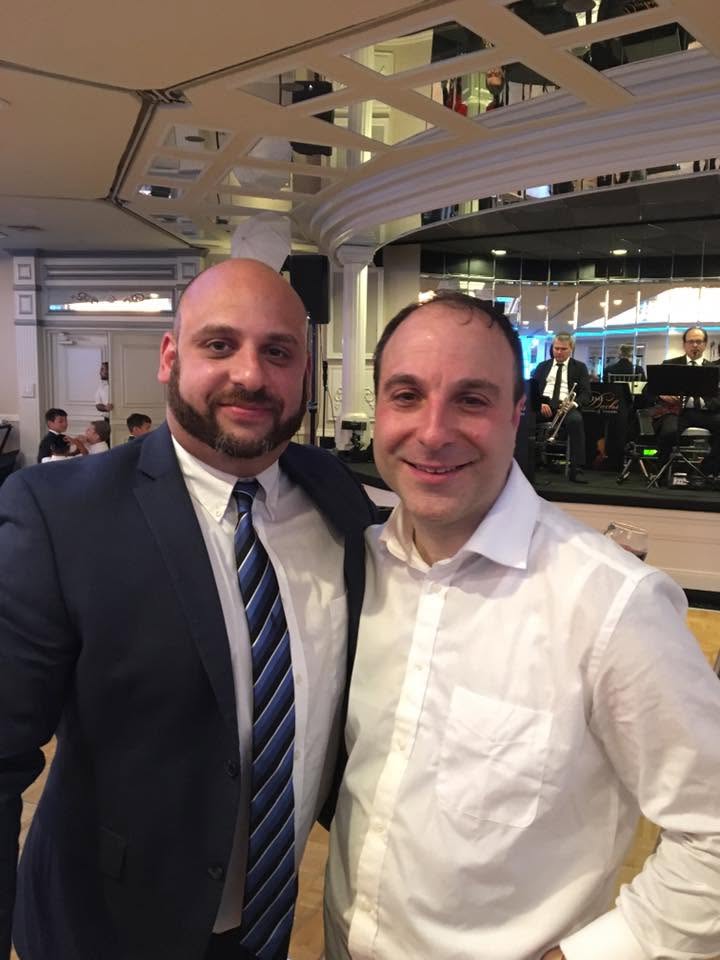
The guy I was brainstorming with at the Broadway Beanery in 1999 — he's on the team. Twenty-five years of creative production, strategy and friendship, and he still helps shape the thinking behind our campaigns.
Same two guys. 20+ years later.
Twenty-five years is a strange amount of time to know someone. You stop explaining yourself. Somebody says a spot isn't working and you already know which part they mean. There's no version of that you can hire for, and no version you can put on an org chart.
What It Adds Up To
Caffeinated Strategies. Bold ideas, built late, and still good in the morning. Then attached to a commercial model where we don't get paid for being busy — we get paid for being right.
That's the entire company. It started over coffee, and honestly, it's still mostly coffee.
If you're running CTV right now and can't tell whether it's working, that's usually not a mystery. It's a measurement problem, and it has an answer. We're happy to talk it through.
Cory Poccia is the founder of CS & Co. Marketing Studio™ in Plainview, New York, and teaches Media and Artificial Intelligence at Adelphi University.
One way to start
Is CTV right for your business?
If CTV is right for your business, we'll show you the math. If it's not, we'll tell you that too — before you spend a dollar.