
General Marketing
YouTube on Your TV Isn’t One Buy. Where Your Ad Runs Decides Who Watches.
TVision's new data on YouTube watched on the TV says the channel your ad runs on changes how much of it gets watched. Studio clips beat big creators on attention. Small niche channels beat the giants. Most brands still buy YouTube by audience alone. Context is the second lever, and your own sales are the proof.
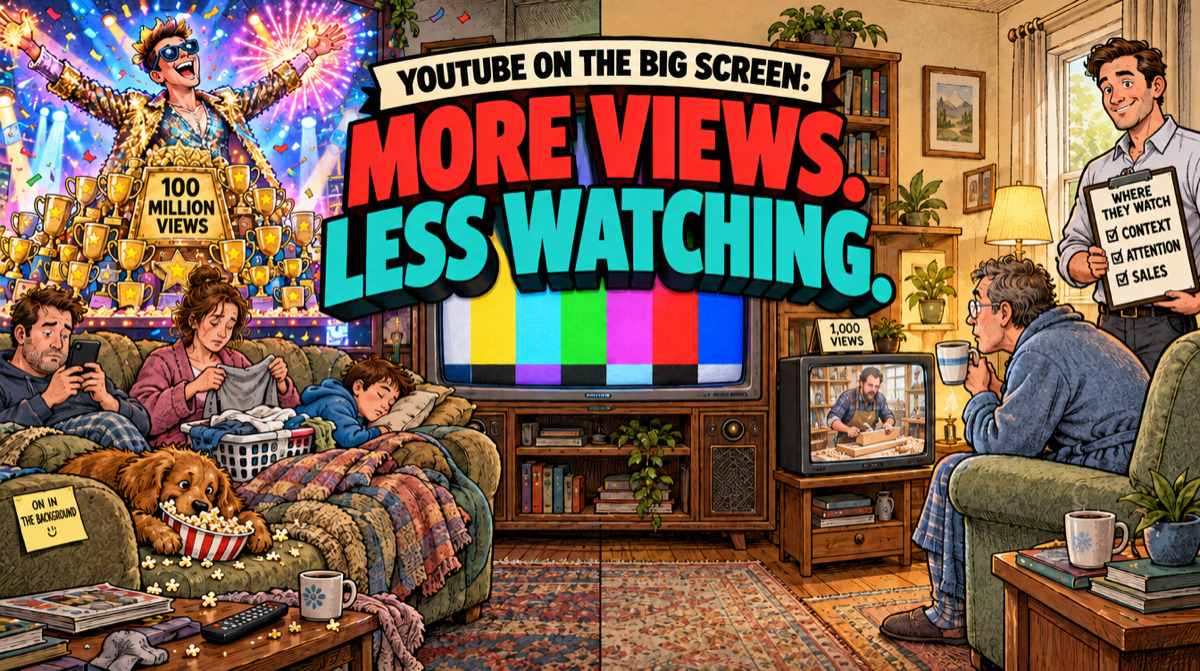
YouTube on the living room TV is real TV now.
Families sit on the couch at night and put it on the biggest screen in the house, the same way they'd put on a network show. TVision's data shows YouTube viewing on TV spikes in prime time, just like traditional TV.
But here's what most media plans still get wrong. They treat "YouTube" as one thing. One line on the plan, one audience target, one price.
New data says it isn't one thing at all. Where your ad runs inside YouTube changes how much of it actually gets watched.

What TVision Found
This week, Mike Shields at Next in Media broke down new numbers from TVision's State of Streaming report, focused on YouTube watched on connected TVs.
TVision runs a panel of U.S. homes. It tracks what's on the TV screen, down to the specific YouTube video, plus whether people are actually looking at it and how many people are in the room.
Here's what it saw.
Creator channels like MrBeast, Dude Perfect and Dash Roblox drove 63% of all YouTube sessions on TV, but only 26% attention.
Studio channels like Apple TV, The Daily Show and WWE pulled a smaller 38% share, but 35% attention. That's 34% higher than creator content.
And then the twist.
Niche channels, the small ones with between 1,000 and 13,000 views, recorded 48% attention. The "mega channels," with 2.5 million to 6 billion average views, came in at 41%.
So it's not "big beats small" and it's not "pro beats creator." Studio clips out-hold the big creators. And the little channels out-hold the giants.
As AdExchanger put it in Thursday's roundup, there are merits to all three.
Why the Gap Might Exist
TVision's CEO Yan Liu had a few theories, and they make sense if you've ever watched YouTube on a TV.
Studio content has a set length and a familiar format. Creator content is "all over the place," as he put it. You might be watching a big, highly produced MrBeast video. You might be watching "goat yoga for five hours."
He also pointed to how people find the video. A popular video often shows up because a recommendation engine served it. A niche video is usually something the viewer went looking for: "niche games I've never heard of, or subgenres with a core fan base."
Here's the part that matters for brands.
Someone who searched for the thing they're watching is leaning in. Someone who got served the next video in a queue might be folding laundry.
Same platform. Same TV. Very different room.
Most Brands Buy YouTube by Audience Alone
Liu said it plainly: "If you think about brands buying YouTube, it's typically only based on audience. There could be another level based on context."
That's the whole story in two sentences.
Audience tells you who's in the house. Context tells you what they're watching and how closely. One without the other is half a plan.
We've been saying a version of this about CTV for a while. Buy the show, not the app. A streaming app is a container. What's playing inside it decides who's watching and how much of your ad lands. YouTube on the TV is the same lesson at a much bigger scale. Liu put the count of YouTube videos at upwards of 14 billion.
And YouTube on the big screen already behaves differently from YouTube on the phone. We covered why YouTube on TV costs more than YouTube on your phone: it's priced like TV, and the same person watches it in a different state of mind. This data adds a layer. Even on the TV, not every placement earns its price the same way.
Right now, acting on it takes work. Brands can't buy YouTube ads using TVision's data directly, but Liu said they could license it to build their own "YouTube curation network," a custom list of channels that fit. AdExchanger notes that targeting specific creator channels today is a manual process of pasting in approved channel lists.
Manual isn't a reason to skip it. It's a reason to do it on purpose.
Reach and Attention Are Two Different Jobs
Don't read this data and conclude "only buy small channels." That would be a mistake, too.
The big creators bring something the niche channels can't: reach, and people watching together. According to TVision, 71% of households watch content from large creators like MrBeast together. Niche YouTube viewing is often a solo activity.
So the trade is real.
Big creator channels put your brand in front of a lot of households, often with more than one person on the couch. Niche channels put it in front of fewer people who are paying closer attention.
And neither one replaces a network-sized moment. Prime time is when YouTube on TV peaks, but TVision found no single creator can command a prime-time audience comparable to network TV. "It's very challenging to get reach," Liu said.
So plan both on purpose.
Use the big channels for reach and co-viewing. Use the focused channels for attention. Use studio content where you want a familiar format. And put frequency discipline on top of all of it, because the same household seeing your ad nine times across nine channels is not nine times the value.
The Honest Asterisk
Let's be straight about what this data is and isn't.
It's one vendor's study, from a panel of homes. TVision was acquired by Viant earlier this year. Liu himself said format differences and content scarcity may explain some of the gap, and Shields expects plenty of "apples vs. oranges" pushback.
The bigger point stands either way. Attention on TV is scarce. TVision's report page says that out of 4+ hours of daily TV viewing, audiences pay attention to just 9 minutes of ads.
So treat these numbers as a strong hypothesis, not gospel. And remember what attention is.
Attention Is a Signal, Not a Sale
Attention tells you the ad had a chance to work. It doesn't tell you it worked.
A household can watch every second of your ad and never buy. Another can half-watch it while cooking and order that weekend.
So use attention data for what it's good at: choosing and curating placements. Then prove the result with the only number that pays the bills, your own sales.
Here's how we'd test this on a real campaign.
Split your YouTube on TV buy by context. Studio, big creator, niche. Same creative, same offer, so the only thing that changes is where it runs.
Read results by geography. Compare sales in the areas where each placement mix runs against each area's own baseline. If demand moves, you'll see it in your own orders.
Keep holdouts. A small set of areas with no ads is the cleanest way to see what the ad actually caused, the alpha, not the beta.
Triangulate. No single report gets the final word, including an attention study. Line up your sales, your geo reads and your platform data, and trust what agrees.
If niche placements really do drive more attention, and that attention really does turn into more sales, your own data will show it. If it doesn't, you've learned something no panel could tell you about your brand.
The Final Take
YouTube on the TV is TV. It belongs in a serious CTV plan.
But it isn't one buy. A studio clip, a mega creator and a small niche channel are three different rooms, with three different levels of attention and three different jobs to do.
Most brands still buy it by audience alone. Context is the second lever, and it's sitting right there.
Pick placements with attention in mind. Plan reach and focus on purpose. Cap your frequency.
Then let your own sales settle the argument.
That's how we build every CTV plan at CS & Co. It's built into the CS Method™. Want to know where your brand belongs on the big screen? Find out if CTV is a fit.
Cory Poccia
CEO, CS & Co. Marketing Studio™