
General Marketing
Ranking What Brands Do With Their First CTV Budget
Five things brands do with their first CTV budget, ranked from D tier to S tier. One of them is why so many brands decide \"CTV didn't work.\" Only one of them proves it does.
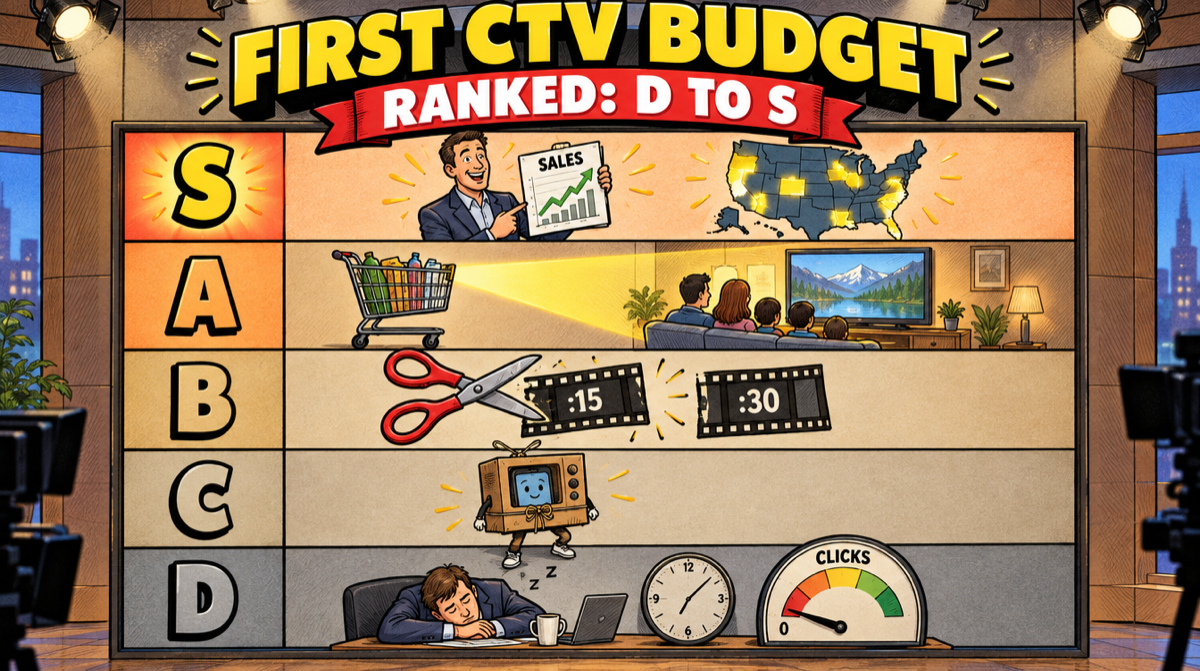
You've seen the tier lists. Somebody ranks pizza toppings, or airports, or every Bond movie, from D at the bottom to S at the top.
So I made one for something I see every week: what brands do with their first CTV budget.
Here's why it matters. One of these habits is why so many brands walk away saying "CTV didn't work." The ad usually worked fine. The habit hid it.
We're ranking habits here, not the channel. Let's start at the bottom.

D Tier: Set it and forget it, judged on clicks
The budget goes live. Nobody touches it for a month. Then somebody opens the report, looks at clicks, and calls it.
Nobody clicks a TV.
They watch, then they go buy. They pick up the phone, search your name, type your URL, or walk into a store. None of that shows up as a click on the ad.
So judge it on clicks, and you'll switch off the ad that's working. That's how brands end up undercounting what TV actually sold.
What to do instead: watch it every day, and judge it on sales. Measure against sales, not just clicks.
C Tier: Buy "CTV" through a social platform's in-app video
Some first budgets go to video that plays inside an app on someone's phone, sold with the CTV label on it.
That's a phone in someone's hand, not a TV in the living room. Same label, different screen.
Phone video can be a fine buy. It's just a different one. You don't get the big screen, the lean-back viewing, or the room full of people watching together. And if it disappoints, it's CTV that gets the blame.
What to do instead: ask one question before you spend a dollar. What screen does this ad actually play on? If the answer isn't a TV, budget it as phone video, and judge it that way.
B Tier: Reuse your TV spot, cut to :15 or :30
This one is a smart start. You already paid for good creative. Use it.
Good creative travels. A strong TV spot usually works on streaming, too. Cut it to a :15 or a :30, and put the brand and the offer up front, so a viewer who only catches the first few seconds still knows who you are and what you're selling. End on a URL people can remember.
So why only a B?
Because the spot only works if the right people see it. Great creative in front of the wrong homes is still a wasted impression.
What's next: keep the spot, and fix who sees it. If you're still picking a partner, here's our checklist for choosing your first CTV agency.
A Tier: Use first-party and retail data to target (Walmart audiences)
Now we're getting serious.
Start with your own customers. Your order system already knows who bought, what they bought and where they live. Then add retail data. Walmart Connect, for example, lets brands "activate our first-party data beyond Walmart's stores, site and app to reach verified customers across CTV, social media, the open web, and more" (Walmart Connect).
Now you're reaching people who actually buy in your category, on the biggest screen in the house. We walked through how we stack shopper data and lookalikes on CTV if you want the details.
So why isn't this S tier?
Because better targeting is a promise. Your orders are the proof.
S Tier: Test with a real budget, measured by incrementality
Which brings us to the top.
Test with a real budget, measured by incrementality.
Two parts, and both matter.
A real budget means big enough to move sales. A test that's too small to show up in your orders can't tell you anything, so it ends with a shrug, and the shrug becomes "CTV didn't work."
Incrementality means you ask the only question that matters: what would have happened if we hadn't run the ad?
Here's the simple version of how you answer it. Run the ads in some areas and keep comparable areas dark. Compare sales in each area against its own normal. The gap between the two is what the TV ad actually did, not the sales that would have happened anyway. That's the alpha CTV actually creates.
This isn't a new idea. Ad researchers have been building cleaner ways to run exactly this kind of test for years. In the Ghost Ads research by Garrett Johnson, Randall Lewis and Elmar Nubbemeyer, the goal was the same one: compare people who could see the ad with people who couldn't, and measure the difference.
That's how you know CTV is working.
The Honest Asterisk
I'm not going to give you a magic minimum number for "a real budget." There isn't one.
What counts as real depends on how much you already sell, how many areas you run in, and how long the test runs. The test is real when it's big enough to move sales you can see in your own orders. That's a conversation about your business, not a number from a blog post.
And none of the lower tiers are crimes. Reusing a good spot is smart. Retail data is powerful. They just aren't the finish line.
The Final Take
CTV is not the problem in any of these tiers.
The households are on the couch. The shows are on. The biggest screen in the house still sells.
What separates D tier from S tier is the habit. Whether somebody watches the buy. Whether it runs on a real TV. Whether the right homes see it. And whether you measure it against what would have happened without it.
So, where did your first CTV budget land?
If you want to know what an S-tier first test looks like for your brand, it's built into the CS Method™. Find out if CTV is a fit.
Cory Poccia
CEO, CS & Co. Marketing Studio™