
General Marketing
Apple Barely Runs TV Ads. The Ones It Runs Are Beating the Benchmark.
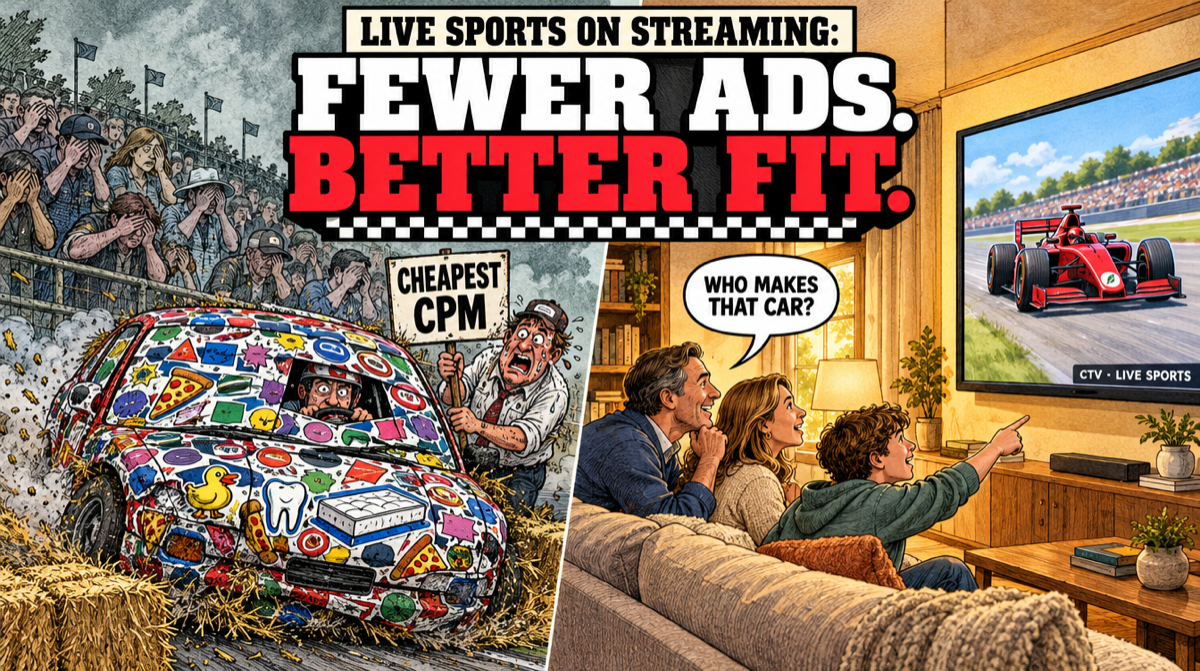
Apple TV has no ad breaks. It sells ads only in live sports like F1, with sponsors who already belong there, and says those brands are beating U.S. CTV benchmarks. The lesson isn't 'buy F1.' It's that fit and audience beat volume.
Apple TV doesn't have ad breaks.
No sponsorships. No ad pods like you get on Netflix or Hulu. Apple has kept its streaming service almost ad-free on purpose, "in the name of customer experience."
Almost.
There's one place Apple does sell ads: live sports. Formula 1 and MLS.
And this week, Apple said those ads are working better than the market average.
What Apple Just Said Out Loud
The Hollywood Reporter sat down with Todd Teresi, VP of Apple Ads, to talk about Apple's first season with F1.
According to Teresi, brand lift studies commissioned by Apple and its advertisers show F1 sponsors on Apple saw increases in brand familiarity, brand favorability and purchase intent, beating overall U.S. CTV benchmarks.
The first-season deals went to American Express and Ford.
Ford's Will Ford said the company is "already seeing stronger awareness of Ford Racing." American Express's Jill Hamilton put it this way: "Connecting with F1 fans at home is just as important as delivering special access and experiences at the track."
On the audience side, Eddy Cue said F1 viewership on Apple TV is up double digits versus ESPN last season.
Now, to be fair, THR is quick to note the numbers are still modest. ESPN averaged 1.3 million viewers in its final F1 season. This is not Super Bowl reach.
Here's the part that matters: Apple isn't pretending it is.
The Most Honest Thing an Ad Seller Has Said All Year
Read this quote from Teresi slowly.
"Do we monetize F1 really well? Yes. Do we have very industry leading CPMs? Absolutely, because it's a high premium audience... But it's a much smaller audience and it's a U.S. audience only."
A seller, on the record, telling you the audience is smaller.
That almost never happens. Most media pitches lead with the biggest number they can find. Apple led with the qualifier.
And then Teresi said the line every media buyer should tape to their monitor:
"The goal here is not grow advertising at all costs, it's to create this balanced model of great experience for the customer and value delivered back to the advertiser."
Not grow at all costs.
From a company sitting on an entire streaming service it has chosen to keep ad-free.
Apple's Formula Has Three Parts
Strip away the brand names and the race cars, and Apple's playbook comes down to three things.
1. Fewer ads.
Apple TV keeps ads out of almost everything. When an ad does show up, it's inside a live broadcast people chose to watch, not buried in a break between episodes.
2. The right fit.
Apple didn't open the doors to anyone with a budget. It went to the sponsors already on the cars and the uniforms. The brands fans already associate with the sport.
Teresi's words: "there's nothing worse than having a mismatch of brands." He wants advertisers who are real fans of F1, and ads integrated so they don't distract from the racing.
That's not a creative note. That's a media strategy. The ad belongs in the room before it ever airs.
3. A qualified audience.
Teresi says F1 draws an upscale audience, with a higher median income than the NFL or NBA, according to the studies he cites. Smaller crowd. Better crowd. For the brands that want that household, a premium CPM can still be the cheaper path to the customer.
Put those three together and you get ads that viewers don't resent and sponsors who say they're seeing it in awareness.
It's Not Just Apple
Apple's story is the boutique version. Amazon's is the stadium version. Same direction.
Adweek reported this week that Prime Video is now in year five of its 11-year Thursday Night Football deal. TNF advertisers are up 6% year over year, with double-digit growth across financial services, retailers, hardlines, auto and travel.
And 17% of this season's TNF advertisers were brand new to TNF and Prime Video.
Read that again. Nearly one in five advertisers in a fifth-year property showed up for the first time.
The premium money is walking into streaming, and it's walking in through the live sports door. We've been saying for a while that live sports is the most premium inventory in CTV. This week Apple and Amazon both put new evidence on the table.
The Lesson Isn't "Buy F1"
Let me be clear, because somebody is going to read this and try to buy a Grand Prix.
Most brands shouldn't buy F1. Most brands can't. Apple is hand-picking sponsors who already live in that world, and it's U.S. only, on a smaller audience, at industry-leading CPMs.
That's fine. The race isn't the lesson.
The lesson is the formula. Context, fit and a qualified audience beat ad volume and cheap CPMs. Every time.
You can run that formula on any CTV budget:
Pick the right room. Put your ad where your buyer is already leaning in, not wherever the inventory is cheapest that week.
Earn your place in it. The ad should feel like it belongs there. A mismatch costs you attention, and it can cost you goodwill.
Pay for the household, not the impression. A cheap CPM that reaches people who will never buy is the most expensive media you'll ever run. Qualified households beat cheap CPMs, and Apple just built an entire ad business on that idea.
Run fewer, better spots. Frequency matters. But ten interruptions that annoy the viewer don't beat three that fit.
That's what CTV does better than any other screen. You can choose the room, the household and the moment. Apple just showed what happens when you actually use those choices instead of chasing volume.
The Honest Asterisk
Now the part a seller won't put in the headline.
Those lift numbers come from brand lift studies commissioned by Apple and its advertisers. The seller and the buyers paid for the scorecard.
That doesn't make them wrong. Brand lift studies are a real, useful tool, and familiarity, favorability and purchase intent are worth moving.
But they measure what people say in a survey. They don't measure what people bought.
"I'd consider buying a Ford" is not a sale. "I feel better about American Express" is not a new cardmember. Purchase intent is a leading signal, not a receipt.
So if you buy premium live sports, and more brands will, don't let the seller's study be the only proof you have.
Pair it with your own sales read:
Geo baselines. Compare sales in the areas where the spots ran against each area's own normal, day by day.
Holdouts. Keep a few comparable areas dark. It's still the cleanest way to see what the ad actually caused, the alpha CTV creates versus the sales you'd have gotten anyway.
Triangulate. Brand lift, branded search, direct traffic, your own orders. One instrument always lies, so read several.
We wrote about this exact problem two weeks ago: everyone wants the big game, and the hard part is proving it sold. Premium inventory raises the stakes on measurement. It doesn't lower them.
The Final Take
Apple could run ads all over Apple TV. It chose to run them almost nowhere.
It picked one kind of programming people watch live, let in only the brands that fit, and charged a premium for a smaller, wealthier audience. Then it told the press the audience was small.
And the sponsors say it's working.
That's the whole lesson. Fewer ads. The right room. The right household. CTV gives you all three, if you're disciplined enough to use them.
Just don't stop at the survey. Brand lift tells you people noticed. Your own sales data tells you they bought.
Get both, and premium stops being a leap of faith and starts being a line item you can defend.
That's how we plan and measure every campaign at CS & Co. It's built into the CS Method™. Want to know if a premium CTV buy makes sense for your brand? Find out if CTV is a fit.
Cory Poccia
CEO, CS & Co. Marketing Studio™