
General Marketing
A Campaign Can Go Dark and Nobody Notices
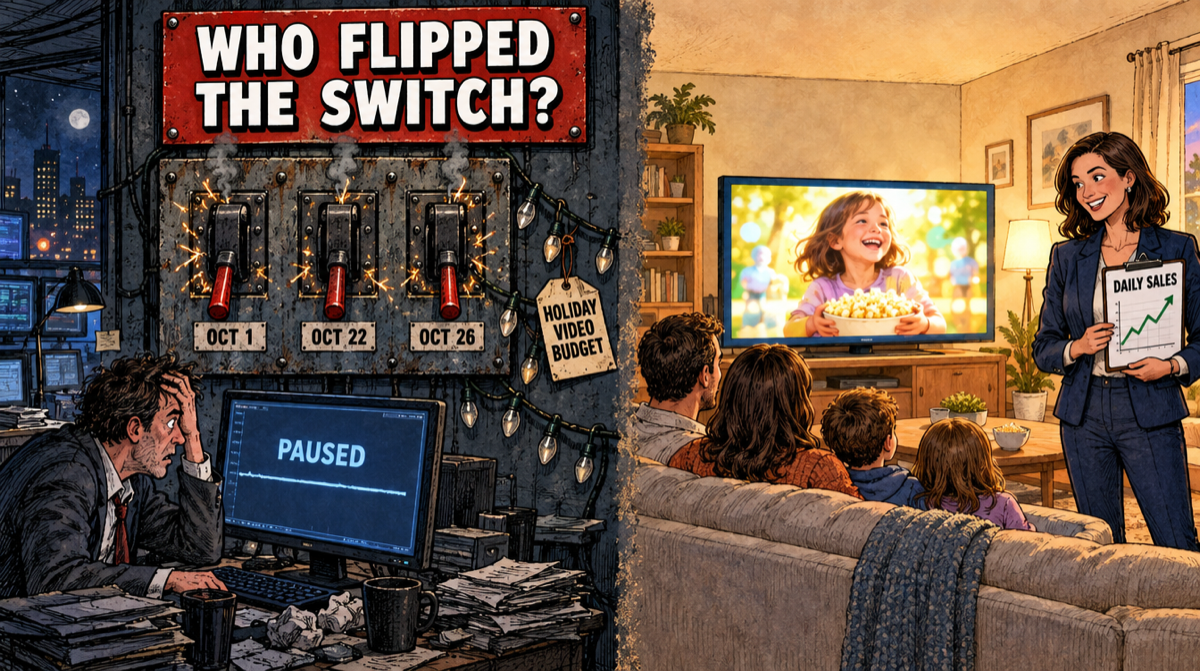
Three Google changes hit video in 26 days. On October 26, legacy DV360 video line items were archived, and some campaigns staged for Q4 simply stopped serving. The TV screen didn't change. The plumbing did. Here's what to check before Black Friday.
This morning I opened AdExchanger's daily roundup with my coffee and found a sentence that should make every advertiser put the cup down.
"The deadline was communicated, but publishers and ad tech didn't upgrade, and many campaigns that had been preset just failed to serve."
That's from the "Surprise Prize" section of today's roundup. Campaigns that were set up, approved and budgeted. Campaigns somebody was counting on for the holidays.
They just stopped.
No alarm went off. No one got a phone call. The money was planned, and the ads weren't running.

Three Changes in 26 Days
Here's what happened, in order.
October 1. Google changed how brand safety works in Display & Video 360 (DV360), its ad-buying platform. The old checkbox lists of sensitive categories and digital content labels were deprecated for programmatic inventory. In their place: three "inventory modes" (Maximum, Moderate and Limited) and ten content themes, run by machine learning, the same way YouTube already works.
October 22. Google updated its AdSense rules on which web video inventory can be monetized based on the content around it. The email to publishers said it plainly: video inventory that includes restricted content "may receive less advertising than other types of unrestricted content."
October 26. The big one. Google automatically archived every remaining legacy video line item for mCPV (maximum cost-per-view) and Video Reach 1.0 campaigns in DV360. Active or paused, it didn't matter. They stopped serving.
Alan Ronis, writing on Medium, summed it up in one line: "Three separate Google changes hit video in 26 days."
He says publishers in Europe, Latin America and Southeast Asia all reported the same thing around that date: Google video demand down, CPMs softer, fill rates shifted. AdExchanger reports the same pattern on open web video since about October 26.
Here's the Part That Should Worry You
There was no automated migration.
PPC Land's read of Google's own roadmap puts it simply. The roadmap listed fourteen changes. Thirteen needed no action from advertisers. One did, with a hard cutoff: October 26. And the move to the newer formats had to be done by hand.
So if nobody rebuilt the campaign, nothing happened. Literally nothing. The line items were archived and the ads stopped reaching anyone.
Ronis describes who got caught: campaigns "that were active, paused, or staged for October and November." In other words, the holiday budget. The one sitting quietly in the account, ready to go, waiting for its moment.
Think about how that looks from the brand's side.
Nothing in the media plan changed. Nothing in the creative changed. Nobody pulled the budget. And the campaign still went dark, a month before the biggest selling weeks of the year.
That's the worst kind of failure, because nobody sees it happen. It looks like a slow week.
The Honest Asterisk
Let me be fair to Google, because the headlines won't be.
Google published the deadline. It sat in a Help Center roadmap last updated on August 21. Ronis himself says Google "executed exactly what it said it would do," and calls it a standard product migration. This wasn't a glitch, and it wasn't a secret.
And there's a lot we don't know.
The roadmap doesn't say how many line items were affected. None of the reporting gives a dollar figure. Ronis is one industry observer reporting what he heard from publishers, and he's careful to say the impact "was not uniform."
You'll also see a scary number floating around: Guideline's data showing video CPMs down 7% year over year in the first half of 2026. That's a blended number for all digital video, and it came before October. It is not a CTV number, and it doesn't measure this outage.
So no, the sky didn't fall. But a deadline nobody acted on turned into budgets that never ran. That's the lesson, and it's bigger than Google.
"Video" Is Not One Channel
The word "video" covers a lot of very different things.
A pre-roll in a player on a news site. A view-based campaign bought across the open web. And a 30-second spot on a streaming app on the 65-inch TV in someone's living room.
The line items archived on October 26 were legacy video formats in DV360: cost-per-view and Video Reach 1.0. And the drop Ronis and AdExchanger describe is on publishers' open web video inventory.
Premium streaming TV, bought on purpose, is a different buy. When you buy the show, you know the app, you know the content, and you know the audience sitting on the couch. You aren't relying on a cost-per-view line item hunting across thousands of websites.
The screen didn't change in October. The audience didn't change. The household still watches, still sees the ad, and still goes and buys the thing.
What changed was the plumbing.
If Your CTV Runs Through a DSP, Check This Week
There is one place where the October changes do reach CTV, and you should know about it.
The October 1 brand safety change covers Connected TV line items in DV360. Google's announcement says programmatic display, video, Connected TV and audio will all use the same tier-and-theme system as YouTube.
That's not a reason to panic. It's a reason to look.
PPC Land makes a sharp point: a tier and a theme are not the same as a checklist. "A buyer with a contractual prohibition on a specific content type cannot express that prohibition as a suitability tier" without blocking more, or less, than the contract says.
So if your brand has rules about where its ads can appear, and you buy CTV through DV360, pull up what you agreed to. Then pull up what the line items are set to now. Make sure they still match.
Who Is Watching the Settings on Your Buy?
Here's the question I'd ask every brand going into Black Friday.
When Google, or any platform, changes the rules, who on your side reads the notice? Who rebuilds the line item? Who checks that the new settings say what your contract says?
If the answer is "I think the agency handles that," find out for sure. Ronis calls October 26 "an industry-wide readiness test," and says a meaningful number of buyers appear to have not been fully prepared.
This is why unmanaged media buying is so dangerous. A buy nobody is actively watching can stop working without any human ever deciding it should.
Every platform ships changes. Somebody has to be paid to notice.
Measure It So a Flat Line Shows Up Fast
The other half of the fix is measurement.
Ronis makes a point aimed at publishers that applies just as much to brands: by the time the impact shows up in reporting, "the cause is often weeks old."
If you only find out your campaign went dark from the monthly report, you've lost a month. In Q4, that might be the whole season.
So read your results where they actually happen: in your own daily sales.
Compare sales in the areas where your TV ads run against each area's own normal, every day. That's how we triangulate CTV measurement. When the ads are running, you see demand move in those areas. When the ads stop, the lift goes flat within days.
A flat line in your own data is a smoke alarm. A mystery in the monthly report is a fire you found too late.
With Black Friday less than three weeks out, that difference matters. If you're still building your plan, our Black Friday and holiday CTV playbook walks through it.
The Final Take
Nothing about the TV screen changed in October.
The families are still on the couch. The shows are still on. CTV still puts your brand on the biggest screen in the house, in front of a real household, right before they shop.
What changed was a setting deep inside a platform. A deadline came and went, nobody rebuilt the campaign, and the holiday budget sat in the account doing nothing.
Ronis put it best: "The dip recovers. The blind spot, if you don't fix it, stays."
So fix the blind spot. Know what you're buying. Check your brand safety settings against your contract. Know who watches the plumbing. And measure on your own sales, every day, so you'd know within days if anything went quiet.
That's how we run every campaign at CS & Co. It's built into the CS Method™. Want to know if your CTV is being watched as closely as it should be? Find out if CTV is a fit.
Cory Poccia
CEO, CS & Co. Marketing Studio™