
General Marketing
Meta Just Reinvented Prime Time. TV Never Stopped Selling It.
Meta's new Ads Super Burst lets brands reserve a 3 to 24 hour window on Facebook and Instagram, with the price agreed up front and rivals locked out. The biggest auction in advertising just admitted what TV has always known: the moment matters. Here's what that means for your CTV plan.
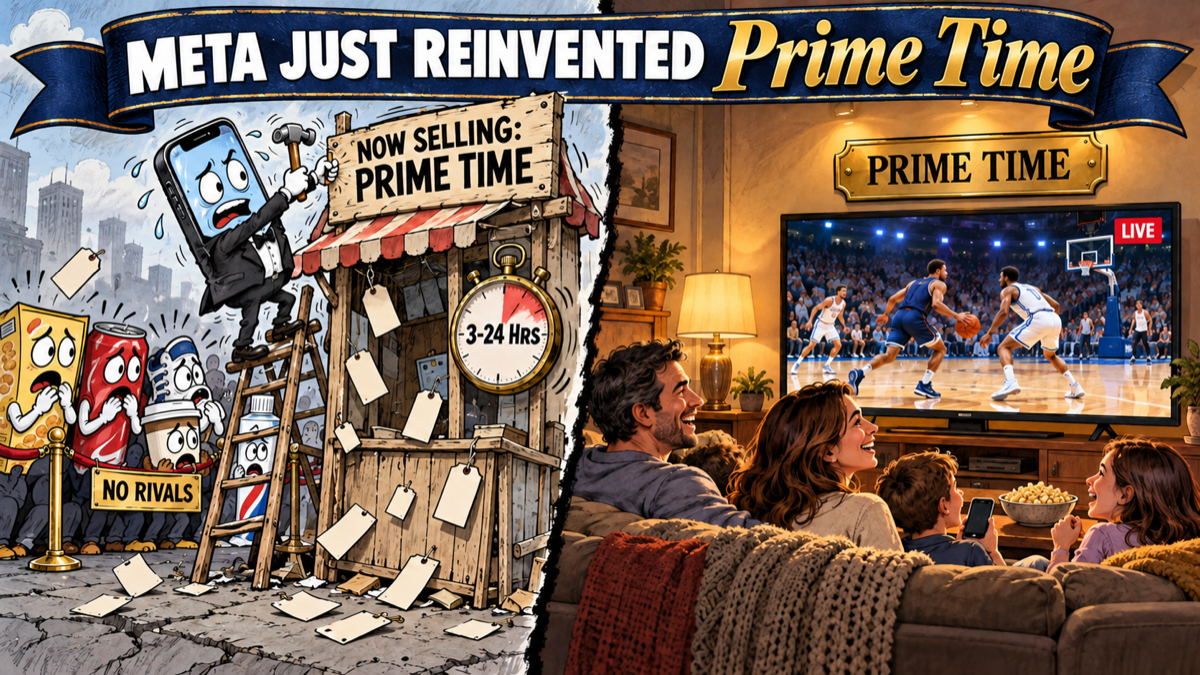
This week, the biggest auction in advertising started selling ads like a TV network.
On Thursday, Meta announced Ads Super Burst. It lets a brand lock in a window of three to 24 hours on a single day across Facebook and Instagram, around moments like the Grammys or the opening weekend of the NBA season, according to AdExchanger.
The price and the approximate reach are agreed up front. Meta commits to hit that reach within 5% of the forecast. And in the US, on select tentpole dates, a brand can even reserve category exclusivity so no rival gets the same window.
AdExchanger's headline put it plainly: "Meta Is Selling Ad Slots, TV-Style."
Meta's own description of the product says it reaches your audience at "TV-like scale," as PPC Land noted.
Read that twice. When the platform built on clicks and auctions wants to describe its biggest new brand product, the yardstick it reaches for is television.
What Meta Actually Built
Strip away the branding and Ads Super Burst is three very old ideas.
A fixed window. You buy the hours around your moment, not a slice of an always-moving auction.
A price set in advance. Normal Meta reach campaigns are bought in the auction, where CPMs rise and fall with demand. Super Burst prices change by date instead. As Meta's Simon Whitcombe told AdExchanger, "A major cultural moment prices differently from an ordinary Tuesday."
Exclusivity. Pay for it, and your category competitors stay out of your window.
If you've ever bought a sponsorship on a big game or a premiere night, none of this is new to you. It's a reserved buy. It's an upfront, compressed into a single day.
Whitcombe explained why advertisers asked for it: "Advertisers have always looked for ways to buy certainty for their biggest moments."
He's right. That's exactly why TV has always been where the big moments get bought.
Here's the Part Nobody's Saying Out Loud
Look at the moments Meta uses to sell this thing.
The Grammys. Opening weekend of the NBA season. In Meta's own announcement, an awards night and "the first weekend of a new sports season."
Those aren't social media moments. Those are TV moments.
The show is on the big screen. The game is on the big screen. The family is on the couch in front of it. The phone is the second screen, the one people pick up during the commercial break to talk about what's happening on the first one.
So Meta has built a product to rent the hours around TV's biggest moments, and it's describing the result by comparing it to TV.
That's not a knock on Meta. Social is a real part of a modern plan. It's a compliment to television, paid by the company with the most to gain from telling you TV doesn't matter anymore.
And it's a reminder of something we tell brands every week. The cultural moment lives on TV. Increasingly, it lives on streaming TV. You can buy the moment itself, like live sports, the most premium inventory on the screen, or you can buy the chatter around it.
The smartest plans do both. But only one of those is the main event.
The Honest Asterisk
Let's be fair about the numbers, because the hype will run ahead of them.
According to Meta, advertisers who tested Super Burst in recent months saw a median lift of 2.9 points in ad recall and 0.6 points in intent, reaching a median of 34 million people per flight, per PPC Land's breakdown.
Those are percentage points, not percent. As PPC Land points out, a move from 30% to 30.6% purchase intent would be a 0.6 point lift. Meta's post didn't publish the baselines, the number of test campaigns or the research behind its footnotes.
Meta also says five seconds of attention spread across a week drove 32% more offline sales than one continuous five-second view. Good finding. But PPC Land notes that just two days earlier a Meta planning director cited a 21% figure for what sounds like the same idea. The direction holds. The size keeps moving.
None of this means the product doesn't work. It means these are a seller's numbers about the seller's own product. Treat them the way you'd treat any network's pitch deck: interesting, and not a substitute for your own sales data.
Even Meta Says the Burst Isn't the Plan
Here's my favorite detail in the whole story.
Super Burst runs with frequency fixed at one. Each impression goes to a different person. One shot, one day.
But Meta's own research, the 32% finding, says the opposite thing wins over time: short exposures, repeated, spread across a week. Whitcombe even said it himself: "The day is a peak on top of an always-on campaign, not a substitute for it."
That's the same lesson we wrote about yesterday. Spacing beats cramming. A single giant burst gets noticed. Repeated, well-spaced reminders are what people remember when they're ready to buy.
AdExchanger cited WPP Media research that 84% of purchases are made by shoppers who already had a brand in mind before they started shopping.
So the real job isn't winning one day. It's being the brand already in their head when the day comes.
What This Means for Your CTV Plan
If you buy streaming TV, here's how to use this news.
Own the tentpoles, early. Whitcombe warned that the best Super Burst windows go first come, first served, and a retailer eyeing a major shopping holiday would need to book well in advance. The same is true on the big screen. If Black Friday, a season opener or an awards night matters to your business, lock in your streaming TV around it now.
Build the peak on top of a base. A tentpole without an always-on flight is a firework. Run steady, well-spaced CTV through the season, then spike it around the moments that matter.
Let each screen do its job. CTV puts your brand on the biggest screen in the house, where the moment is actually happening. Social can echo it on the second screen. And the visitors CTV sends to your site tend to arrive more qualified than paid social clicks, because they came looking.
Measure with your own data. Recall lifts and intent lifts are nice. Sales are better. Read your results by geography against each area's own baseline, keep a few holdout areas, and triangulate with branded search and direct traffic. If your peak moment worked, your own orders will show it.
The Final Take
Meta just spent a keynote reinventing prime time.
Fixed windows. Prices that change with the moment. Exclusivity for the brand that pays. Guaranteed reach. It's a smart product, and plenty of brands will buy it.
But notice what it tells you. When the biggest digital platform on earth wants to sell certainty around the moments that matter, it builds something that looks like TV and describes it by comparing it to TV.
TV never stopped selling prime time. It just moved to streaming, where you can buy it by household, by geography and by moment, and measure it against your own sales.
So go ahead and add the echo. Just don't forget to buy the main event.
That's how we plan every campaign at CS & Co.: a steady base, peaks on the moments that matter, and proof in your own sales. It's built into the CS Method™. Want to know if streaming TV fits your next big moment? Find out if CTV is a fit.
Cory Poccia
CEO, CS & Co. Marketing Studio™