
AI News
I Use AI for Everything. It Still Isn’t Replacing Anyone.
55% of HR leaders say their AI layoffs weren't worth it. Cory Poccia on why AI is a tool, not a replacement, and what the companies getting it right do instead.
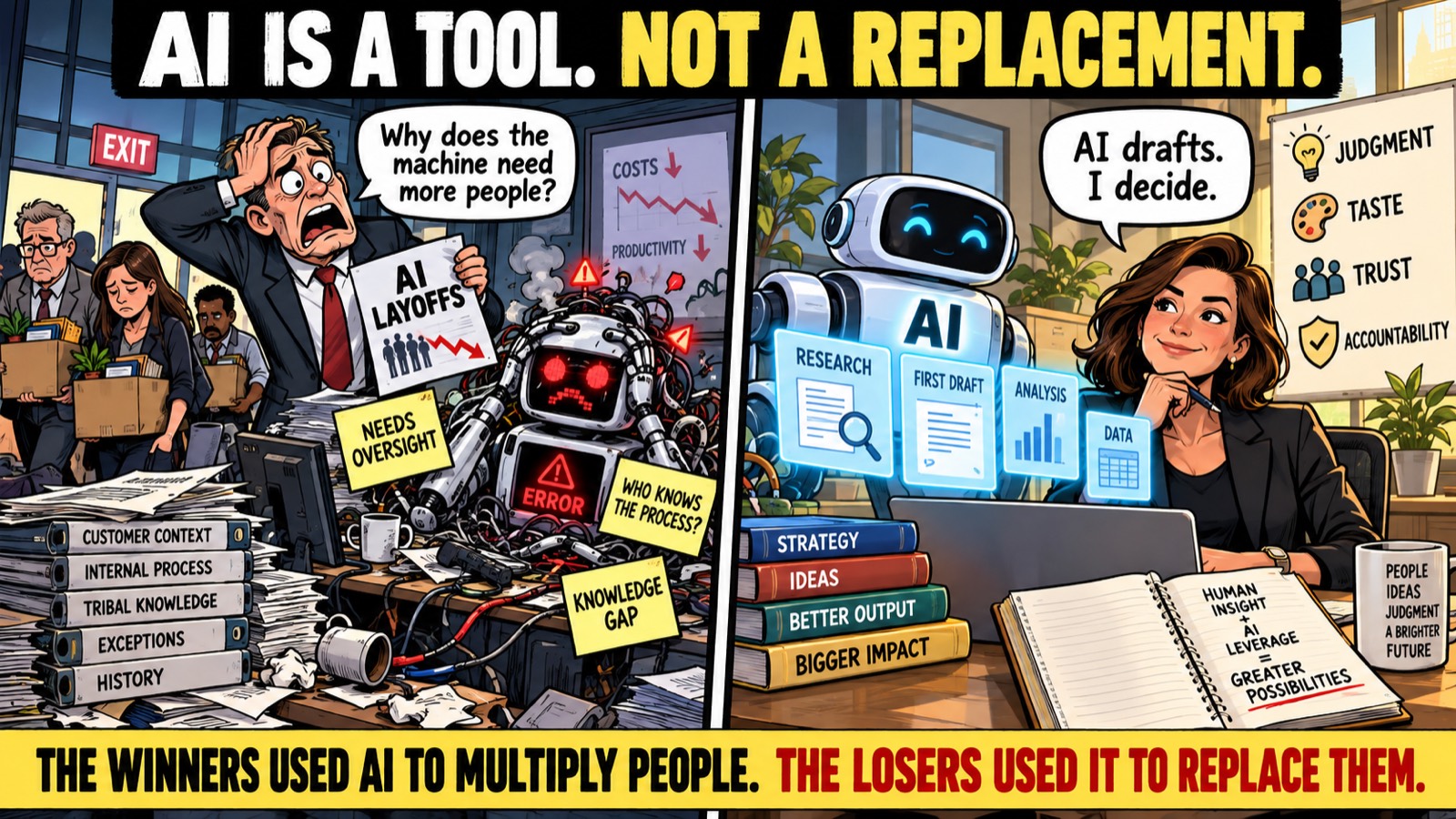
I use AI for everything.
Research. First drafts. Campaign analysis. Data pulls that used to take an afternoon and now take four minutes. I build AI agents. I teach Media and AI at Adelphi University. I have spent twenty-two years in media, and I can tell you that nothing in that time has changed how I work faster than this.
And I have never once confused it for a person.
AI is a tool. It is the most powerful tool I have ever held. But it is a tool — and the companies that forgot that are now finding out what it costs.
The Results Are In
A new study in Harvard Business Review by Babson College professor Tom Davenport, along with Faisal Hoque and Paul Scade, looked at what actually happened when companies cut people and pointed to AI as the reason.
It did not go well.
The early AI-driven layoffs largely failed to deliver the returns executives expected. They exposed gaps in organizational knowledge nobody knew existed until the people holding it were gone. And they created new demand for the exact thing the cuts were supposed to eliminate — human oversight. Some employers are now reversing course.
One number says it all. In one survey, 55 percent of HR leaders said their layoffs were not worthwhile, because AI required more human oversight than expected.
More than half. They cut the people, then discovered they needed people to watch the machine that replaced the people.
They Fired People for a Future That Hadn't Arrived
Here's the part that should make every executive uncomfortable.
Most of these cuts weren't based on evidence. They were based on forecasts. Davenport's earlier survey of more than a thousand global executives found that layoffs attributed to AI were almost entirely made in anticipation of what AI might do — not what it was actually doing inside their own companies.
Read that again. They didn't cut because the tool proved it could do the job. They cut because the headlines said it someday would.
That's not strategy. That's panic with a spreadsheet.
And the irony runs deeper. Research from Revelio Labs found that the companies that blamed layoffs on AI actually lagged their industry peers in AI adoption. The loudest voices about AI replacing people were often the worst at using it.
I've Seen This Movie Before
I wrote earlier this year about Ford.
Ford leaned on AI for quality control, let veteran engineers walk out the door, and assumed the technology would carry the load. It didn't. They ended up rehiring 350 experienced engineers — the "gray beards" — to fix what the AI got wrong.
The AI wasn't broken. The problem was that the people who knew how to train it, check it, and catch its mistakes had already left the building.
Same story. Different company. Now there's a study to prove it's a pattern.
Why the Shortcut Fails
AI multiplies whatever you give it.
Give it deep human judgment, and it makes that judgment faster and sharper. Strip the humans out, and it confidently amplifies your blind spots — at scale, at speed, with nobody left who can tell the difference.
That's the knowledge gap the study found. So much of what makes a business work isn't written down anywhere. It's the veteran who knows why the process has that extra step. The editor who can feel when a story is off. The analyst who looks at a number and says, "That can't be right." That knowledge lives in people, and AI can't learn what nobody ever documented.
The research backs this up from every direction. Stanford found that experienced workers in AI-exposed jobs held steady or even grew, because AI complements what they already know. Experience is the hedge.
And a University of Pittsburgh study found something even more striking: AI layoffs and the job insecurity they create actively destroy the conditions AI needs to make people more productive. Employee sentiment toward AI is one of the strongest predictors of whether it actually improves productivity. Scare your people, and they stop leaning in. The layoff poisons the very tool it was supposed to justify.
How I Actually Use It
Here's the line I draw every single day.
AI drafts. I decide.
AI finds the statistic. I verify it before it goes out under my name — because the machine doesn't lose credibility when it's wrong. I do.
AI can crunch a campaign's numbers in seconds. It can't sit across from a client and understand what they're actually afraid of. It can generate fifty headlines. It can't tell you which one is true to the brand. It can summarize a market. It can't earn trust.
Judgment. Taste. Accountability. Relationships. The instinct to ask "does this make sense?" before hitting send. That's the human job, and AI made it more valuable, not less. The tool took the grind off my plate so I could spend more of my time on the parts only a person can do.
That's the whole point. Not subtraction. Multiplication.
The Better Way
The study's authors land on the right answer: redesign the work instead of cutting the roles.
Stop starting with a headcount target. Start by looking at how work actually gets done — where AI genuinely creates value, and where human capability is still essential. Then build around both.
The companies that get this right will have people who are dramatically more capable than they were a year ago. The companies that got it wrong are now paying to buy back the knowledge they showed the door.
The Final Take
I'm not an AI skeptic. I'm about as far from one as you can get. I use it all day, I build with it, and I teach the next generation how to use it well.
Which is exactly why I can say this with confidence.
AI is a tool. Not a replacement.
The results are in. The companies that treated it like a replacement fired their expertise, inherited new oversight problems, and are now reversing course. The ones that treated it like a tool made their best people better.
Use it for everything. Just never forget who's holding it.
Cory Poccia
CEO, CS & Co. Marketing Studio™