AI News
The People Who Built AI Just Changed Their Tune on Jobs. I Never Had To.
Ford, Klarna, Commonwealth Bank and IBM cut people for AI, then hired them back. Cory Poccia on the AI boomerang and why AI is a tool, not a replacement.
For two years, the loudest voices in tech told us the same story.
AI is coming for the jobs. Half of entry-level white-collar work, gone. Unemployment spiking. Get ready.
Now those same voices are quietly changing their tune.
Anthropic's CEO, Dario Amodei, the man who warned AI could wipe out half of entry-level white-collar jobs, said this spring he'd been "pretty wrong" about the economic impact. OpenAI's Sam Altman now argues the companies adopting AI most deeply are among the ones hiring the most. Jeff Bezos has gone further, suggesting AI could create a labor shortage, not a jobless future.
And CEOs have noticed. Companies announcing cuts this summer are going out of their way to say the layoffs weren't about AI replacing people.
I never had to change my tune.
I use AI for everything. Research, first drafts, campaign analysis, data pulls that used to take an afternoon and now take four minutes. I build AI agents. I teach Media and AI at Adelphi University. Twenty-two years in media, and nothing has changed how I work faster than this.
And I have never once confused it for a person.
AI is a tool. The most powerful one I've ever held. But a tool.
The companies that forgot that are now learning what it costs.
Meet the AI Boomerang
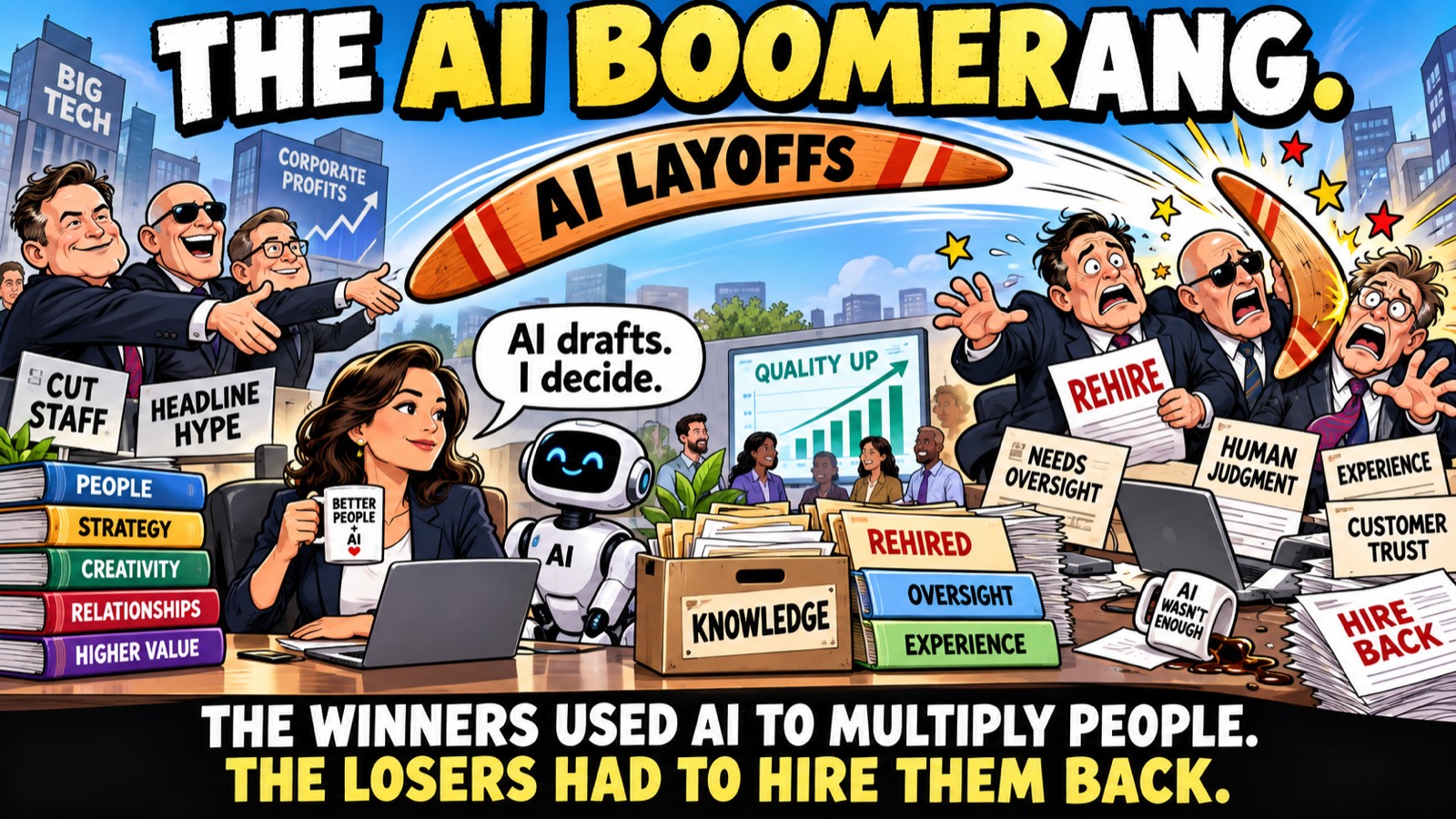
There's a name for what's happening now. The AI boomerang.
Companies cut people, pointed at AI, and then found themselves hiring those same roles back. Sometimes the same people. Sometimes under a new job title so nobody notices.
This isn't a handful of anecdotes. Robert Half found that 32 percent of US hiring managers who eliminated a role primarily because of AI later rehired for the same or a similar position. In finance, it was 44 percent.
Forrester predicted half of AI-attributed layoffs would be quietly reversed. Gartner expects that by 2027, half the companies that cut staff for AI will rehire for similar work.
Throw the boomerang hard enough, and it comes back and hits you.
Here's who got hit.
Ford: The Gray Beards Come Home
Ford leaned on AI for quality control, let veteran engineers walk out the door, and assumed the technology would carry the load.
It didn't. Ford ended up rehiring 350 experienced engineers, including retirees. The "gray beards." And once they were back, Ford hit number one in J.D. Power's quality rankings for the first time in sixteen years.
Here's the part everyone misses. The AI wasn't broken. Ford's own engineering leadership said it plainly: AI is only as good as the information you train it on. The people who knew how to train it, check it, and catch its mistakes were gone.
The tool worked. The hands that should have been holding it had left the building.
Klarna: The Poster Child Walks It Back
In 2024, Klarna became the face of AI replacing people. Its AI assistant, the company said, could handle the work of 700 customer service agents.
The headlines loved it. The customers didn't.
Quality slipped. Klarna's CEO admitted that cost had been too dominant a factor in how they organized it, and the result was lower quality. So Klarna started hiring human agents again, so customers would always have the option to talk to a real person.
Klarna says it isn't retreating from AI. It's running both: AI for the easy stuff, humans for the moments that matter.
That's not a reversal. That's the right answer, arrived at the expensive way.
Commonwealth Bank: Six Weeks to Regret
Commonwealth Bank of Australia cut 45 customer service roles and replaced them with an AI voice bot.
Call volume went up, not down. The bot couldn't handle the workload.
About six weeks later, the bank reversed the cuts, offered the roles back, and apologized, admitting it hadn't adequately considered all the relevant business factors.
Six weeks. That's how long "AI can do this job" lasted in the real world.
IBM: No Pipeline, No Future
IBM's CEO said in 2023 he could see roughly 30 percent of back-office roles, around 7,800 jobs, replaced by AI and automation over five years. Hiring for those roles paused.
This year, IBM announced it would triple entry-level hiring, for the very kinds of roles people keep saying AI can do. The new jobs focus on judgment, customer interaction, and overseeing the AI itself.
IBM's chief HR officer explained why. If you stop hiring juniors, you stop building the people who become your seniors. The well simply dries up.
That's the long-term cost nobody put in the spreadsheet. AI can take on entry-level tasks. It can't grow into your next generation of leaders.
They Fired People for a Future That Hadn't Arrived
Put the pattern together and it's hard to miss.
A new study in Harvard Business Review by Babson College's Tom Davenport, with Faisal Hoque and Paul Scade, found that early AI-driven layoffs often failed to deliver the returns executives expected. They exposed gaps in organizational knowledge nobody knew existed. And they created new demand for the one thing the cuts were supposed to remove: human oversight.
In one survey, 55 percent of HR leaders said their layoffs weren't worth it, because AI required more human oversight than expected.
The authors also call out what they describe as AI-washing: ordinary restructuring dressed up in AI language to reassure investors. Goldman Sachs estimates AI has trimmed only about 16,000 jobs a month from US payroll growth. Real, but a long way from the apocalypse we were sold.
Most of these cuts weren't based on what AI was doing inside the company. They were based on what the headlines said it would someday do.
That's not strategy. That's panic with a spreadsheet.
To Be Fair, It's Not All Boomerangs
I want to be honest here, because this isn't a "nothing is changing" post.
AI is showing up in layoff announcements, and some of those cuts are sticking. AI was the leading reason cited for job cuts in the first half of this year. Entry-level roles in AI-exposed fields are genuinely harder to land. Work is being reshaped, fast.
But reshaped is the key word. BCG estimates AI will reshape half or more of US jobs over the next two to three years. Reshape. Not erase. And the people who know how to use AI well are the ones being paid a premium. PwC found jobs requiring AI skills pay 62 percent more and are growing far faster than the market.
The winners aren't the companies that replaced people with AI. They're the ones whose people got better at using it.
How I Actually Use It
Here's the line I draw every day.
AI drafts. I decide.
AI finds the statistic. I verify it before it goes out under my name. The machine doesn't lose credibility when it's wrong. I do.
AI can crunch a campaign's numbers in seconds. It can't sit across from a client and understand what they're actually afraid of. It can write fifty headlines. It can't tell you which one is true to the brand. It can summarize a market. It can't earn trust.
Judgment. Taste. Accountability. Relationships. The instinct to say "that number can't be right" before you hit send. That's the human job, and AI made it more valuable, not less.
The tool took the grind off my plate so I can spend more time on the parts only a person can do.
Not subtraction. Multiplication.
The Final Take
The people who built AI spent two years warning us it would replace everyone. Now they're walking it back. Ford, Klarna, Commonwealth Bank, and IBM have already paid to learn the lesson in real time.
I didn't need the reversal. I use AI all day, I build with it, and I teach the next generation how to use it well. Which is exactly why I've always said the same thing.
AI is a tool. Not a replacement.
The companies that treated it like a replacement fired their expertise, inherited new problems, and are now buying back the knowledge they showed the door. The companies that treated it like a tool made their best people better.
Use it for everything. Just never forget who's holding it.
Cory Poccia
CEO, CS & Co. Marketing Studio™