
General Marketing
The 90% Myth: Why the Loudest CTV Critics are Wrong
A LinkedIn critic has built a personal brand telling advertisers Connected TV is mostly fraud and ROAS is fiction. The data tells a different story. CEO Cory Poccia walks through the verification stack, the 225-test Stella benchmark, and the 164 million audited viewers the critics never mention.

I have spent twenty-five years in the media business. I have watched every digital channel — search, display, social, video, programmatic, and now CTV — graduate from the wild west into a measurable growth engine. I have seen the bots. I have caught the bots. I have written the line items that blocked the bots. So when a credentialed and persistent voice on LinkedIn — a materials-science PhD turned digital ad-fraud crusader, founder of a competing analytics product, and a man who built an entire personal brand on the thesis that programmatic is "mostly fraud" and CTV is "a scam" — challenges me publicly, I take that seriously.
I take it seriously enough to respond with data instead of volume.
I am not going to print his name. He doesn't need the citation, and this is not about him. It is about the channel he keeps trying to bury, the advertisers his framing keeps scaring out of growth, and the gap between what his data actually says and what his rhetoric claims it says.
So let's go to the receipts.
What he gets right — let's concede it upfront
A credible defense begins with honest concessions. The critic is correct that:
Open-exchange long-tail programmatic CTV contains documented invalid traffic. Pixalate's most recent Q4 2025 report puts open-RTB CTV IVT at 21%. That is real and it matters.
Made-for-Advertising sites have wasted billions of dollars. The ANA quantified this at $10–13B annually in their 2023 programmatic transparency study.
Last-click attribution overstates paid-media credit. It does. Everyone who has ever audited a multi-channel customer journey knows it does.
Some attribution windows can be gamed.
The mobile-app cost-per-install market had a documented attribution-fraud crisis circa 2017–2019. The Uber / Kevin Frisch case study where a $100M campaign turn-off produced no install drop is real and instructive — for that channel, in that era.
Conceded. All of it. None of it is in dispute.
What is in dispute is the leap from "these specific failures exist" to "Connected TV is mostly fraud, ROAS is fiction, and the only valid measurement is to turn the campaigns off and see if your sales drop." That leap is where the analysis collapses, and that leap is what every advertiser this man scares away from CTV is paying the cost of.
The single sentence that breaks the argument
Here is the load-bearing sentence. It is from Pixalate's own Q4 2025 CTV Ad Supply Chain Trends Report — the same source that produces every alarming CTV fraud headline he cites:
"The insights in this report are derived exclusively from Pixalate's datasets, which primarily consist of buy-side open auction traffic sources."
Read that twice. Every CTV fraud number in circulation — 18% IVT, 21% IVT, the malformed Bundle ID rates, the SneakyTerra and CycloneBot disclosures — measures only the open-RTB programmatic slice of Connected TV. It does not measure Disney's direct-sold inventory. It does not measure Netflix. It does not measure Hulu, Peacock, Max, Paramount+, Tubi, the Roku Channel, or any of the upfront commitments that account for roughly half the dollars in this channel.
DoubleVerify's own Rob Aksman said it on the record in AdExchanger: "Fraud in CTV is not nearly as pervasive as many claim. Most inventory is bought direct, from premium, trusted publishers. Whatever percent of CTV folks are saying is fraud, should be caveated that they're talking about programmatic only."
When a critic generalizes from "open-RTB programmatic CTV has 21% IVT" to "Connected TV is mostly fraud," he is committing a textbook composition fallacy — generalizing the worst-case sub-segment to the entire category. That is not analysis. That is a sales pitch, and it sells fraud-detection consulting.
What the actual fraud-rate distribution looks like
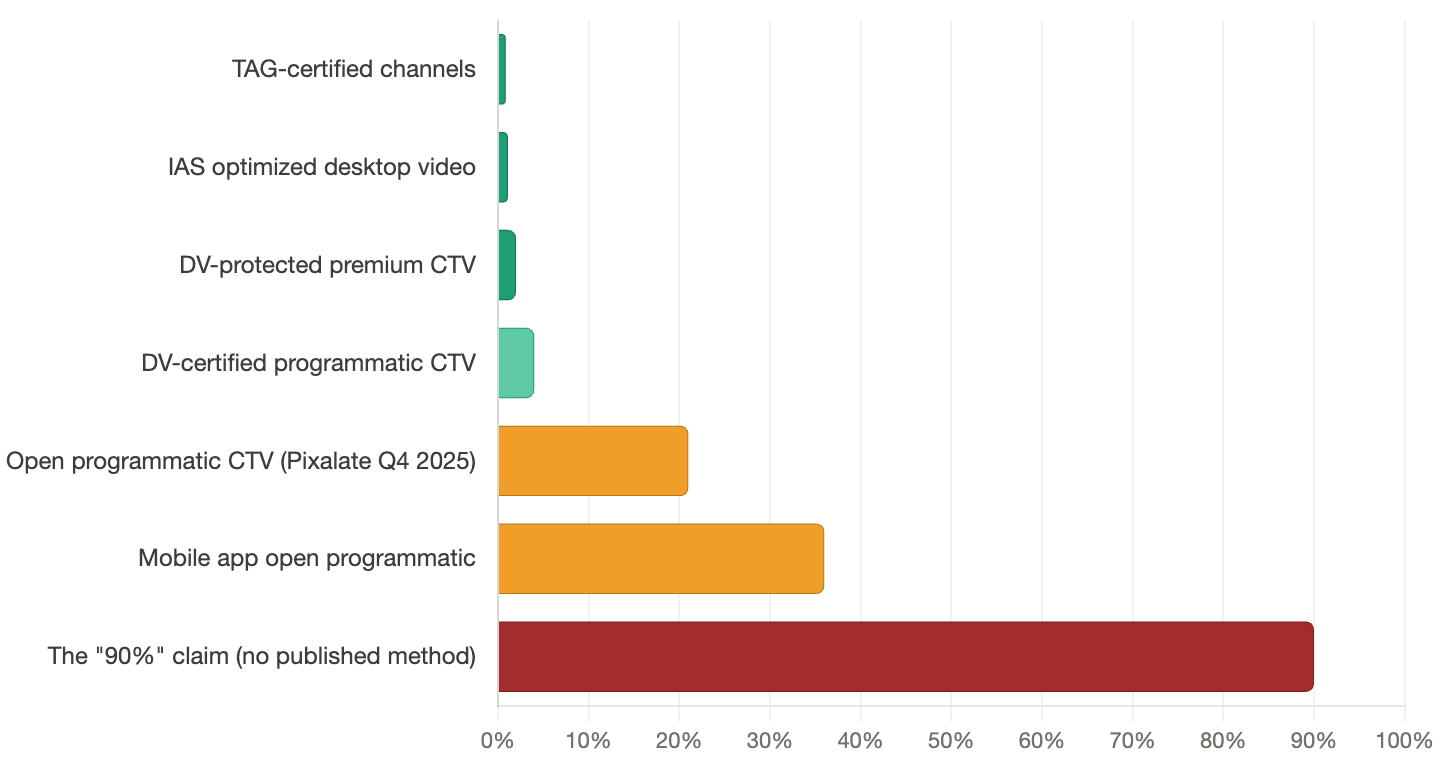
Look at the actual distribution. TAG-Certified channels run at 0.86% IVT, sustained for years. IAS-optimized desktop video runs at 1.1%. DV-protected premium CTV runs lower still. The IAS 20th Media Quality Report, released May 2025, found that "sophisticated ad fraud is now 15x higher in non-optimized campaigns vs. campaigns using pre-bid fraud protection." DoubleVerify's own data shows an 11x fraud differential between non-certified and certified programmatic CTV.
Pre-bid verification reduces CTV fraud by an order of magnitude. Critics cite the unprotected number — and only the unprotected number — and present it as the channel.
The single chart above is the rebuttal. The "90%" figure he repeats in podcasts, by the way, has no published methodology. In his own LinkedIn article "Is Ad Fraud 9% or 90%?" he writes — and I am quoting him verbatim — "I will not give an industry-wide dollar estimate of ad fraud… ANY estimate of industry-wide ad fraud is wrong because of the gross assumptions, approximations, and extrapolations that have to be done." He then proceeds to say "90%" in podcasts and posts. You cannot have it both ways. Either the number is unknowable or it is 90%. Pick one.
How the verification stack actually works
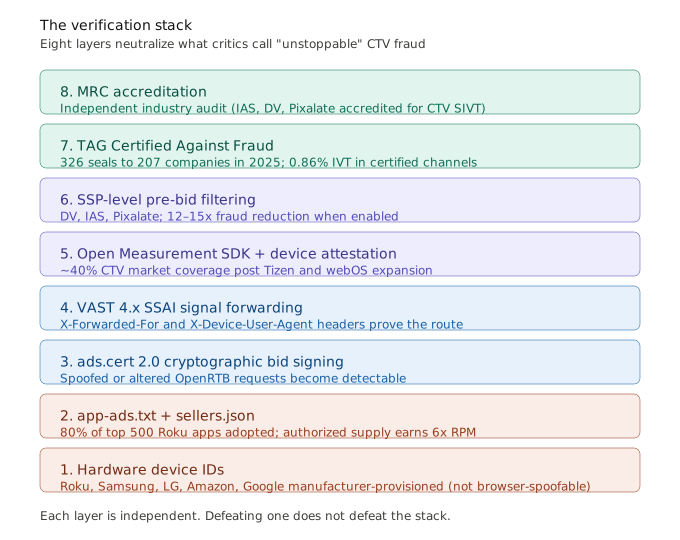
The critic likes to wave his hand at the SSAI exploitation diagram, point at a rogue server, and conclude that the system is broken. The system is not broken. The system has eight independent layers of defense, and disabling one does not disable the stack.
This is not theoretical. It is the operational reality of how every sophisticated CTV agency, including ours, actually buys media. We enforce VAST 4.x SSAI signal forwarding so every legitimate stream carries X-Forwarded-For and X-Device-User-Agent headers proving the routing path. We require ads.cert 2.0 cryptographic signing on bid requests. We demand app-ads.txt and sellers.json compliance — and we transact almost exclusively with TAG Certified Against Fraud counterparties, where IVT runs below 1%. We layer SSP-level pre-bid filtering on top of all of it.
When the critic claims CTV fraud is "ridiculously easy to solve" — those are his words — he is, paradoxically, correct. It is. We solve it every day. The industry solves it every day. In March 2025, HUMAN, Google, Trend Micro, and Shadowserver disrupted the BADBOX 2.0 botnet that had infected over a million CTV devices. The FBI issued a public service announcement. Google sued the operators. CycloneBot, ShadowBot, MultiTerra, SneakyTerra — every named scheme he cites was identified, neutralized, and prosecuted by the verification ecosystem he claims doesn't work. The fraud he points to as evidence the system has failed is, in fact, evidence the system caught it.
DoubleVerify's global Fraud/SIVT rate dropped 7% year-over-year in 2025. TAG awarded 326 certification seals to 207 companies in 2025 — a record. The Media Rating Council has now accredited Pixalate, IAS, and DoubleVerify for CTV-specific Sophisticated Invalid Traffic detection. The Open Measurement SDK has expanded to roughly 40% of the CTV market across Samsung Tizen and LG webOS.
The verification ecosystem is not a marketing brochure. It is a working system, audited by independent third parties, that processes hundreds of billions of impressions per quarter and reduces fraud rates by 12 to 15 times. Critics who pretend it doesn't exist are not making a sophisticated argument. They are making a misinformed one.
Then there is the "turn it off and see" prescription
The critic's preferred measurement methodology is to stop the campaign for one to four weeks and watch what happens to sales. He calls this "the only real test." He cites the Uber CPI case as proof.
Let's take this seriously and walk through what is actually wrong with it.
A pre-post observation is not an experiment. There is no control group. There is no counterfactual. You do not know what would have happened in the absence of the spend, because you did not measure that universe. You measured one universe — the one where you turned the campaign off — and concluded something about a universe you never observed. That is not a method. That is a guess.
A turn-off does not control for seasonality. A two-week pause in March behaves nothing like a two-week pause in November. Haus.io's 2024 Cyber Week Incrementality Report documented that brands measuring CTV in the pre-Black-Friday window saw a median +344% post-treatment lift — meaning a turn-off measured in the wrong window catastrophically misrepresents the channel's true contribution. A 2-week pause in October would tell you CTV is dead. A 2-week pause in late November would tell you CTV is the most powerful channel you own. Neither is correct. Both are artifacts of a method that is not designed to isolate the variable it claims to be isolating.
A turn-off does not control for competitive activity. It does not control for brand-building lag effects, which on upper-funnel CTV measure in weeks to months. It does not distinguish channel-level effectiveness — turn off all paid spend at once and you have learned exactly one bit of information, which is useless for budget allocation across the eight or nine channels we actually run.
And the Uber case — the one paradigm case he keeps citing — was specifically about attribution fraud in mobile-app cost-per-install advertising, where SDK fraud networks were claiming credit for organic installs through last-click manipulation. It is the least representative possible analog for CTV brand advertising on Disney, Netflix, and Hulu. Generalizing from one is to commit a hasty generalization on the order of saying that because a 2007 Toyota was recalled, all cars are unsafe.
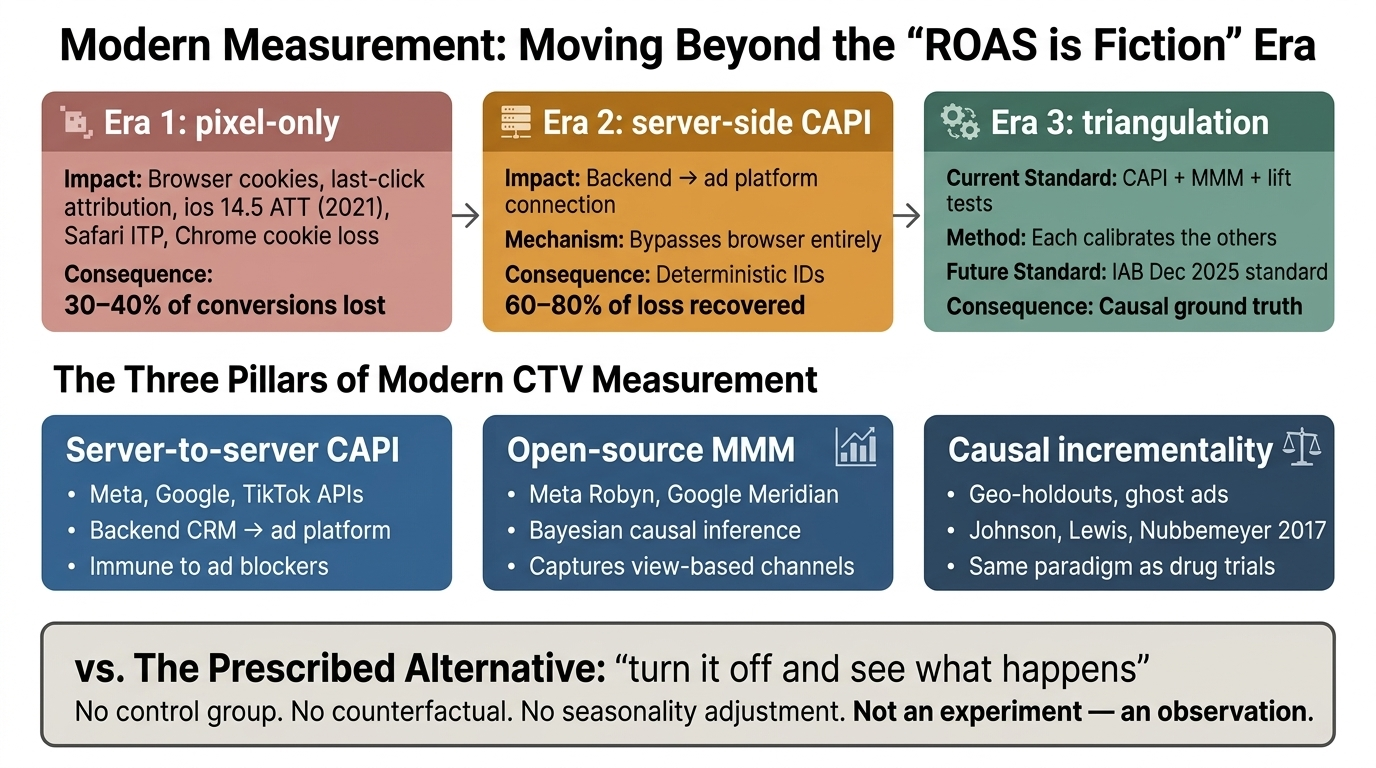
The industry already has more sophisticated tools. The peer-reviewed ghost-ads methodology — Johnson, Lewis, and Nubbemeyer in the Journal of Marketing Research, 2017, deployed at Google scale of over 100 million tests per day — is a real causal experiment. Geo-holdouts with synthetic controls, Public Service Announcement controls, intent-to-treat designs (the same paradigm the FDA uses to approve drugs), platform-native conversion lift studies, Bayesian Media Mix Models like Meta's open-source Robyn and Google's Meridian — these are the tools modern measurement uses. In December 2025 the IAB published "Modernizing MMM Best Practices for Marketers" as the new vendor-neutral industry standard.
The naive on/off experiment is the least sophisticated tool in the modern measurement toolkit. Recommending it as "the only real test" is roughly equivalent to insisting that the only valid medical diagnostic is the patient's self-report. It is not wrong because it is unscientific. It is wrong because it is so methodologically thin that it cannot answer the question it is asked.
What modern measurement actually looks like
When the critic says "ROAS is fiction," he is describing 2021. He is describing the post-iOS-14.5 measurement collapse, when browser pixels lost 30 to 40% of conversions to ATT, Safari ITP, and Firefox ETP. That collapse was real. We lived through it.
But measurement did not stay there. It evolved.
At CS & Co., we are a CTV-only agency. We do not buy Meta. We do not buy paid social. We buy Connected TV — and we buy it with the full modern measurement stack underneath every dollar.
Every campaign we run is wired with server-to-server Conversion APIs. CAPI sends conversion events directly from our clients' backend CRM, point-of-sale, or e-commerce platform to the publisher and demand-side platform — completely bypassing the user's browser, immune to ad blockers, ATT, Safari ITP, and the deprecation of third-party cookies. CAPI implementations typically recover 60 to 80% of the conversion visibility that legacy pixels lose. The IAB's October 2025 report "Role of CAPI in Closing the Outcome Gap for CTV" found that 75% of advertisers using CAPI are willing to reallocate budgets based on conversion performance, and nearly two-thirds report improved ROAS. IAB CEO David Cohen put it directly: "Without standardization and implementation of CAPI, CTV platforms will struggle to reach their full potential." This is exactly the gap a CTV-only agency exists to close.
We run CAPI alongside deterministic identity resolution — the infrastructure that lets a CTV impression on a living-room screen actually tie back to a household, a transaction, and a customer. LiveRamp's RampID is deployed at 215+ global publishers, including 65% of the US Comscore top 20. Unified ID 2.0 is open-source, privacy-safe, and interoperable with RampID. MNTN's identity graph reaches 99% of US households. iSpot's automatic content recognition covers 83 million smart TVs and set-top boxes. In June 2025, Innovid launched pixel-free purchase attribution against Affinity Solutions' 18 billion annual transactions across 95 million consumers — and the PMG beta showed 25 times more attributed revenue and 4.3% incremental sales lift. None of this exists in the world the critic describes. All of it exists in the one we operate in.
We then triangulate. CAPI feeds daily tactical optimization. Media Mix Modeling — using vendor-neutral, open-source frameworks like Meta's Robyn and Google's Meridian — handles strategic budget allocation and captures the view-based, upper-funnel impact of CTV that last-click attribution systematically under-credits. Incrementality experiments — geo-holdouts, ghost ads, conversion lift studies — provide causal ground truth that calibrates the MMM as a Bayesian prior.
This is not three competing methods. It is one integrated system where each component compensates for the others' weaknesses. CAPI fixes signal loss. MMM captures view-through impact. Incrementality validates causality. The IAB has now standardized this approach in vendor-neutral guidance — and as a CTV-only agency, this is the stack we built our practice on, not an afterthought.
So when someone tells you CTV ROAS is fiction, ask them when they last looked. The system they're criticizing is four years old. Modern CTV measurement — built on CAPI-fed deterministic conversions, identity-graph cross-device matching, triangulated MMM, periodic incrementality validation, and MRC-accredited verification — is not fiction. It is an audited, peer-reviewed, statistically rigorous, multi-method system drawn from clinical-trial methodology, applied econometrics, and modern causal inference.
If that is fiction, then so is every randomized controlled trial the FDA uses to approve medication.
The empirical knockout: 225 independent causal tests
Let's stop arguing about methodology and look at outcomes.
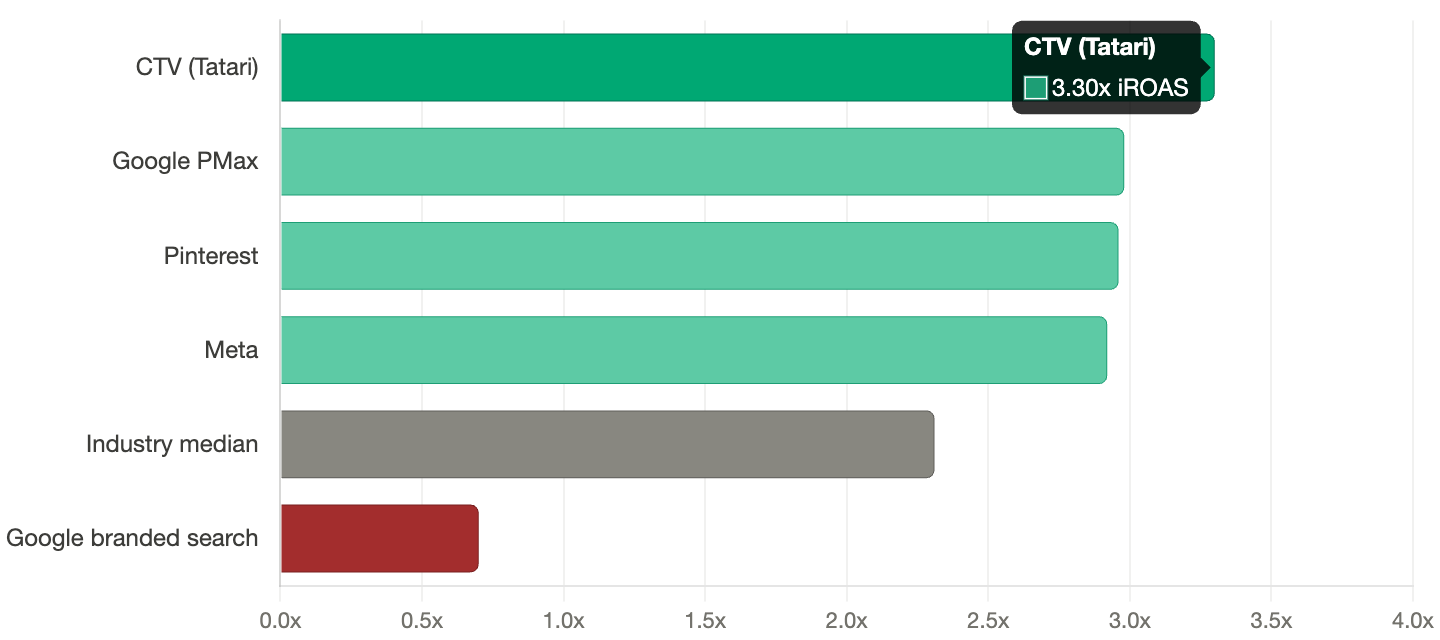
The Stella 2025 DTC Digital Advertising Incrementality Benchmarks is the largest published independent CTV-inclusive incrementality benchmark in the market: 225 tests across all major paid channels, 88.4% reaching statistical significance at 90%-plus confidence, methodology disclosed (geo-holdouts and platform-native conversion-lift studies).
CTV finished first. Median 3.30x iROAS — ahead of Google PMax, ahead of Pinterest, ahead of Meta, ahead of every channel in the test set. Branded search, the channel CTV critics often hold up as the "real" performer, came last at 0.70x. (Branded search frequently posts negative incrementality because it primarily intercepts demand the brand was already going to receive — the criticism the critic levels at all of digital is, ironically, most accurately leveled at the channel he doesn't criticize.)
If CTV were "mostly fraud," it could not produce the highest median iROAS in the most rigorous causal-test framework available. Bots cannot generate $3.30 of incremental revenue against $1.00 of spend, validated in a 225-test geo-holdout framework with statistical significance reporting. The arithmetic does not allow for it.
This is the empirical knockout. Everything else in this letter is the explanation.
And then there is the audited reality...
To believe the channel is largely fraudulent, you have to believe a lot of things at once.
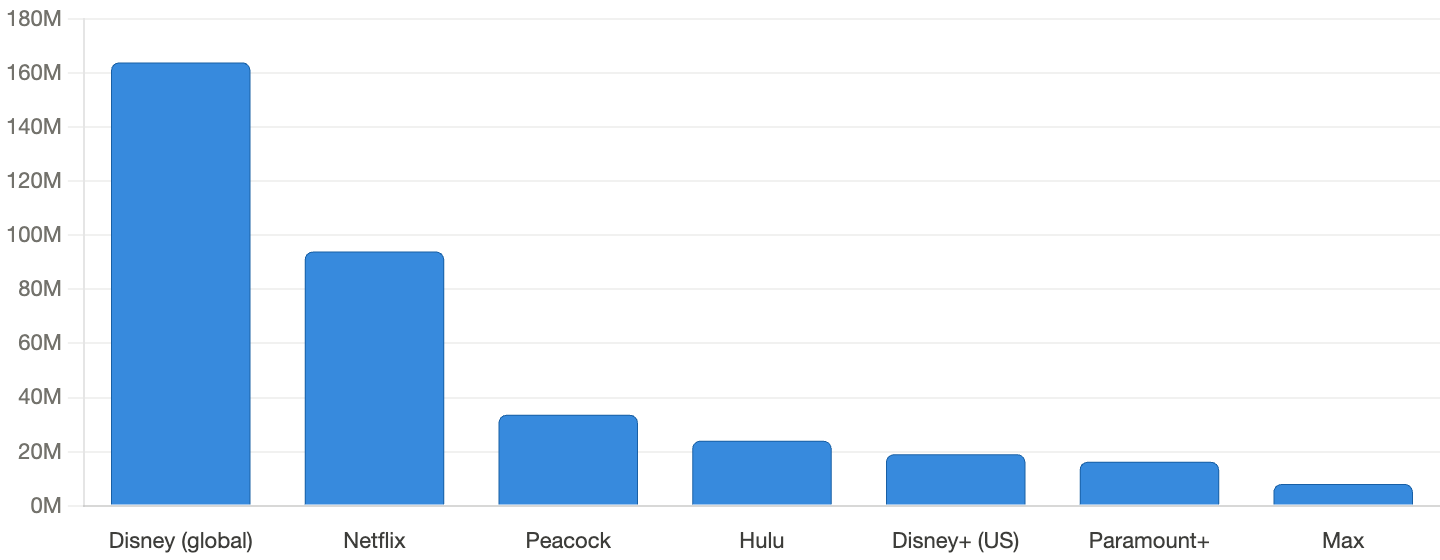
You have to believe Disney is committing securities fraud by reporting 164 million ad-supported monthly active users. You have to believe Netflix is misrepresenting 94 million ad-tier subscribers in SEC 8-K filings. You have to believe Nielsen's panel-based The Gauge — measuring real metered TVs in real households, not programmatic supply logs — is also wrong, despite reporting that streaming captured a record 47.5% of all US TV viewing in December 2025 (single-day record of 54% on Christmas Day, 55.1 billion viewing minutes). You have to believe Paramount, NBCUniversal, Warner Bros. Discovery, and Comcast are all reporting fictional ad revenue in audited 10-K filings — and that the Big Four auditors who personally certify those filings under SOX criminal liability are all complicit.
You have to believe Procter & Gamble, Unilever, Mars, and Mondelez — companies with dedicated econometrics teams whose work exposed the digital-display fraud crisis of 2017 — have somehow failed to detect that the $30B+ they spend annually on CTV reaches no real audiences. You have to believe Roku, Samsung, LG, Amazon, and Google — companies whose hardware businesses depend entirely on advertiser trust — are all complicit. You have to believe the 51.4 million billed ad-tier subscribers Antenna tracked in net new US streaming subscriptions between Q1 2023 and Q1 2025 are bots paying credit card bills.
This conspiracy is structurally impossible. It requires complicity from public companies whose audited financial statements are signed under threat of federal prosecution. It requires complicity from auditors. It requires complicity from a panel-based viewership measurement service that has nothing to do with programmatic. It requires the world's most data-driven advertisers to be missing what one consultant on LinkedIn has figured out.
I'm willing to entertain the proposition that one of those things might be wrong. I'm not willing to entertain that all of them are.
What modern CTV actually delivers — the receipts
The original draft cited a few of these. Let me extend the list, with proper attribution.
Net32 × Keynes Digital, validated independently by Haus.io with a 50% holdout, 6-week geo test: 12.8x iROAS, 86% incrementality factor, 1.89% lift.
Pluralsight × MNTN (B2B, CRM-validated): 70% spend-to-pipeline efficiency improvement, 15% inbound demo growth — proving the channel works for sustainable B2B pipeline creation.
Calm × Tatari: 27% incremental app installs, 60% subscription lift, 52% CAC reduction, 612K incremental installs.
Saatva × Tatari with Invoca (Custom Gamma GLM linking weekly DMA spend to retail): 5.7% of total retail sales attributed to TV.
Built In × MNTN (B2B): 62% lower CPA than target, 2.4x conversion-rate increase.
Klaviyo × MNTN (B2B): 11.6% conversion rate.
Bolt × MNTN (B2B): higher conversion than LinkedIn AND paid search.
Quaker Oats × Roku: 12% reach increase, 3.9% incremental sales lift, 75% from new or lapsed buyers.
Innovid / PMG / Affinity QSR (2024–25): 4.3% incremental sales lift, 55x increase in attributed transactions, 25x revenue increase.
Walmart Connect / Circana (CES 2026): Walmart Connect CTV delivers 2.8x stronger incremental ROAS and 2x higher sales lift than Circana digital benchmarks in CPG categories; up to 9.0% sales lift and $10.06 iROAS in the general merchandise case.
Napkyn DV360 CTV: $3M incremental revenue in 6 weeks, matched-market test.
These are not platform self-reports. They are independently-validated incrementality studies, geo-holdout tests, MRC-accredited measurement, and CRM-tied B2B attribution. The pattern across them is consistent: when CTV is treated as a first-class, data-driven channel — bought through curated premium supply, measured with CAPI and identity graphs, validated with incrementality testing — it consistently produces high-single-digit to low-double-digit incremental ROAS, beats branded search, and frequently beats Meta and Google PMax.
That is the channel. That is what we sell. That is what we deliver. That is what the data — primary-source, third-party-validated, audited — actually shows.
Closing
I want to be respectful here, because the critic deserves credit for genuine work on real problems. Open-exchange programmatic has documented fraud. MFA inventory has wasted billions. Last-click attribution has overstated paid-media credit for years. He has correctly identified failures the industry needed to confront and partially confronted because of voices like his. That contribution is real, and I will not minimize it.
But there is a difference between identifying real problems in specific sub-segments and broadcasting that the whole channel is a scam. There is a difference between healthy skepticism and reflexive nihilism. There is a difference between rigorous measurement and a one-line prescription to turn it off and see what happens. There is a difference between independent research and lead generation for a competing analytics product.
To the advertisers reading this who have been told CTV is a scam, ROAS is fiction, and your only recourse is to pull the plug: please. Do better than that. Read the Pixalate scope caveat. Read the IAS Media Quality Report. Read the IAB's October 2025 CAPI guidance. Read the Stella benchmark. Read Disney's 8-K. Read Nielsen's Gauge. Then make a decision based on what the data actually says, not what one loud voice on LinkedIn says it says.
Connected TV — when bought through premium supply, measured with server-side conversions, validated with causal incrementality, and protected by the MRC-accredited verification stack — is not a scam. It is the most powerful, highest-incrementality, fastest-growing screen in the consumer's home. It captures 47.5% of US TV viewing and 8.1% of US ad spend. That gap will close. The advertisers who close it first will compound the advantage. The ones who listened to the wrong LinkedIn post will spend the next decade explaining why their competitors got there first.
I'm running this firm to make sure my clients are in the first group.
Sincerely,
Cory Poccia
CEO, CS & Co. Marketing Studio