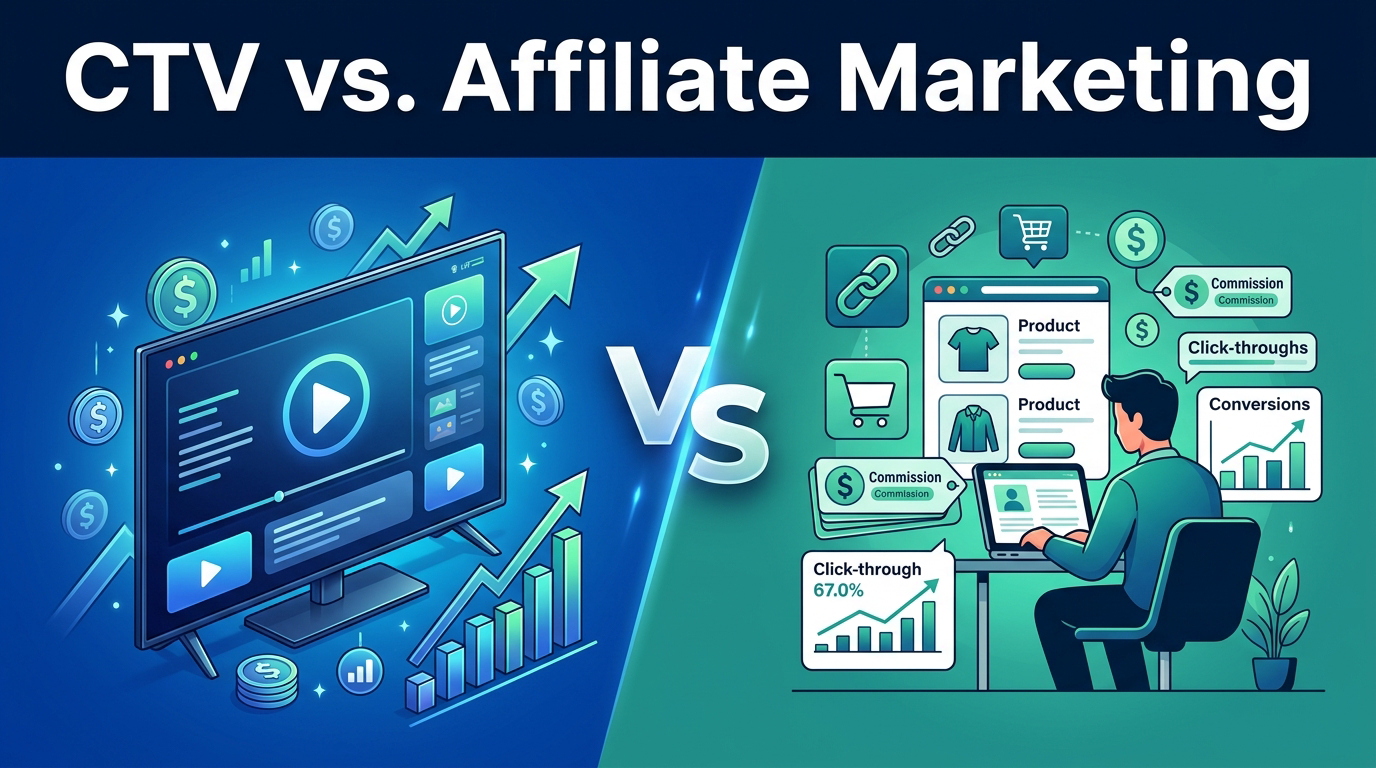
CTV vs Affiliate (Part 2): What Target Is Learning About the Limits of Creator-Driven Performance
Affiliate marketing has long been positioned as one of the most efficient growth channels in digital advertising.
No upfront media spend.
Pay only for results.
Scale through creators and distribution.
On paper, it’s the perfect model.
But as large retailers push deeper into creator and affiliate ecosystems, a different reality is starting to emerge.
And companies like Target are now seeing it firsthand.
The Promise of Affiliate — and Where It Breaks
Affiliate marketing works best when:
Trust is high
Audience intent is clear
The creator has influence
In those conditions, performance can be strong.
But those conditions don’t scale evenly.
As brands expand affiliate programs, they quickly encounter a structural issue:
Performance concentrates among a small percentage of participants
This creates a long tail of creators who:
Generate little to no revenue
Drive inconsistent results
Contribute minimal impact at scale
What Target Is Seeing in Real Time
Retailers are actively investing in creator-driven commerce.
Target has expanded its creator and affiliate initiatives as part of a broader push into social commerce and performance partnerships.
But as reported across industry coverage, the results are uneven.
A small group of creators drives the majority of revenue, while most participants see limited traction.
At the same time:
Creator earnings remain inconsistent
Conversion rates vary significantly
Attribution is fragmented across platforms
This is not a failure of affiliate.
It’s a reflection of how it behaves at scale.
More creators does not equal proportional growth.
The Core Issue: Affiliate Is Not a Scalable System
Affiliate is often treated like a media channel.
It’s not.
It’s a distributed performance layer built on human behavior.
That means outcomes depend on:
Individual creator effort
Content quality
Audience trust
Platform algorithms
These variables introduce volatility.
And volatility does not scale predictably.
CTV vs Affiliate: Two Fundamentally Different Models
This is where the comparison becomes clear.
Affiliate Marketing
Outcome-based (in theory)
Low upfront cost
Highly variable performance
Dependent on external creators
Difficult to scale consistently
CTV Advertising
Requires upfront investment
High-attention environment
Controlled reach and frequency
Scalable delivery
Measurable with the right framework
Why This Gap Matters Now
As brands like Target push deeper into affiliate and creator ecosystems, they’re running into a fundamental constraint:
You can’t fully control performance in a decentralized system
You can:
Recruit more creators
Offer better incentives
Improve tools
But you cannot guarantee:
Output
Quality
Conversion
That’s the tradeoff.
The Hidden Advantage of CTV
Most marketers approach affiliate from a risk perspective:
“We only pay when it works.”
But that’s incomplete.
Because modern growth isn’t about minimizing spend.
It’s about controlling outcomes
CTV offers something affiliate cannot:
Predictable reach
Consistent delivery
Unified messaging
Audience-level targeting
And when paired with proper measurement:
IP + pixel matching
Multi-touch attribution
Incrementality testing
It becomes a scalable performance channel
Where Affiliate Still Works
This isn’t a dismissal of affiliate.
It remains effective in specific scenarios:
High-trust creators with engaged audiences
Niche categories with strong intent
Supplemental distribution alongside paid media
In those cases, affiliate can amplify performance.
But it rarely serves as the primary growth engine anymore.
The Strategic Shift Happening Now
What we’re seeing is not the decline of affiliate.
It’s the repositioning of.
Affiliate is moving toward:
A supporting channel
While CTV evolves into:
A primary demand driver
What Smart Brands Will Do
Brands that understand this shift will not choose one over the other.
They will structure them together.
1. Use CTV to Create Demand
Drive awareness, attention, and intent at scale.
2. Use Affiliate to Capture and Extend
Leverage creators where trust already exists.
3. Measure Across the System
Track:
Cross-channel impact
Incremental lift
Full-funnel performance
Final Take
Target’s expansion into creator and affiliate programs is not proof that affiliate is the future of performance marketing.
It’s proof that:
Brands are still searching for scalable growth channels
And in that search, they are rediscovering a core truth:
Affiliate is powerful — but inconsistent.
CTV is expensive — but controllable.
In modern marketing:
Control scales
Variability doesn’t